
At the 2026 NASCC: The Steel Conference in Atlanta, industry leaders and researchers highlighted advancements in cold-formed steel (CFS) framing. The event drew more than 6,500 attendees and featured nearly 300 technical sessions at the Georgia World Congress Center, April 22-24, 2026.
The conference placed a significant spotlight on CFS, both in education and in standards development. Hosted by the American Institute of Steel Construction, the event featured a dedicated CFS track.
Don Allen, executive director of the Steel Framing Industry Association (SFIA), attended several sessions. His takeaway: CFS’s capabilities are expanding, and is the industry’s ability to model, test and apply it in complex structures.
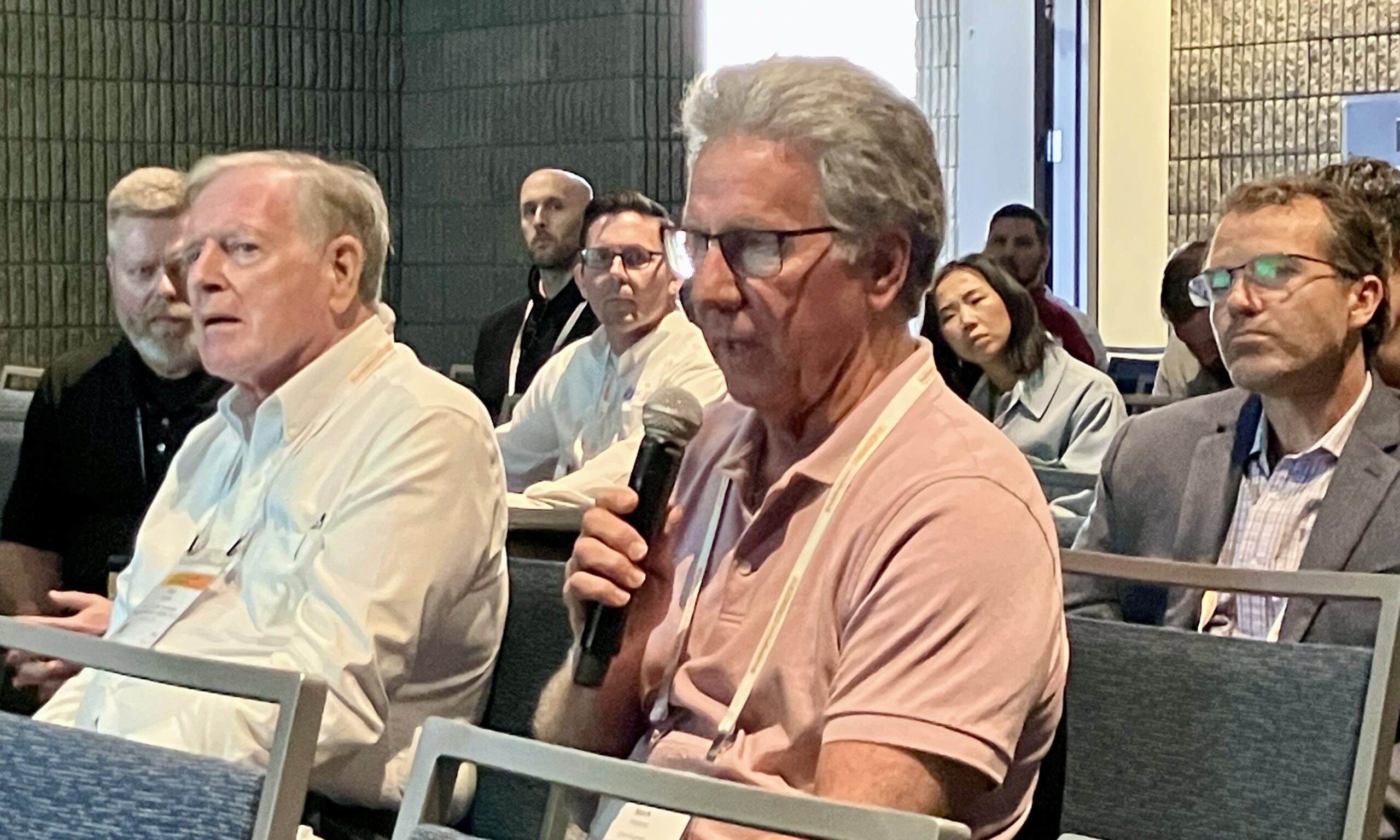
Mark V. Holland, P.E., chief engineer at Paxton & Vierling Steel Co., Omaha, Neb., raises a point on cold-formed steel (CFS) standards during a Steel Conference session. Holland serves on the American Institute of Steel Construction Committee on Specifications and chairs the AISC Manual Committee.
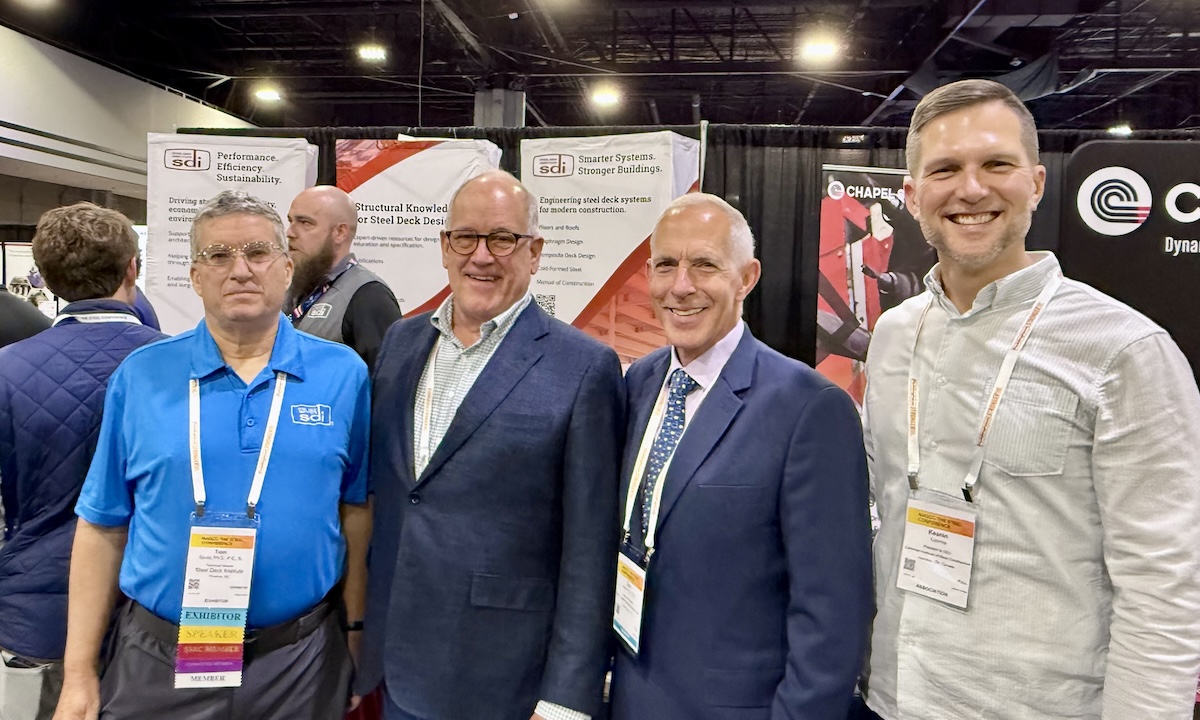
Left to right, Tom Sputo and Ken Charles of the Steel Deck Institute, SFIA Executive Director Don Allen, and Keenan Loomis of the Canadian Institute of Steel Construction mingle at NASCC: The Steel Conference in Atlanta.
The Steel Conference: CFS Sessions
Here are a few of the CFS sessions held recently at The Steel Conference.
The 10-Story Story: Flying High with Cold-Formed Steel and the CFS10 Effort
One of the most closely watched sessions focused on the CFS10 project, an ongoing research effort exploring the feasibility of a 10-story cold-formed steel building.
Researchers outlined the results of the CFS structural system design and full-scale shake table testing. The work examines CFS’s structural and nonstructural performance under seismic conditions. It showcases the value of using repeatable framing systems and the technologies required to scale them vertically.
Leading the discussion were Benjamin Schafer, professor at Johns Hopkins University, and Tara Hutchinson, professor at the University of California, San Diego.
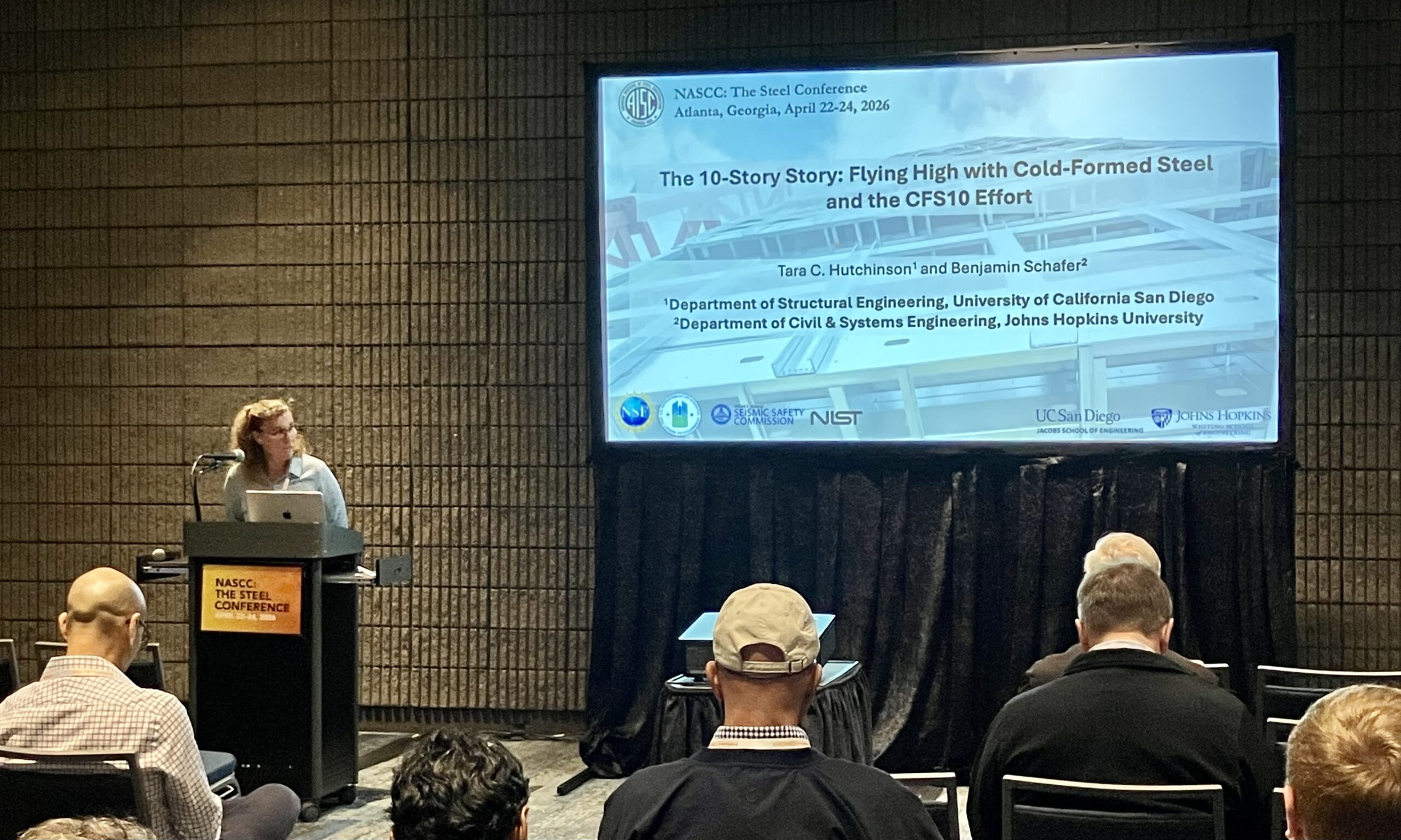
Tara Hutchinson, Ph.D., University of California, San Diego, highlighted the growing viability of cold-formed steel (CFS) in tall structures at NASCC: The Steel Conference.
Schafer emphasized the importance of translating research into practical design standards. Schafer’s work continues to shape design, particularly in how engineers predict the strength and stability of cold-formed steel components.
Hutchinson, who has led several landmark shake table test programs, detailed the experimental side of the CFS10 effort. Her research focuses on large-scale testing to better understand how systems behave under multi-hazard conditions, particularly seismic loading.
Together, the session underscored a central theme: cold-formed steel is no longer limited by traditional height assumptions. With validated research and evolving design methods, the pathway to mid-rise and taller applications is becoming clearer.
The CFS Magic 8 Ball: Cold-Formed Steel Connections Primer
While the CFS10 session looked at system-level performance, another session drilled into a critical component of that performance: connections.
“The CFS Magic 8 Ball” session focused on the fundamentals of cold-formed steel connections and their role in predicting system behavior.
Presenters emphasized that connection behavior often governs overall structural response. By understanding those mechanics, engineers can better anticipate how entire systems will perform under load.
The session featured Cris Moen, founder and CEO of RunToSolve, along with Kara Peterman, associate professor at UMass Amherst, and Shahab Torabian, senior project manager at Simpson Gumpertz & Heger.
Moen highlighted the growing role of computational tools in advancing structural analysis and design, particularly as software becomes more capable of modeling complex behaviors.
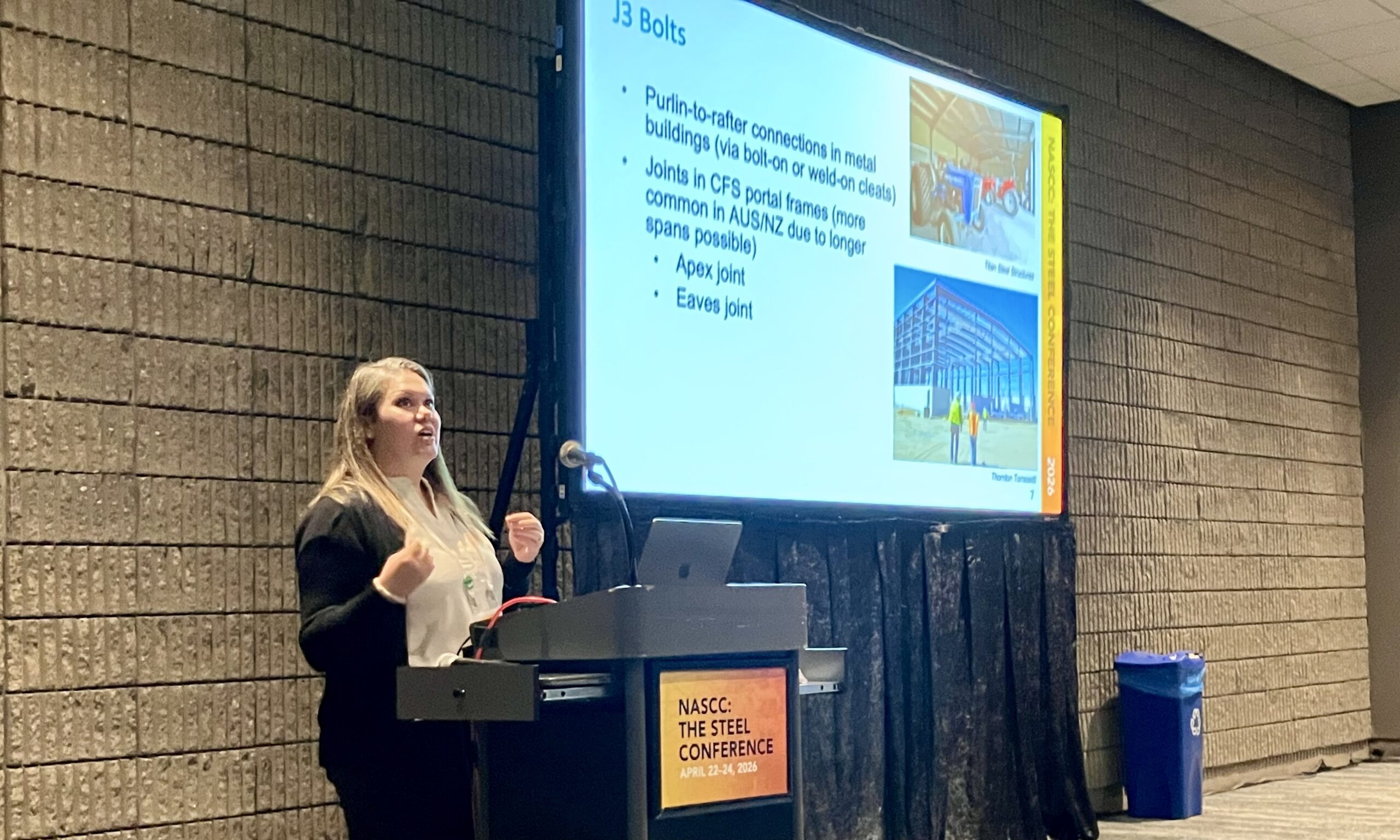
Kara Peterman, Ph.D., associate professor at UMass Amherst, talks about cold-formed steel connection behavior during “The CFS Magic 8 Ball” session at NASCC: The Steel Conference.
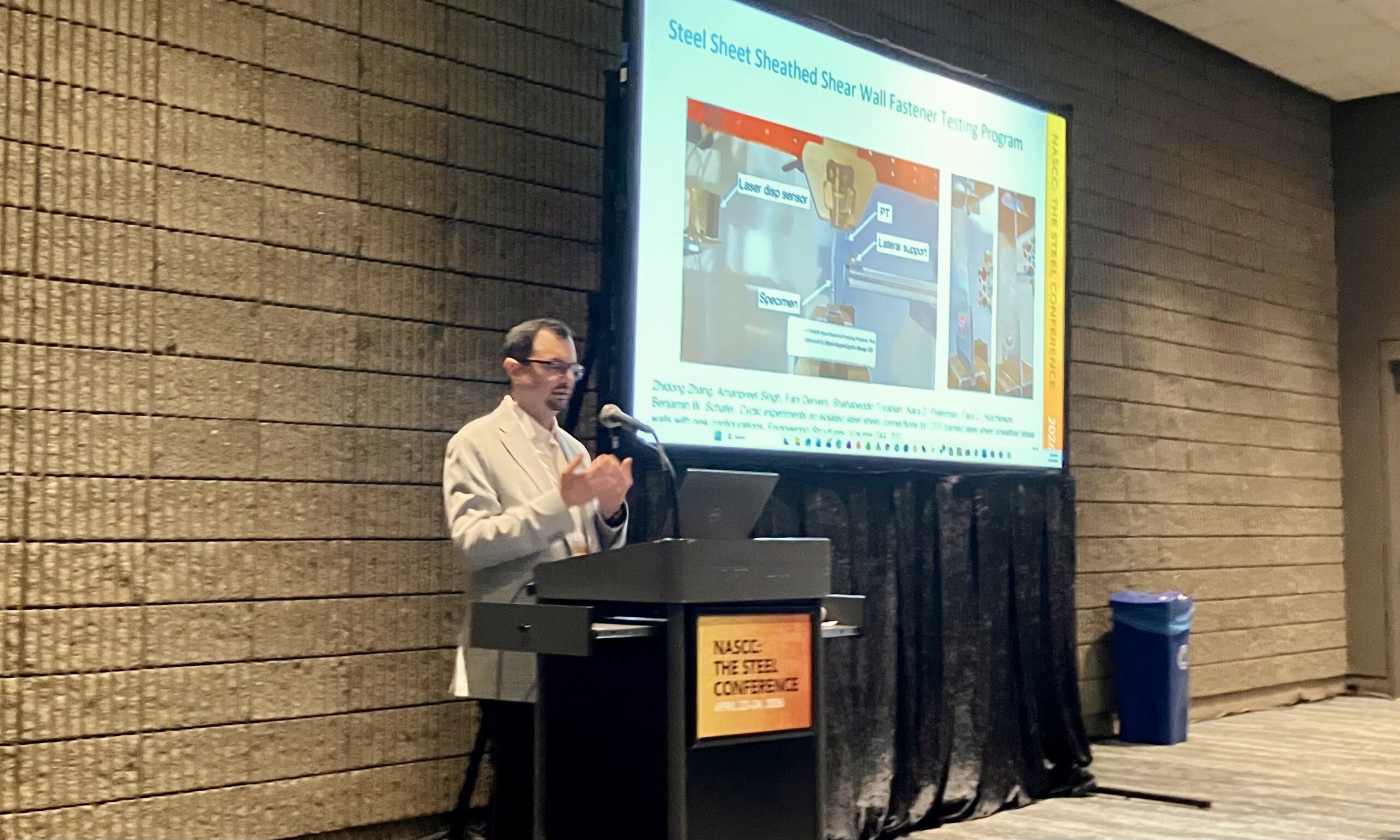
Shahab Torabian, Ph.D., P.E., S.E., Simpson Gumpertz & Heger, discusses steel sheet shear wall fasteners at NASCC: The Steel Conference.
Peterman focused on research into thin-walled steel members and infrastructure systems, tying connection performance to broader questions of stability and sustainability.
Torabian brought a practitioner’s perspective, drawing from experience in mission-critical and high-performance structures. His work in nonlinear analysis and performance-based design reinforced the need for precision in connection modeling — especially under extreme loading conditions.
Frames and Systems
The “Frames and Systems” session brought together research and practice across structural behavior, connection detailing and emerging design tools. Presentations ranged from laboratory testing of cold-formed steel members to frame stability considerations and the use of large language models in structural design.
Mohammad Adil Dar of the University of Sheffield presented testing on web crippling behavior in built-up cold-formed steel I-beams composed of lipped channels. Perry Green, Ph.D., P.E., examined how slotted end connections in HSS vertical bracing affect frame stability. Zhidong Zhang of the University of Virginia introduced a framework for applying large language models to structural steel design. The session was moderated by Craig Quadrato of Wiss, Janney, Elstner Associates.
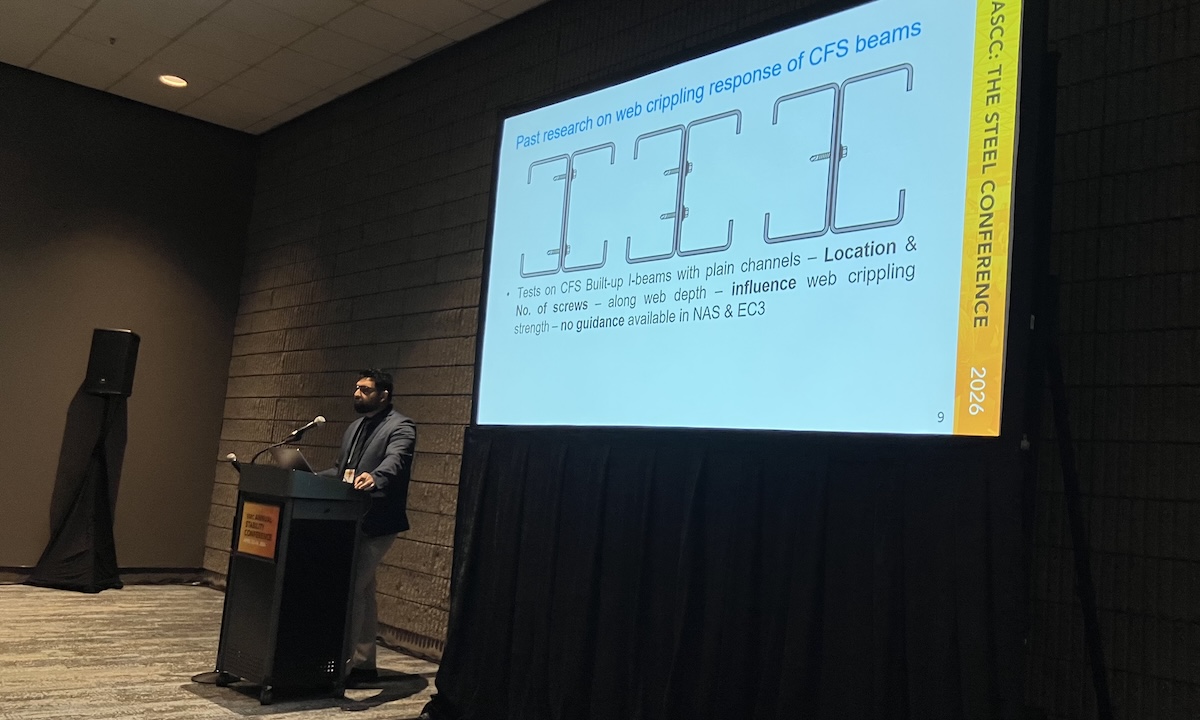
Mohammad Adil Dar, University of Sheffield, presents research on web crippling behavior in built-up cold-formed steel (CFS) I-beams during the “Frames and Systems” session at NASCC: The Steel Conference.
SSRC 2026 Beedle Award Presentation
At NASCC: The Steel Conference, Benjamin W. Schafer received the 2026 Lynn S. Beedle Award from the Structural Stability Research Council. The award recognizes his contributions to structural stability research and cold-formed steel design.
In his presentation, Schafer reflected on the evolution of stability research through his Ph.D. students and collaborators at Johns Hopkins University. The session traced developments from early studies of thin-walled columns. It also covered advances in system behavior, reliability and imperfection modeling.
The presentation highlighted contributions that underpin widely used tools and methods, including the Direct Strength Method and CUFSM. These tools have shaped modern approaches to analyzing and designing cold-formed steel members and systems.
Schafer emphasized the role of collaboration in advancing the field. The session abstract describes progress driven by both analytical and experimental methods. It also points to sustained collaboration among researchers studying complex structural behavior.
The presentation connected decades of research to current applications, including wind turbine towers and modular steel systems. It showed how ongoing work in stability continues to influence engineering practice. It also shapes the next generation of structural research.
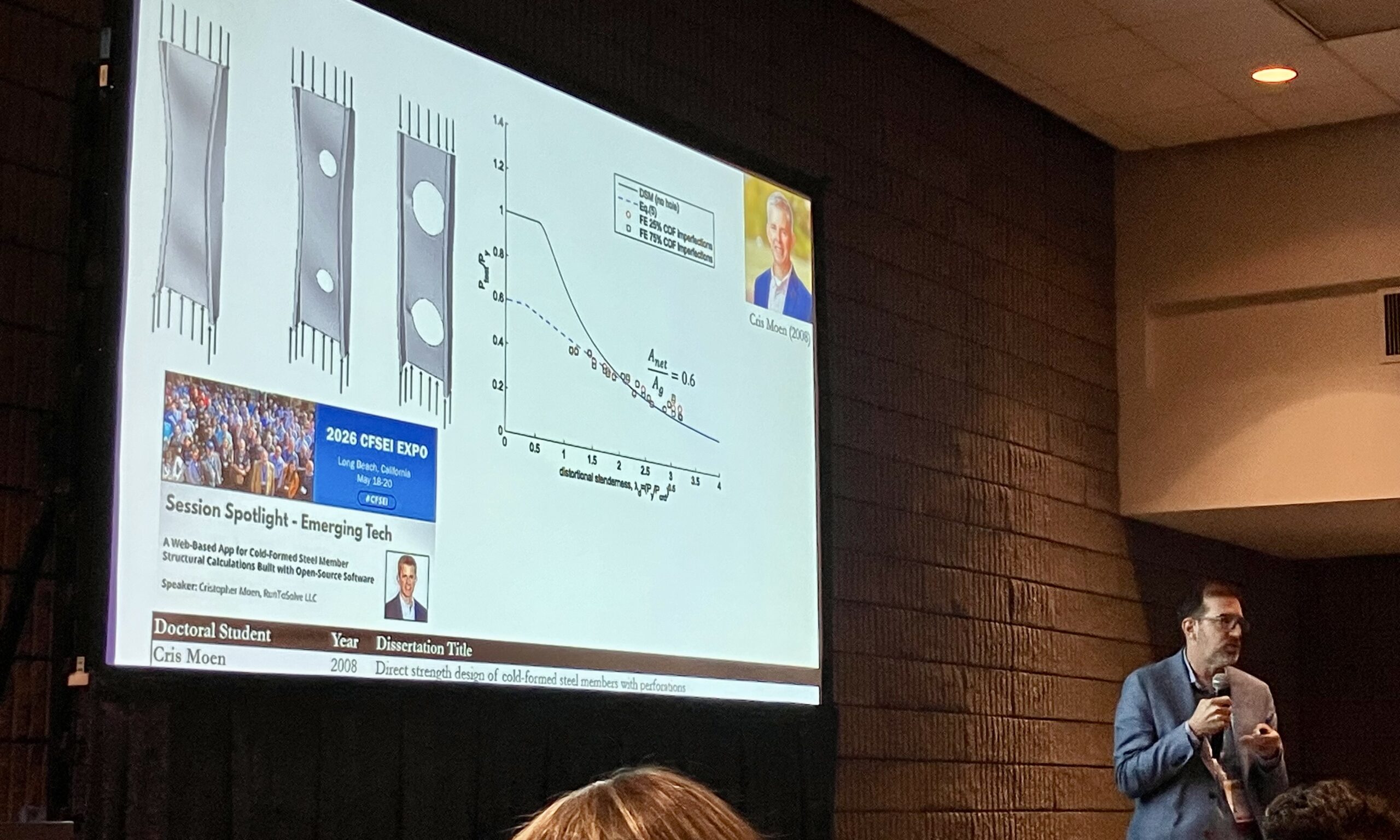
Benjamin W. Schafer, winner of the 2026 Lynn S. Beedle Award, discusses a post-buckling journey of 25 years.
CFS Research to Practice
Across sessions, a consistent message emerged: the gap between research and real-world application continues to narrow.
From full-scale seismic testing to improved connection modeling, the tools available to engineers are becoming more sophisticated — and more actionable.
That aligns with the broader mission of NASCC, which focuses on delivering practical insights that attendees can apply immediately in design and construction.
For the steel framing industry, the implication is clear. As research advances and standards evolve, the material’s role in modern construction will continue to expand — not just in efficiency and speed, but in structural ambition.
Several SFIA members and their parent companies showcased their innovations at NASCC: The Steel Conference.
Additional Resources
- CFS-NHERI and CFS10 Capstone Seismic Research to Take Center Stage in Keynote at 2026 CFSEI Expo
- CFS10’s Trial by Fire: Photos from UC San Diego’s Burn Tests Prove CFS’s Resilience
- SFIA Approves Updates to Code Compliance Certification Program