
May 5, 2026 — Cold-formed steel (CFS) framing is easy to underestimate if your design experience has centered on concrete, wood or hot-rolled structural steel. CFS looks light. It often arrives as studs, track, joists, trusses, channels and other framing members.
But these individual CFS components work together to deliver predictable performance, speed and flexibility. The 2025 Steel Framing Industry Association (SFIA) Industry Project and Product Awards reinforce that point: Teams choose CFS to reduce structural weight, improve tolerances and accelerate installation.
What Is Cold-Formed Steel?
CFS framing starts with structural-quality sheet steel, typically formed at room temperature into C-sections and other shapes. The process produces straight, consistent members for interior partitions, exterior walls, floors, roofs and engineered assemblies. BuildSteel’s “Cold-Formed Steel (CFS) Framing 101: A Practical Guide for Designers, Builders and Owners” says teams choose CFS because it installs quickly, stays straight, resists fire and pests and supports prefabrication and panelization.
For architects and engineers new to CFS, the first lesson is simple: CFS is not just “metal studs.”
CFS serves both nonstructural and structural applications, including:
- Partitions, soffits and ceilings
- Exterior walls and load-bearing walls
- Floor systems
- Roof framing
- Engineered assemblies
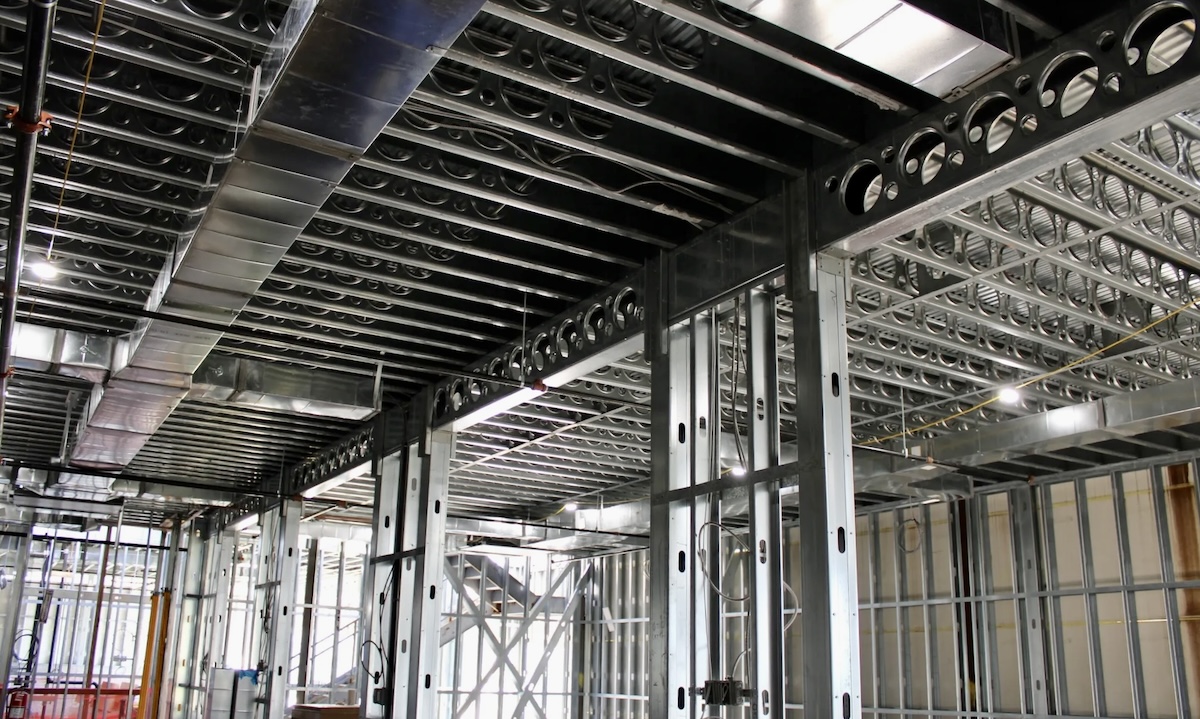
Cold-formed steel (CFS) posts support the second floor of college sports facility. Image credit: ADTEK Engineers
CFS is more than just metal studs or light-weight steel. The BuildSteel CFS Framing 101 Guide says:
Architects: “CFS framing supports flexible layouts, straight lines and consistent dimensions.”
Engineers: “CFS framing systems support clean specifications that reduce ambiguity in submittals.”
In this CFS Framing: In Practice guide, we highlight real-world applications from recent SFIA award-winning projects.
CFS Reduces Weight with No Performance Loss
Several projects used SFIA-certified steel framing products because CFS’s strength-to-weight ratio solved problems that heavier systems complicated.
Cost Savings Through CFS Load Path Design
At West Point II Apartments in Tucson, Arizona, Industrialized Construction Solutions used CFS to deliver a seven-story superstructure without a concrete podium. The team vertically aligned bearing walls from the upper residential floors to the foundations, eliminating concrete or red-iron transfer systems. Engineers also used built-up CFS stud packs instead of HSS members for shear wall hold-downs and balcony supports, saving more than $1 million while maintaining performance.
Achieving Long Spans with CFS Joists and Trusses
At Kindred Resort/One River Run in Keystone, Colorado, the project used 12-inch CFS joists and CFS trusses to create lightweight vaulted ceilings and long, open spans. MiTek engineered the CFS trusses to transfer diaphragm loads and reduce dead load on the building.
Supporting Complex Interior Assemblies with CFS
At the Mullin Transportation Design Center in Pasadena, California, CEMCO’s CFS products helped convert a former supersonic wind tunnel into a 31,000-square-foot education and design facility. The team used CFS in place of wood and structural steel in interior assemblies, reducing weight and supporting floating architectural features without added supports.
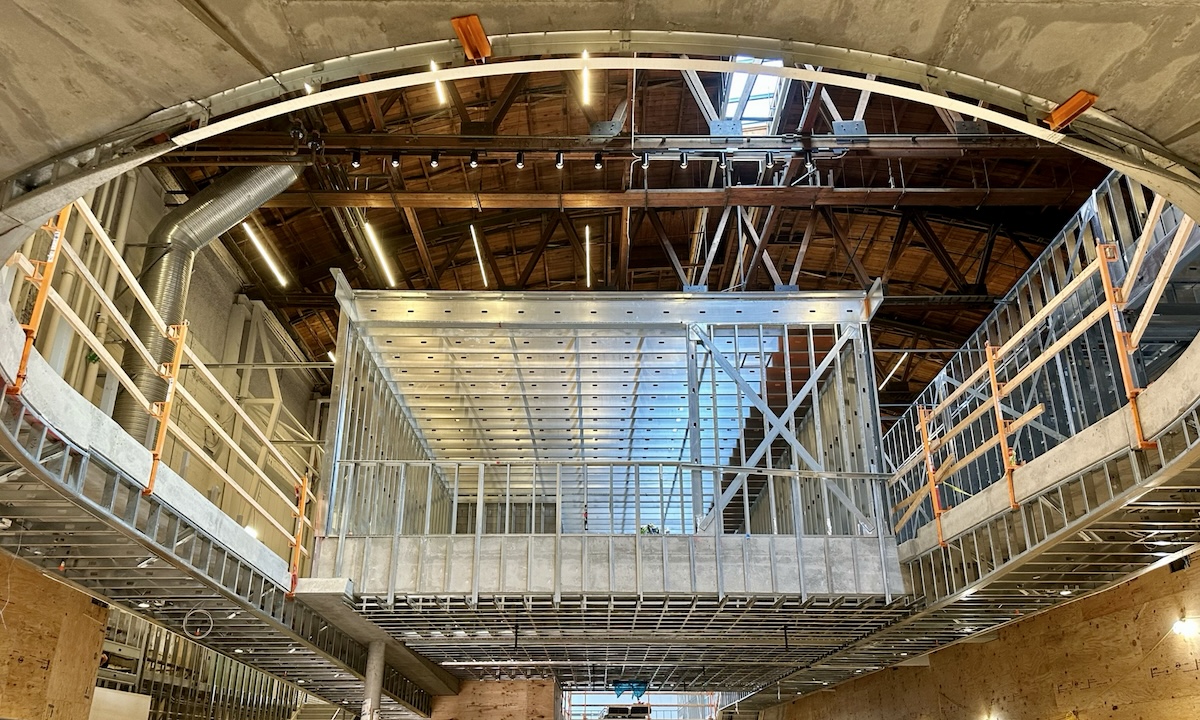
CEMCO’s cold-formed steel (CFS) framing products helped transform a historic Caltech wind tunnel into a unique education center.
CFS Supports Repeatable Construction
CFS appeals to project teams when schedule risk matters. Because members are consistent and dimensionally stable, teams can shift work off site, improve quality control and reduce job-site congestion.
Up to 3 Days Saved Per Floor
West Point II Apartments provides another practical lesson. The Tucson project used prefabricated CFS panels on a tight infill site with limited staging. The CFS framing process reduced the schedule by roughly two to three days per floor, and crews erected the structure in 75 days.
35 Buildings in 3 Months
At UCSC Student Housing in Santa Cruz, California, crews framed 35 residential buildings and two community centers in three months using panelized CFS production. ADCO Drywall and Metal Framing framed the walls off site, trucked the panels to the job site and craned them into place. CEMCO custom produced and cut materials to length, minimizing waste.
CFS Attachment Saves Labor, Waste
At 24th & Rio Grande Housing in Austin, Texas, ClarkDietrich supplied CFS framing for prefabricated exterior panels on a 30-story student housing tower. The team fabricated framing, sheathing, windows, vents, weatherproofing and EIFS off site. A drift track attachment method helped crews create a continuous exterior skin while reducing labor and material waste.
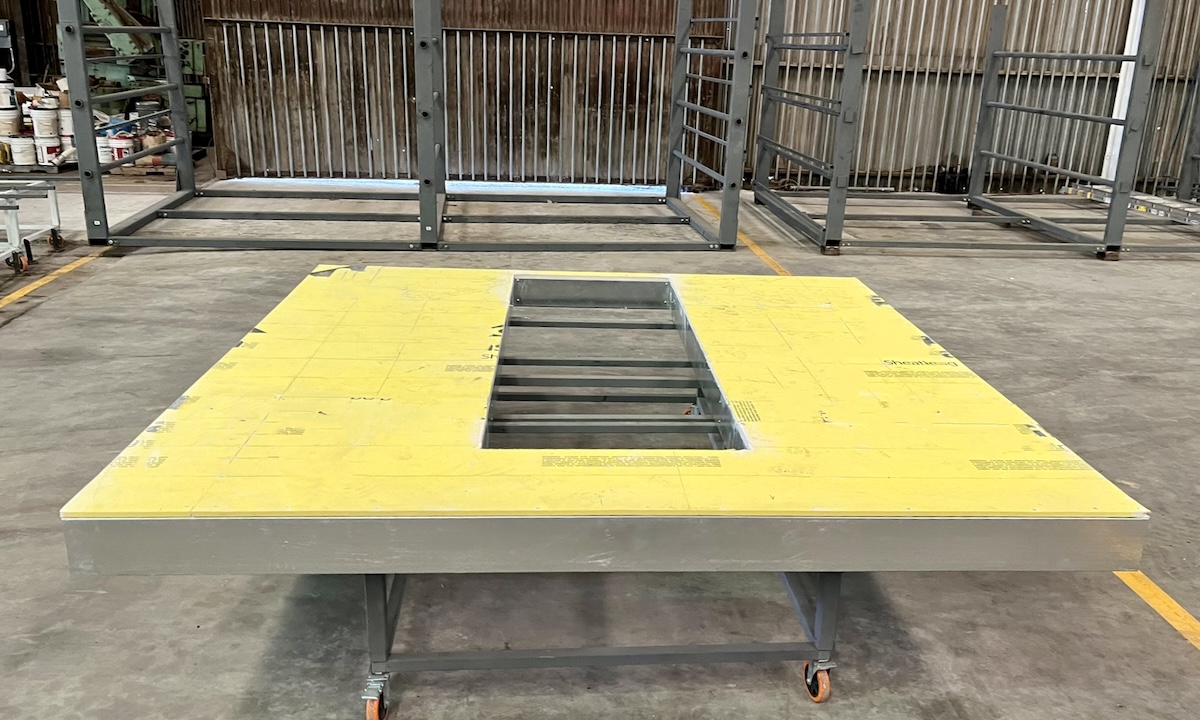
ClarkDietrich pre-cut CFS materials based on panelized shop tickets, which optimized usage and reduced waste at the 24th & Rio Grande Housing project.
CFS Can Create Complex Geometry
CFS also serves architects when design intent includes curves, slopes, radiused walls and unusual openings.
Framing Large Openings with CFS Headers
At Wind Creek Chicago Southland Casino, raSmith engineered CFS framing for 30-foot-plus floor-to-floor heights, large openings, curved and sloped walls, soffits and multi-tiered column covers. In several nearly 30-foot-wide openings that originally called for HSS members, the team value engineered a CFS solution using a box header and additional studs framed like an L-header.
2-6 mm Tolerances Achieved
At the Westerly 2 South Tower canopy in Etobicoke, Ontario, Maxan Interior Systems used standard CFS studs and angles to form a free-flowing canopy. The team used 3D scanning and modeling to plan the geometry, then cut and fit each stud with precision. Field tolerances came in at 2 to 6 millimeters against a 10-millimeter allowance.
Executing Complex Geometry with CFS Framing
At the Populus hotel in Denver, CEMCO supplied 150 tons of CFS for interiors with no straight, 90-degree angles. The project team value engineered interior wall systems with CFS to provide strength, save costs and fulfill Studio Gang’s design intent.
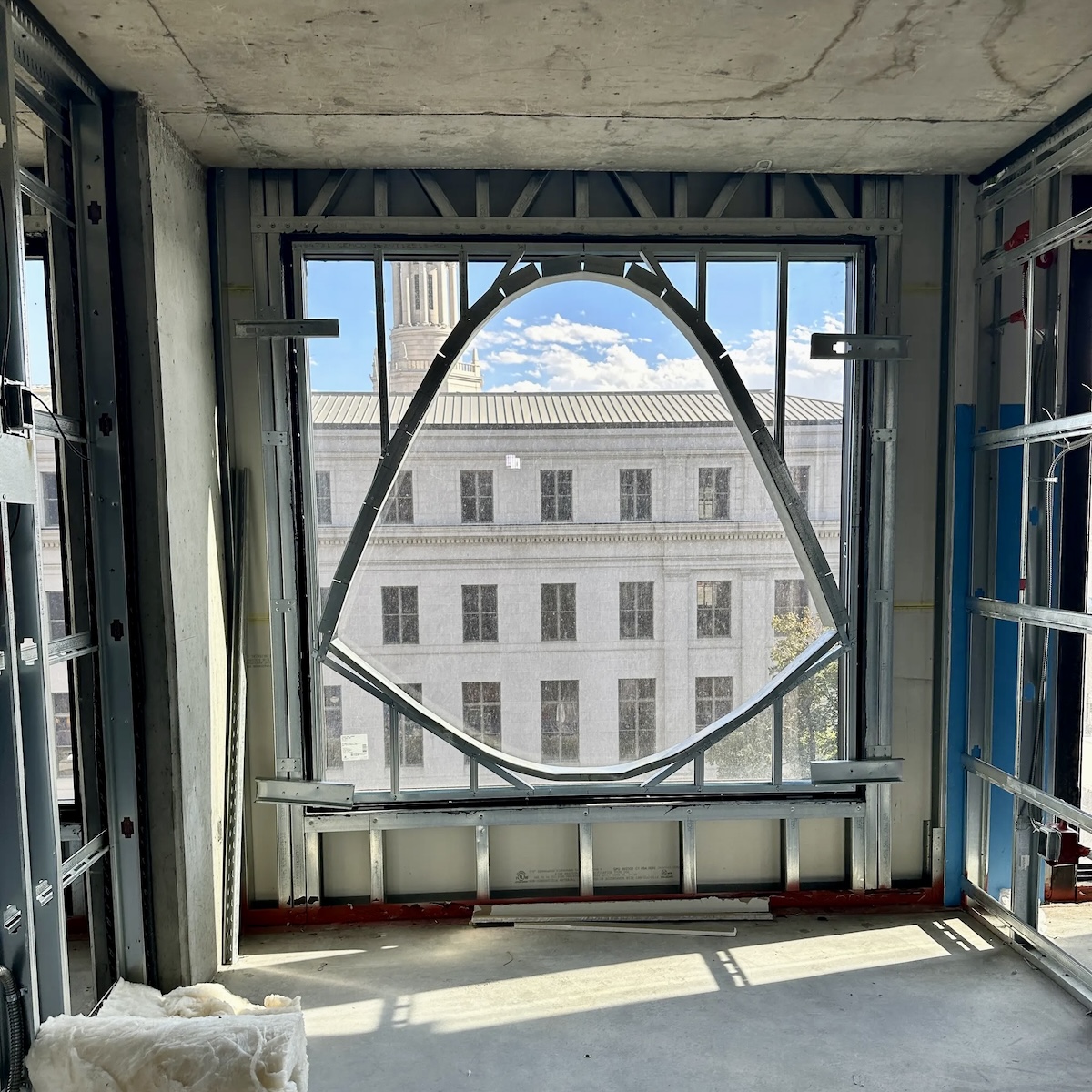
The Populus project team value engineered the interior cold-formed steel (CFS) framing system to provide strength, save costs and fulfill the architect’s curvy window opening design.
CFS Can Reduce Building Weight
Cold-formed steel does not replace structural steel in every condition. But award projects show that it can reduce the amount of hot-rolled steel needed when engineers coordinate load paths early.
CFS Replaces Structural Steel
At Allston Labworks in Boston, T.J. McCartney installed 133 tons of CFS framing. The project used CFS in place of structural steel to support unitized and metal panel curtainwalls, reducing cost. The team also used BIM coordination and laser layout systems to maintain tolerances.
Using CFS Studs to Support Masonry Loads
At The Trade Milwaukee, raSmith tailored CFS framing to varying floor-to-floor heights, including extra-tall levels for professional athletes. Where possible, the team avoided structural steel in favor of CFS. In one late-stage condition, the team used installed CFS studs to support brickwork above first-level openings, avoiding added steel members and protecting the schedule.

R.S. Smith designed an elaborate cold-formed steel (CFS) framing system with multiple jambs and headers interconnecting at various levels to accommodate varying floor to floor heights.
CFS Supports Sustainability Goals
Cold-formed steel can also contribute to energy performance when teams use it as part of a coordinated envelope strategy.
Steel Panels Trump Tilt-Up Concrete
At Sunset & Decatur Industrial Park in Las Vegas, Industrialized Construction Solutions used load-bearing prefabricated CFS panels instead of tilt-up concrete for six warehouse buildings. The panels supported continuous exterior rigid insulation and cavity batt insulation. The system helped the project meet energy requirements and positioned the buildings for long-term operational savings.
The same project used 35-foot-tall CFS panels, long-span roof trusses and mezzanine joists. CNC roll forming allowed the fabricator to produce profiles on demand, avoiding schedule disruption and maintaining consistent tolerances.
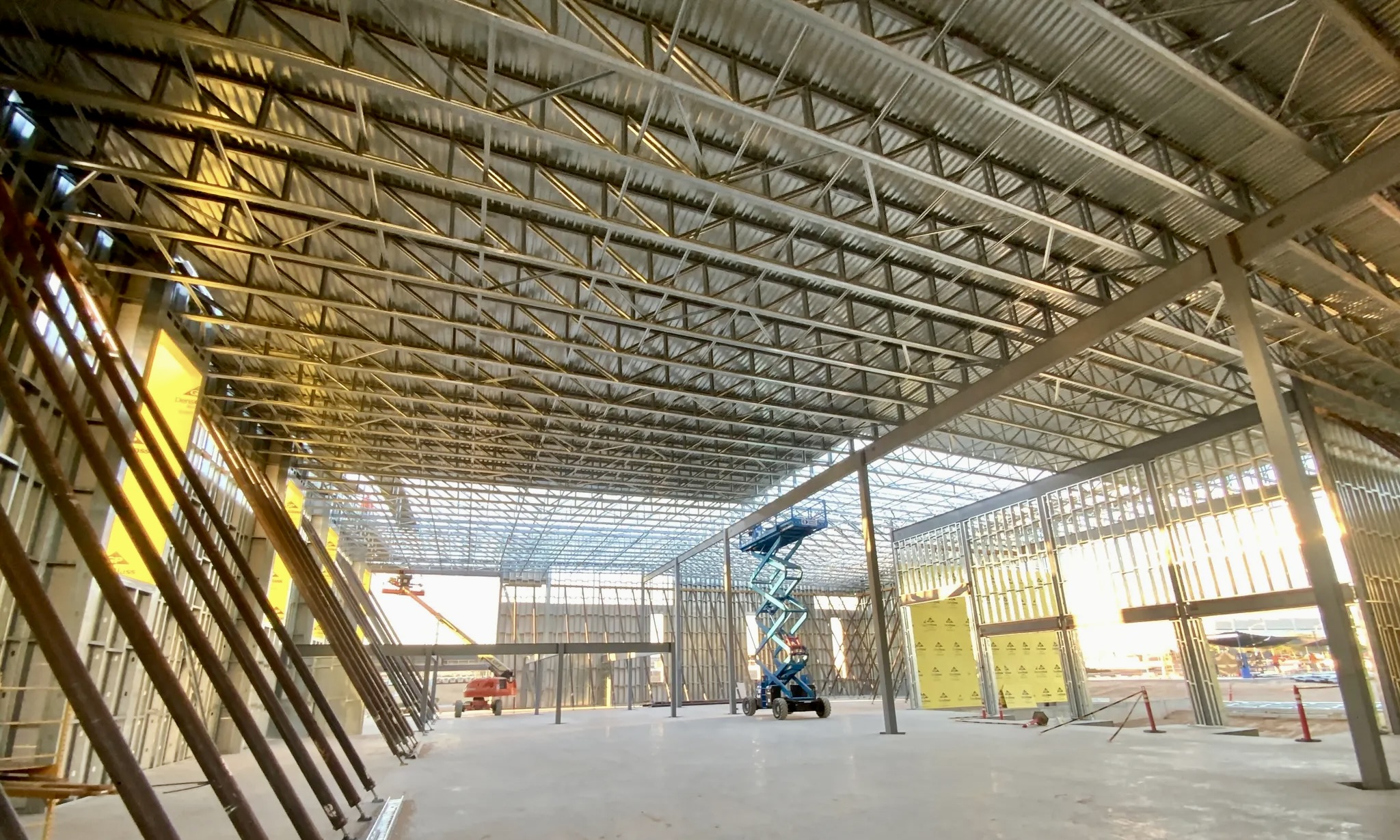
Industrialized Construction Solutions designed the shell of Sunset & Decatur Industrial Park, Phase I, in Las Vegas. The project features long-span cold-formed steel (CFS) trusses.
CFS Rewards Early Coordination
For designers new to CFS, the biggest takeaway may be this: CFS performs best when architects, engineers, fabricators and installers coordinate early.
CFS at Its Most Custom
The Central Florida themed attraction by KHS&S Contractors shows why. The project used 550 tons of CFS across six connected structures, including long-span ceilings, tall walls, themed façades and complex rooflines. The team relied on 3D models, shop drawings and weekly coordination to keep framing aligned with the design intent. In one 175-foot wall, no sections over two to three feet repeated.
That project also shows CFS at its most custom. Nearly every stud, screw and angle was customized to match the architectural drawings and 3D sculpt model. In repetitive areas, the team prefabricated mansard roof trusses and flew them into place where access was limited.
What Designers New to CFS Should Remember
CFS is a lightweight, durable framing system made from sheet steel and formed into repeatable shapes. It can serve structural and nonstructural roles. It can reduce dead load, support prefabrication, improve dimensional consistency, contribute to fire and moisture-risk strategies and help teams execute complex geometry.
But it is not a magic substitution. The award projects show that CFS works best when teams define performance requirements, separate structural and nonstructural scopes, coordinate load paths and engage CFS expertise early.
That is why project teams choose cold-formed steel framing: not as a replacement for every system, but as a precise, efficient solution when performance and constructability must align.
Locate trusted cold-formed steel (CFS) products and service suppliers near you using BuildSteel’s ultimate steel framing resource.
Next Steps for Beginners
- Download: A Beginner’s Guide to Cold-Formed Steel Framing (PDF).
- Use a spec “cheat sheet”: Checklist for Architects and Engineers Writing CFS Specifications.
- Stay aligned with current codes and standards: Complying with New Codes and Standards for Cold-Formed Steel Framing.
- Search for products and providers: The BuildSteel Product and Provider Directory

About SFIA
The Steel Framing Industry Association (SFIA), a unique organization representing steel mills, coil coaters, stud and connector manufacturers, component fabricators, Cold-Formed Steel Engineers Institute (CFSEI) members, suppliers/distributors, contractors and others, provides members with exclusive access to technical cold-formed steel (CFS) framing services, including CFS certification, environmental product declarations, market data and analysis, technical design guides, specification review services, architectural services, the Steel Framing Learning Portal, the SFIA Awards and more. SFIA is an accredited ANSI Standards Development Organization. Follow SFIA on LinkedIn, Facebook, Instagram and X.

Additional Resources
- Cold-Formed Steel (CFS) Framing 101: A Practical Guide for Designers, Builders and Owners
- Cold-Formed Steel Framing 101
- SFIA’s Steel Framing Learning Portal Has Metal Framing Education (24/7/365)