
Image: Steel framing was used in San Diego’s first zero net energy building, the Alpine Library in Alpine, Calif.
A new movement is taking place in how building owners and investors view sustainability.
When Lendlease opens a $600 million residential and office complex in Los Angeles, likely in 2025, the site will boast the usual features of sustainable development — solar panels, a pedestrian plaza, a nearby light-rail stop and an all-electric residential tower.
“But those features are considered commonplace these days,” says The New York Times. “What makes this development more striking is how sustainability isn’t simply an amenity or signifier of corporate responsibility, but a core feature of its financing plan.”
“We were doing sustainable development before there was investor pressure, but now there is investor pressure,” says Sara Neff, head of sustainability for the Americas region at Lendlease.
Indeed, the perception of risk associated with climate change has prompted investors to steer money toward higher-performing green assets. To reduce risk, building owners are framing their assets with non-combustible, cold-formed steel (CFS) for its durability, infinite recyclability and resiliency.

The recycling rate for steel used in general construction, which includes recycling cold-formed steel stud scrap material, is 74%.
Sustainability for Increased Profitability
The development of sustainable building construction is not a new idea. The modern practice of green building emerged in 1990 with the formation of the Committee on the Environment within the American Institute of Architects. This was followed a few years later with the founding of the U.S. Green Building Council.
Over time, building professionals realized that sustainable design practices:
- Make a structures more resilient
- Improve the quality of life for inhabitants
- Is good for business by reducing operational budgets and increasing property values
“Five to 10 years ago, there was a lot of debate about sustainability, that, ‘It’s nice, but I don’t want to pay for it,’” says Stephen Tross, chief investment officer of international investments at Bouwinvest. “Today, you don’t sacrifice returns for sustainability, you create returns with sustainability.”
Thanks to the evolution of steel framing technology, it’s now possible to build structures using innovative construction techniques. This allows construction crews to work smarter, faster and safer — and minimize construction costs — while reducing the environmental impact of a building over its life.
Poly Canyon Student VillageThe Poly Canyon Village, San Luis Obispo, provides a quintessential example of a sustainable building framed with cold-formed steel (CFS). Poly Canyon Village is the largest CFS load-bearing framing project in California, achieving a LEED Gold Certification from the U.S. Green Building Council. Tegan Sullivan, Clark Design/Build, confirms that the LEED certification requirement was a main reason steel framing was selected for the project.
“When they were deciding how they would build, CFS and the panelization process was attractive because of the off-site plant,” Sullivan says.
Reducing materials and construction waste at a job site is a sustainable practice that helps gain LEED points. CFS is a preferable product in this regard because it can be manufactured off-site to exact specifications, which translates into less on-site waste. And thanks to steel’s recyclability, any scraps resulting from production can be repurposed into new products, keeping materials out of landfills.
Strength in the Face of Disaster
Increasingly dire reports of more frequent natural disasters have hammered home the realization that climate change is affecting real estate much sooner than expected, says the Times. Hurricane Ida’s flooding and harsh winds, for example, caused an estimated $27 billion to $40 billion in property damage this year, according to the data firm CoreLogic.
Eighty-eight percent of large companies have already had a physical asset, such as an office or warehouse, affected by extreme weather, according to Cervest, an A.I. platform that monitors corporate climate risk.
CFS offers a number of material characteristics and performance attributes that enable a building to withstand the demands on a structure as a result of such major events as fire, earthquakes and high wind.
“When it comes to framing, there is no more resilient option than cold-formed steel framing,” writes Jen Edgar, ClarkDietrich corporate product manager, in an article for Metal Construction News.
Resiliency, Edgar says, refers to a building’s ability to withstand, respond to and recover rapidly from extreme events in a cost-effective manner.
A key characteristic of resilient building materials is the strength-to-weight ratio. This relatively easy way to compare the merits of several different materials is determined by dividing the maximum imposed load by the weight of the material.
Of all commonly used construction materials, steel has the highest strength-to-weight ratio. When CFS sheet is formed into a C-shape, like a stud, the bends in the steel act as stiffeners and increase the strength of the steel stud dramatically, providing a strength-to-weight ratio that is up to seven times greater than that of dimensional lumber.
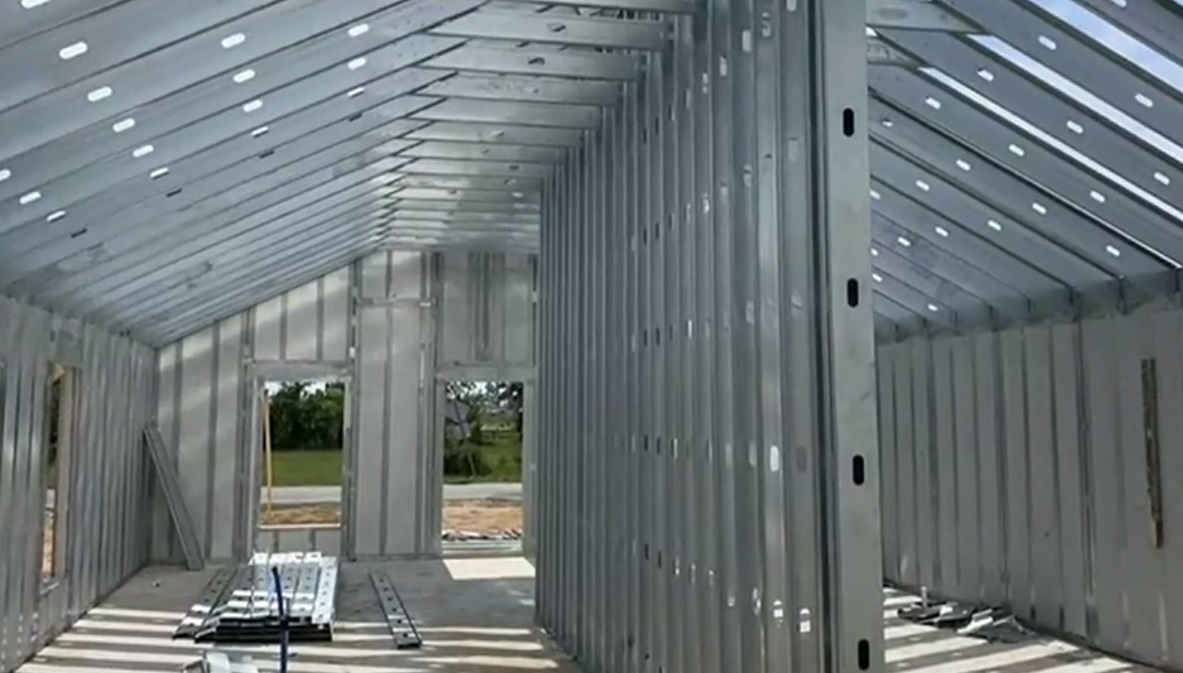
Steel was selected over concrete to rebuild homes after Hurricane Michael in 2018. Panama City, Fla. leaders opted to use steel framing due to it’s speed of construction and ability to withstand 167 mile per hour winds.
5 Reasons Cold-Formed Steel (CFS) Contributes to Resiliency
- CFS is highly ductile. CFS can easily bend or stretch without breaking when force is applied. This gives it a higher degree of resistance to lateral loads, uplift and gravity loading, such as those imposed on a structure by seismic or high wind events.
- CFS is non-combustible. According to the Steel Framing Industry Association, both load-bearing and non-load-bearing CFS-framed assemblies are fireproof up to four hours when subjected to tests conforming to ASTM E119.
- CFS is durable. CFS is corrosion resistant. It does not retain moisture and will not harbor mold growth. CFS uses zinc or similar coatings to boost durability and will last hundreds of years before its corrosion resistance deteriorates.
- CFS is impervious to pests. CFS is one of the few building materials completely impervious to termites and other pests in any climate or building type.
- CFS is a highly sustainable material. Steel framing contains on average a minimum of 25% recycled content and is 100% recyclable at the end of its life.
Building Back Better with Cold-Formed Steel
The United States Senate passed a $1.2 trillion infrastructure bill to rebuild our nation’s infrastructure. The bill now heads to the House of Representatives, before it can be sent to President Joe Biden to be signed into law. The bill includes funding for new climate reliance initiatives. Buildings will be an essential element of those initiatives.
In addition, on October 15, President Biden released a strategy to seek more financial disclosures from publicly traded companies on climate risk in an effort to help steer investors toward more resilient assets.
In order to develop stronger buildings, resilient materials such as CFS will play a key role in the rebuilding process.
“To meet the challenges of the 21st century,” says AIA 2021 President Peter Exley, “our nation’s infrastructure funding needs to move beyond roads and bridges to include schools, hospitals and other building projects, especially as buildings contribute nearly 40 percent of worldwide carbon emissions”.
“There were many logs in our path, detours along the way, but the American people will now see the most robust injection of funds into infrastructure in decades,” said Senate Majority Leader Chuck Schumer of New York in August.
With the inclusion of climate criteria in the infrastructure package, building smart and sustainable communities with resilient structures will be key to the success of the bill. Resilient, sustainable, non-combustible CFS framing is ready to play a role to meet these needs.
Additional Resources:
- eBook: Strength in the Face of Disaster: How Cold-Formed Steel Framing Keeps Buildings Safe
- EQ Metal Studs Help Designers Build Sustainable Structures
- SFIA Releases Industry Environmental Products Declaration for Cold-Formed Steel Framing