
A research project progressing from the American Iron and Steel Institute’s Small Project/Fellowship Program has received significant funding through the National Science Foundation to advance performance-based fire design for cold-formed steel (CFS) structures.
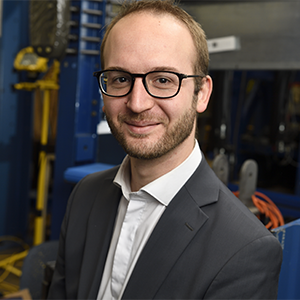
Thomas Gernay, Ph.D., Johns Hopkins University
Thomas Gernay, Ph.D., assistant professor in the Department of Civil and Systems Engineering at Johns Hopkins University, was named a recipient of the NSF’s Faculty Early Career Development Award for nearly $580,000 over five years.
The award will enable research to develop an advanced science-based framework for assessing the fire performance of CFS structures that results in more accurate modeling to ensure increased public safety, resource efficiency and resilience. The NSF award will run from July 1, 2023 through June 30, 2028.
Funding Builds on AISI Research
The NSF funding will allow Dr. Gernay to build on research initiated through a 2021 AISI Small Project/Fellowship Program award for “Structural Design for Fire Conditions of a Prototype Metal Building Using the New Proposed Appendix to AISI S100, North American Specification for the Design of Cold-Formed Steel Structural Members.”
AISI’s Small Project/Fellowship Program identifies and provides funding for research projects that will significantly impact the reliability, performance and cost-competitiveness of CFS in construction. The research is conducted by teams comprised of students, faculty advisors and steel industry advisors.

“We congratulate Thomas on this significant accomplishment, which will empower him to collect data and methods that answer fundamental questions about the complex fire-thermal-structural interaction in thin-walled members, improve understanding of the mechanics of stability-critical structures in fire, and advance simulation capability for CFS structures under physically based design fires,” said Jay Larson, P.E., F.ASCE, managing director of AISI’s Construction Technical Program.
“Cold-formed steel structures are traditionally protected from fire based on prescriptive provisions derived from standardized testing. However, this reliance on prescriptive provisions is costly and impedes innovation toward more sustainable and affordable buildings,” said Larson. “This NSF research grant will enable performance-based fire design for CFS by developing the capability to quantify the fire behavior of thin-walled framing members. The research also has implications beyond CFS structures.”
Project Brings Performance-Based Fire Design to the CFS Community
“The AISI Small Project/Fellowship Program award provided me with support and industry contacts to explore the application of the principles of performance-based fire design to cold-formed steel structures,” said Gernay. “Before joining JHU, I had worked extensively on the fire behavior of concrete and hot-rolled steel structures but had no experience with CFS.”
“In 2019, I started working with an AISI task group to develop a fire appendix to the S100 Specification, which allowed me to identify the challenges, research gaps and opportunities with fire and CFS structures that supported the preparation of my CAREER proposal in terms of technical preliminary results and broader impacts,” said Gernay.
“AISI also supported my experimental work with material donations, for which I am grateful,” said Gernay. “I am looking forward to working closely with AISI in this five-year project to bring performance-based fire design to the CFS community.”
Additional Resources
- Winning Cold-Formed Steel Proposals Announced for AISI Program
- Recent Studies Confirm the Durability and Seismic Performance of Cold-Formed Steel Sheathing
- Steel Framing on the Rise as Wildfire Risk to Homes Increases