
By Marco Johnson, editor, BuildSteel.org
LONG BEACH, California — The Cold-Formed Steel Engineers Institute‘s 2026 CFSEI Expo showcased findings from one of the most ambitious cold-formed steel (CFS) research programs ever undertaken. The Cold-Formed Steel—Natural Hazards Engineering Research Infrastructure (CFS-NHERI) and CFS10 Capstone programs culminated in the design, construction and full-scale seismic testing of a 10-story cold-formed steel building.
Using a shake-table test building, researchers evaluated the seismic performance of the CFS structure beyond current code height limits. The research is expected to inform future design methods, modeling tools and code development, as the test building demonstrated low drift, limited damage and relatively modest estimated repair costs following several earthquake simulations.
The findings were presented during the May 19, 2026, CFSEI Expo keynote session, “Advancing Cold-Formed Steel in Mid-Rise Building Systems in High Seismic Zones: Accomplishments of the CFS-NHERI and CFS10 Capstone Programs,” at the 2026 CFSEI Expo in Long Beach, California. Presenters included Tara Hutchinson, Ph.D., S.E., professor of structural engineering at the University of California, San Diego; Benjamin Schafer, Ph.D., P.E., F.SEI, professor at Johns Hopkins University; and Lynn Padgett, P.E., of ClarkDietrich Engineering Services, LLC.
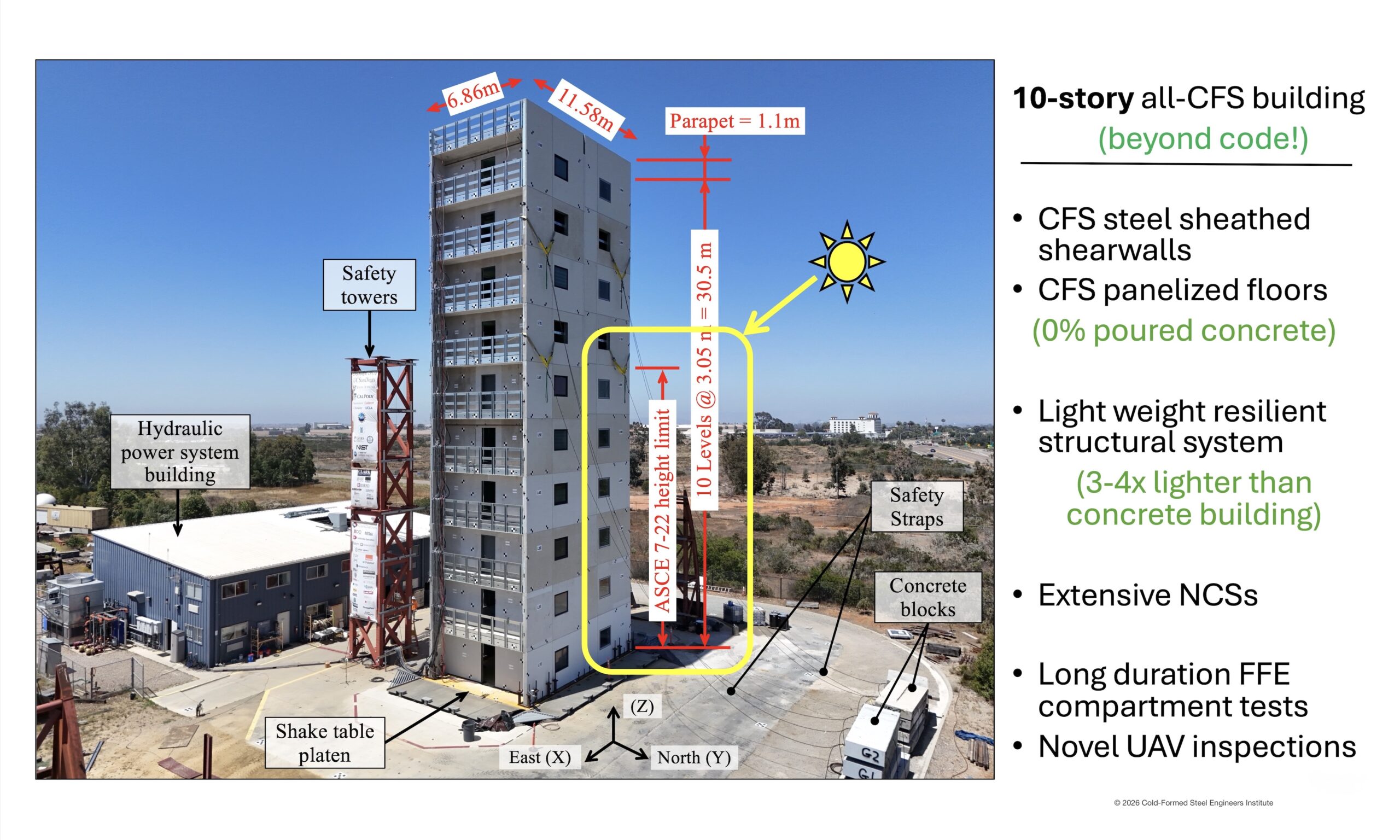
The 10-story CFS10 test building at UC San Diego exceeded current code seismic height limits and served as the centerpiece of extensive research. Copyright 2026 Cold-Formed Steel Engineers Institute (CFSEI). Used with permission.
Generating an Unprecedented Dataset
Conducted at the University of California, San Diego’s outdoor shake-table facility, the project pushed beyond current code limitations and generated an unprecedented dataset on structural behavior, nonstructural performance, functional recovery and fire-following-earthquake resilience.
The Steel Framing Industry Association (SFIA) and numerous member companies, including ClarkDietrich, CEMCO, Grabber Construction Products, KHS&S, MiTek, The Raymond Group and USG, contributed engineering expertise, materials, construction support and other resources to the CFS-NHERI and CFS10 research programs.
For researchers and industry participants alike, the project represented far more than a large-scale experiment. It demonstrated the potential for cold-formed steel to play a larger role in tall structures, particularly in high-seismic regions.
“This moves the window of where you should feel comfortable bidding things,” Schafer said to CFSEI Expo attendees. “Most people thought this was just not possible.”
A Vision for Mid-Rise Seismic Design
The project began with a straightforward but ambitious objective: determine whether cold-formed steel systems could support taller buildings in seismic regions while overcoming longstanding code barriers limiting their construction.
According to Hutchinson, the CFS-NHERI program sought to develop data ranging from individual connections and wall-line assemblies to full building systems.
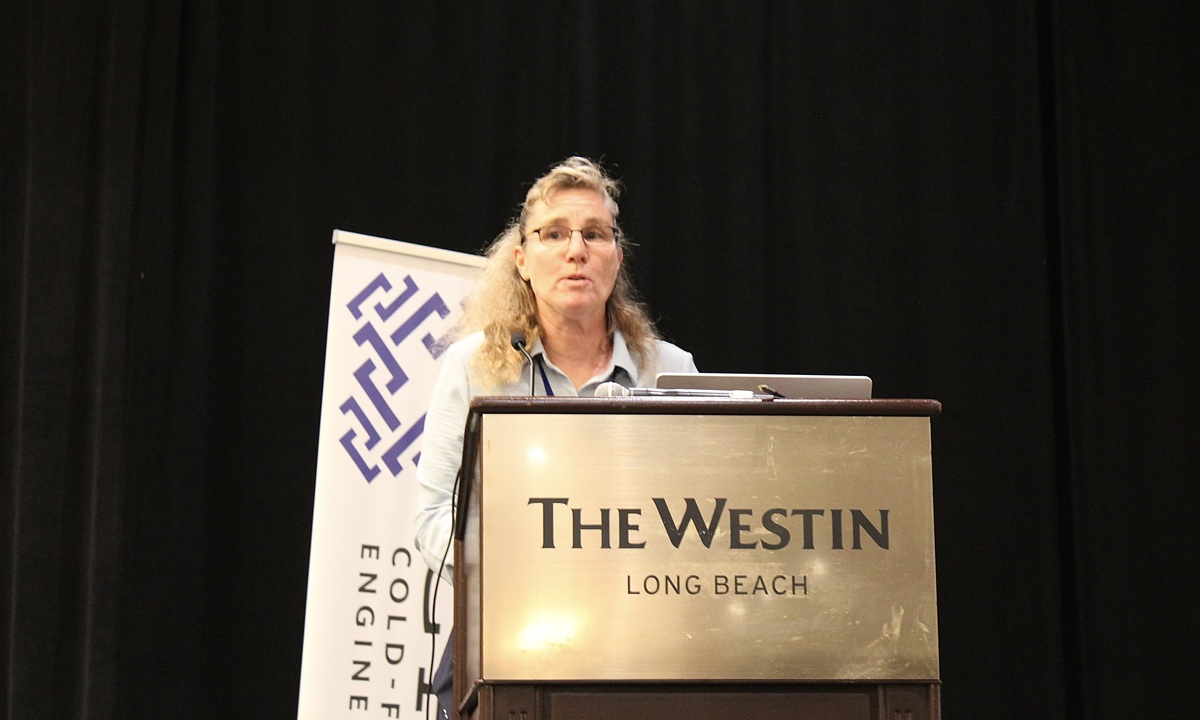
Tara Hutchinson, Ph.D., professor of structural engineering at the University of California, San Diego, outlines the goals of the CFS-NHERI and CFS10 research programs during the keynote session at the 2026 CFSEI Expo in Long Beach, California. Photo: Marco Johnson
“We wanted to engage industry, develop and support codes, build new archetype designs and enable models,” Hutchinson said.
The effort also sought to address several challenges that have historically constrained taller cold-formed steel structures. This included uncertainty surrounding seismic design factors, height limitations contained in ASCE 7, practical limits on stud capacities, cumulative drift concerns and questions surrounding dry floor diaphragm systems.
The CFS10 project built on earlier experimental programs, including the two-story CFS-NEES building tests and the six-story CFS-HUD building. Those efforts demonstrated the importance of system-level behavior and revealed how finishes and nonstructural elements contribute to overall building performance.
Researchers envisioned taking the next step by assembling and testing a significantly taller CFS-framed structure.
Designing a 10-Story Building
Turning that vision into reality required extensive collaboration between researchers and industry. Initially, Padgett joined the project as a reviewer of an existing archetype design. But the research team quickly expanded his role.
“They said, ‘Why don’t you just do the whole design?’” Padgett recalled.
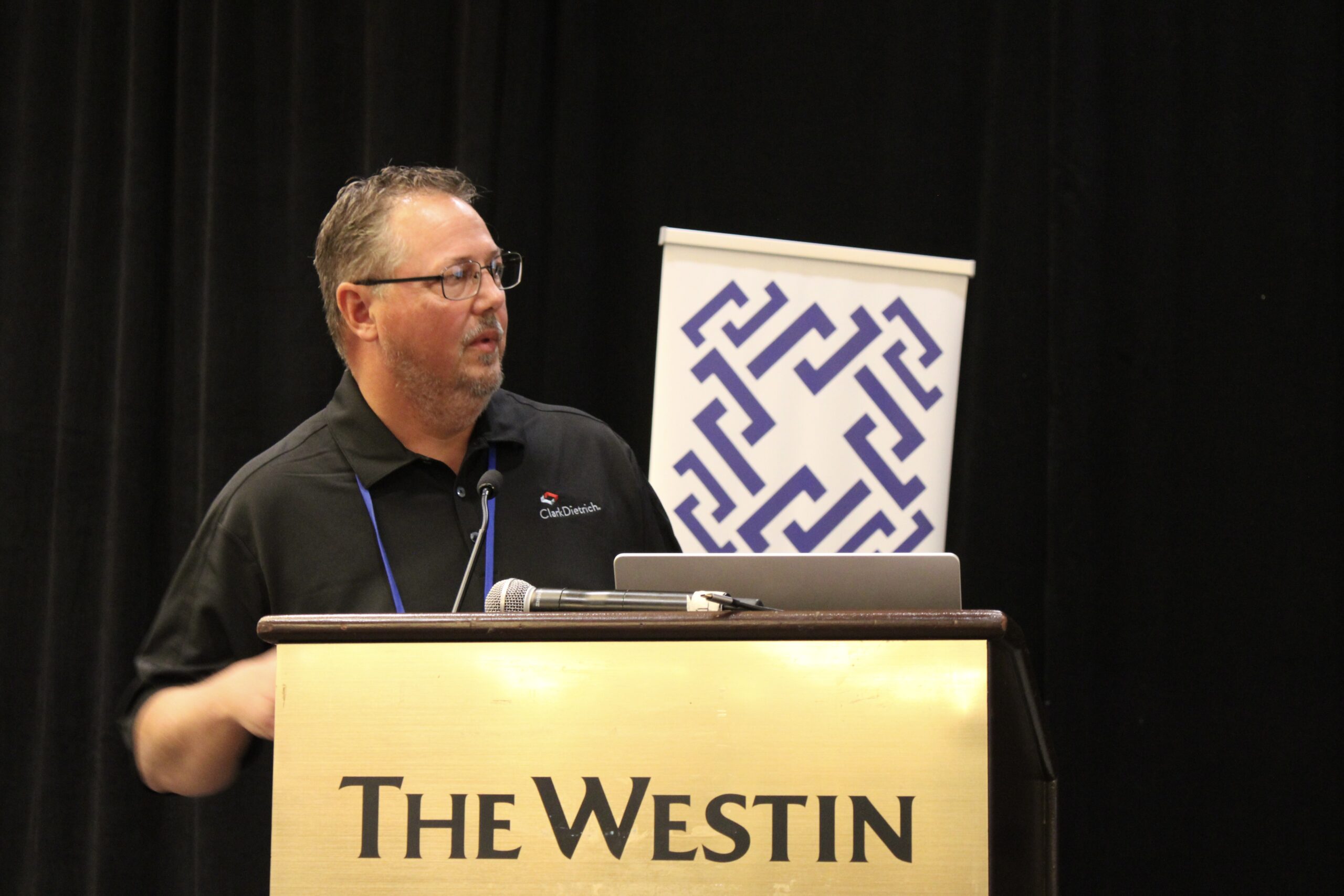
Lynn Padgett, P.E., of ClarkDietrich Engineering Services explains the design of the 10-story CFS10 test building during the CFSEI Expo keynote. Photo: Marco Johnson
The design team established several objectives. The CFS10 building would use all steel framing with no wood structural components. It would rely on cold-formed steel joist floors and roof systems. It would eliminate concrete floor toppings and other wet construction methods. The structure also would use contemporary construction approaches such as ledger framing and panelized assemblies.
Researchers intentionally pushed beyond current industry practice. While many CFS buildings 10 stories and taller have been constructed across the country, current building codes limit CFS lateral-force-resisting systems to 65 feet in high-seismic regions.
“We knew we were going to exceed the 65-foot height limit,” said Padgett.
CFS10 Design and Construction
The resulting CFS10 structure incorporated steel-sheet-sheathed shear walls, dry floor diaphragms and a combination of lateral systems. Continuous tie-rod systems were used in one direction, while HSS cord studs and hold-down assemblies were used in the other.
The project also explored multiple construction methods. Half of the building used panelized construction. The other half employed modular construction techniques, allowing researchers to evaluate both approaches within the same test structure.
Padgett described the effort as “state of the art plus plus,” because it intentionally pushed beyond current industry practice. CFS10 reflected a willingness to incorporate emerging concepts and higher-capacity components that extend beyond conventional practice.
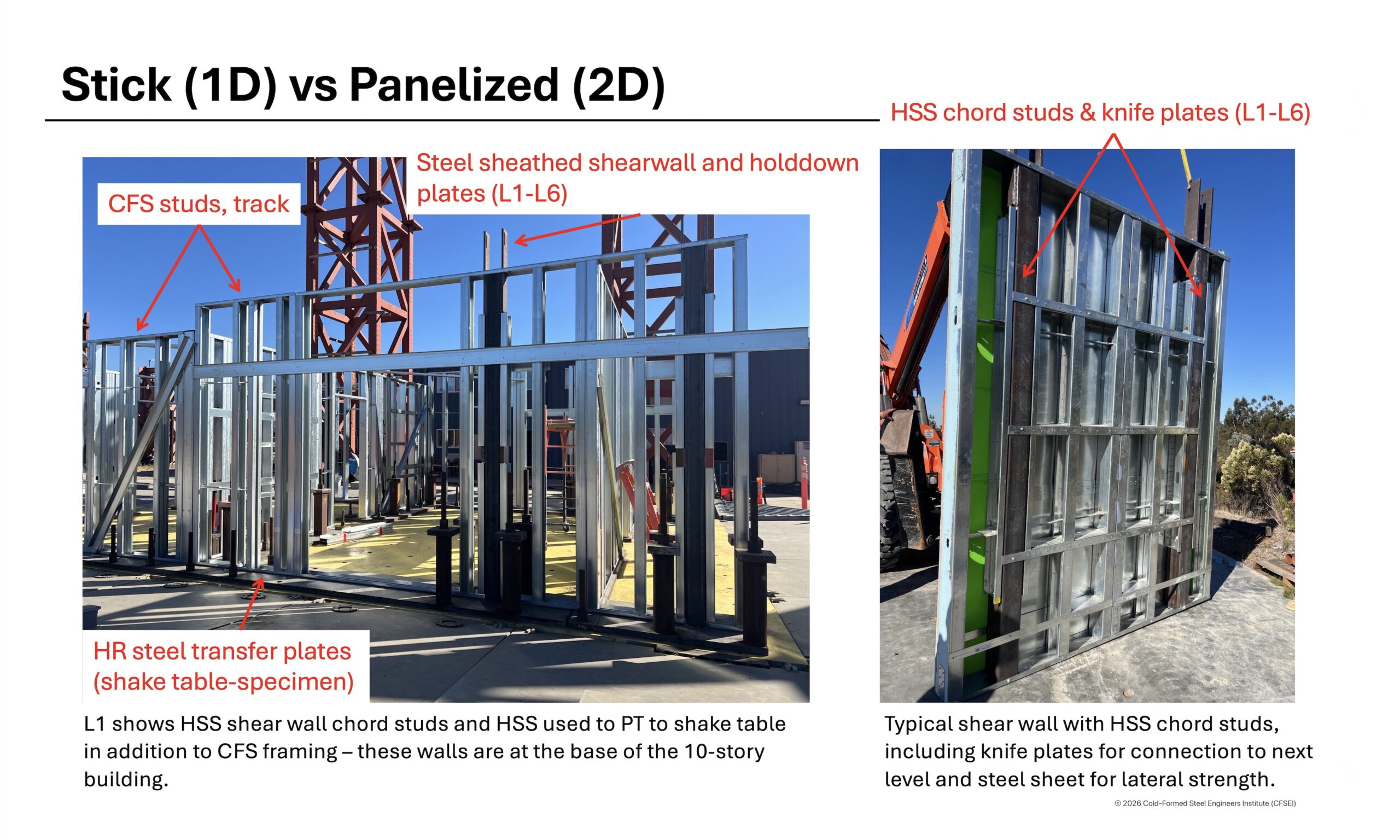
Cold-formed steel framing (CFS) and steel-sheet-sheathed shear walls were among the structural systems evaluated in the 10-story CFS10 testing program. Copyright 2026 Cold-Formed Steel Engineers Institute (CFSEI). Used with permission.
Building Beyond Current Limits
CFS10 is the tallest cold-formed steel building ever intentionally subjected to full-scale seismic testing. The final specimen stood approximately 100 feet tall.
Researchers designed the structure based on archetypes developed for Southern California seismic conditions. Because an entire building could not fit on the 40-foot-by-25-foot shake-table platform, the team selected a representative portion of a building, enough to capture critical structural behavior.
The completed specimen included three primary wall lines in one direction and two wall lines in the other. It incorporated fully finished interiors, mechanical equipment, ceilings, drywall and numerous nonstructural systems.
For Hutchinson, construction alone represented a significant accomplishment.
“We already accomplished something beyond code,” she said, when referring to the high seismic aspect of the test. “This is proof that a lightweight, resilient structural system can be built in cold-formed steel.”
The building weighed approximately 375,000 pounds. Its included five rooftop mechanical units weighing about 300 pounds each. Researchers also integrated systems intended for future fire-following-earthquake studies and nonstructural performance investigations.
CFS10: A Constructibility Laboratory
The construction of CFS10 itself became a research effort.
Panelized floor systems were installed alongside modular units fabricated on site. Contractors experimented with erection sequences, lifting methods and assembly details while documenting the process. Researchers used drones to monitor construction and collect data on installation procedures.
The project ultimately created a full-scale laboratory for studying both structural performance and constructability.
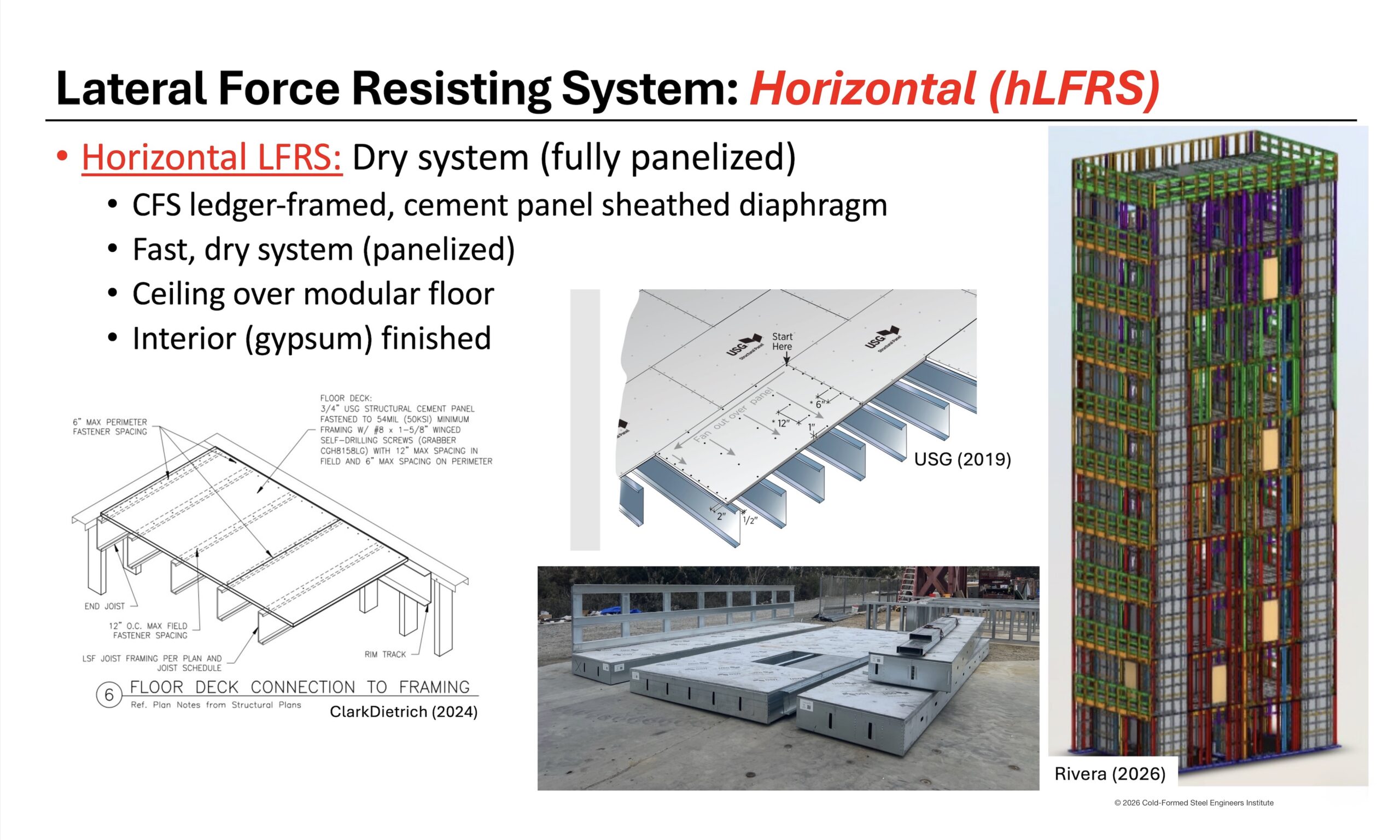
The CFS10 building used a fully panelized dry floor diaphragm system to transfer seismic forces. Copyright 2026 Cold-Formed Steel Engineers Institute (CFSEI). Used with permission.
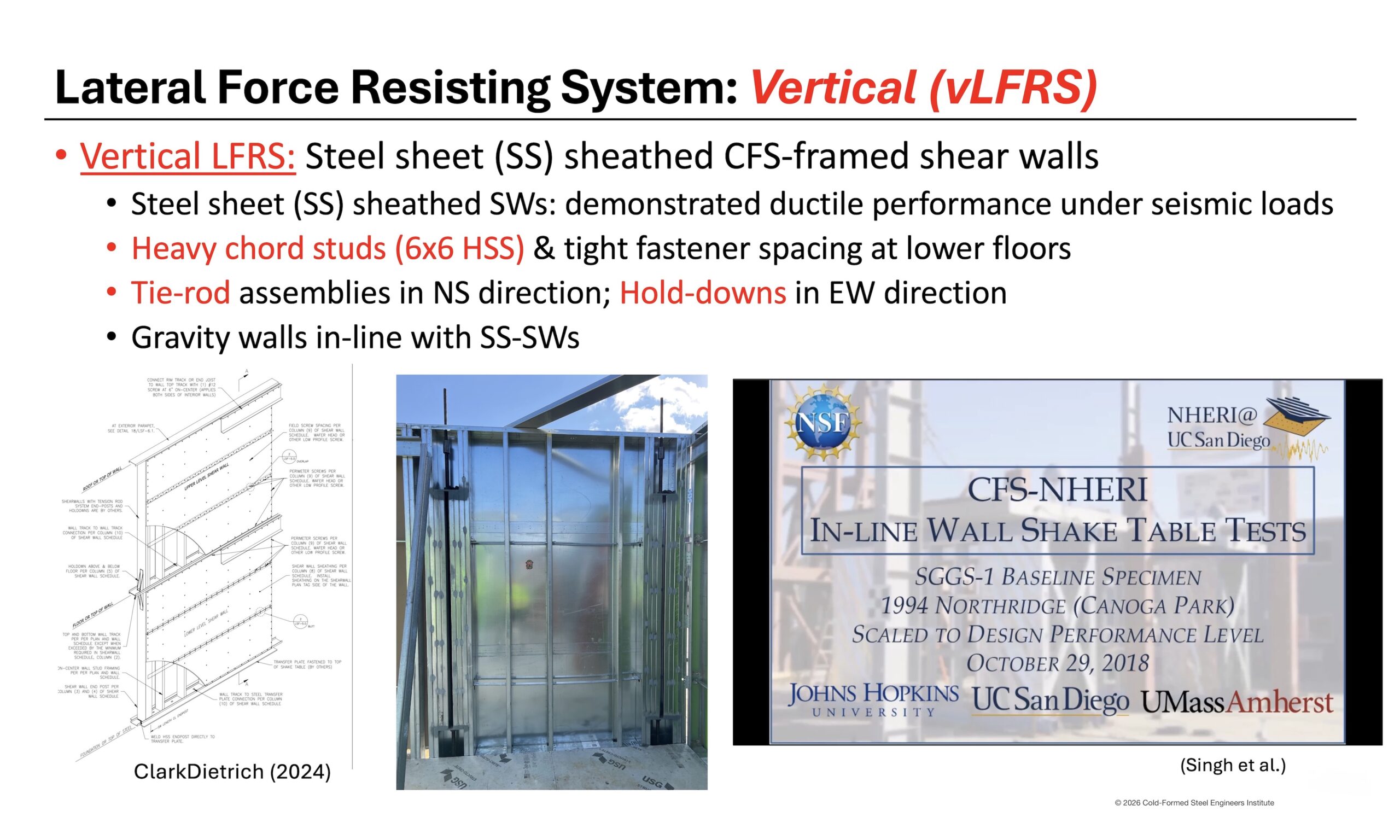
Steel-sheet-sheathed cold-formed steel (CFS) framed shear walls formed the primary vertical seismic-force-resisting system in the 10-story CFS10 building. Copyright 2026 Cold-Formed Steel Engineers Institute (CFSEI). Used with permission.
More Than 1,000 Sensors
Once construction was complete, the team instrumented CFS10 with one of the most comprehensive monitoring systems ever deployed on a cold-formed steel structure.
They installed more than 1,000 sensors throughout the specimen. Researchers tracked global building response, wall behavior, diaphragm performance, nonstructural systems and rooftop equipment. Installing the instrumentation required nearly 26.2 miles of cabling, enough to stretch the length of a marathon.
The resulting dataset allowed researchers to monitor virtually every aspect of CFS10’s behavior during testing.
18 Earthquake Simulations
Over a month-long testing campaign, the team conducted 18 earthquake simulations. The testing program included 15 service-level earthquake motions, one design-level earthquake and two Maximum Considered Earthquake motions, representing roughly 2,475-year return-period events.
Ground motions included recordings from California earthquakes as well as longer-duration subduction-zone events that researchers said could be representative of seismic hazards beyond California, including the Cascadia region, Hutchinson said.
The maximum-considered-earthquake motions subjected the building to ground accelerations approaching 0.8g. Despite that intensity, peak inter-story drift ratios remained near 1.2%, while peak floor accelerations at the roof exceeded 2g.
What CFS10 Revealed
One of the most significant findings involved the structure’s overall dynamic behavior. Using data collected during testing, researchers identified the building’s natural vibration modes and tracked how those characteristics changed as damage accumulated.
According to Hutchinson, the building’s two primary translational modes occurred at approximately 0.7 and 0.8 seconds, while the torsional mode occurred at roughly 0.5 seconds. The torsional mode drew particular interest because earthquake ground motions often contain significant energy in that range.
Researchers also observed period elongation and changes in damping as the testing program progressed. The first translational mode degraded by roughly 35%, while the second translational and torsional modes degraded by about 20% as damage accumulated.
Lower Than Anticipated Drift
The data also demonstrated the building’s resilience. According to Hutchinson, inter-story drift ratios remained lower than anticipated. Under the design-level earthquake, peak drift remained below approximately 0.5%, while the largest drift ratios observed during testing reached only about 1.2%.
The researchers documented localized damage to finishes and wall interfaces, including gypsum crushing, separation and cracking, but reported no evidence of major structural distress. Later in the keynote presentation, Schafer noted that the building remained “dead plumb” after two Maximum Considered Earthquake motions.
The testing also revealed differences between the two lateral-force-resisting systems. Hutchinson reported that the HSS cord-stud system produced a stiffer response and lower drift demands, while the tie-rod system exhibited a more uniform drift profile throughout the building height. The researchers continue to study the results.
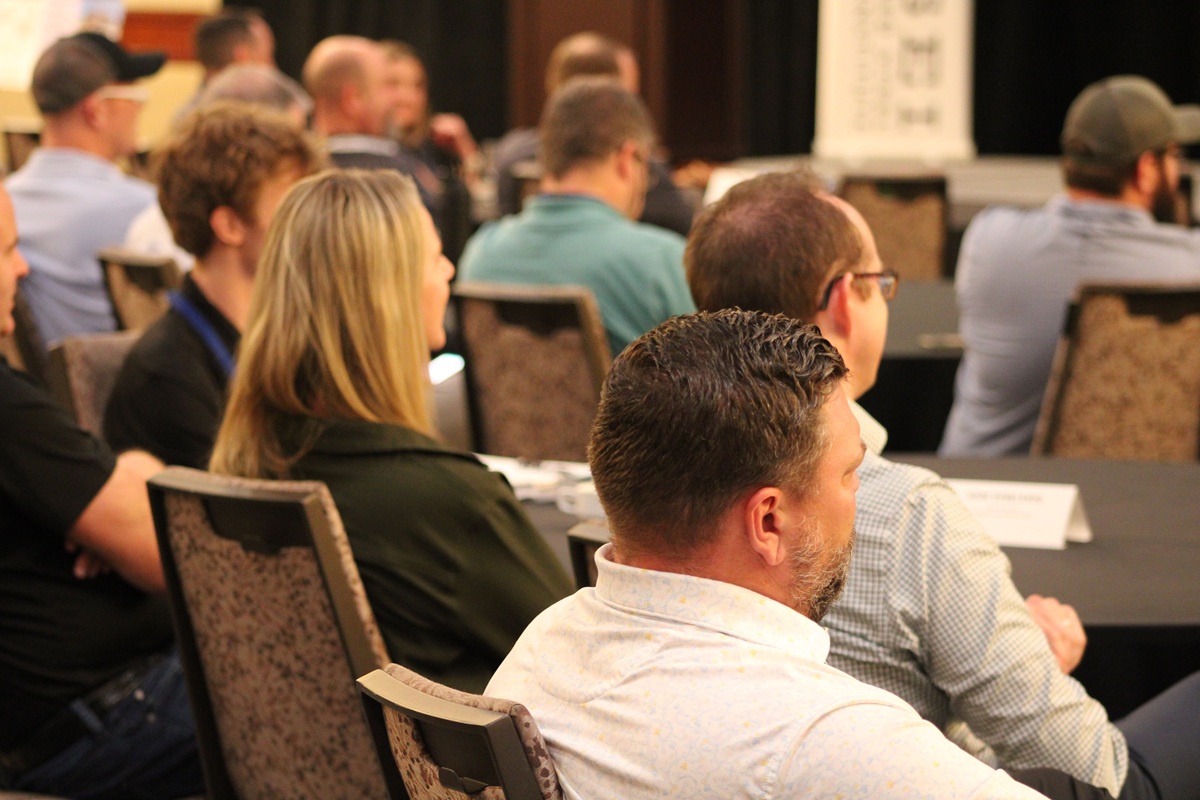
More than 250 attendees gathered at the 2026 CFSEI Expo in Long Beach, California, to hear the conference keynote on CFS10. Photo: Marco Johnson
Functional Recovery and Nonstructural Performance
A major focus of the project involved understanding how buildings perform after earthquakes, not simply whether they remain standing.
Researchers examined ceilings, partitions, mechanical equipment and other nonstructural systems. The work aligns closely with emerging functional-recovery initiatives and future performance-based design provisions.
One finding involved the rooftop mechanical equipment.
Researchers found that measured component accelerations often exceeded values predicted by current code-based amplification procedures. In one rooftop equipment test, researchers observed the detachment of an anchor connection under bidirectional loading demands.
“That’s an unfortunate, but good finding, right? Better to find it in a test than in an earthquake,” Hutchinson said.
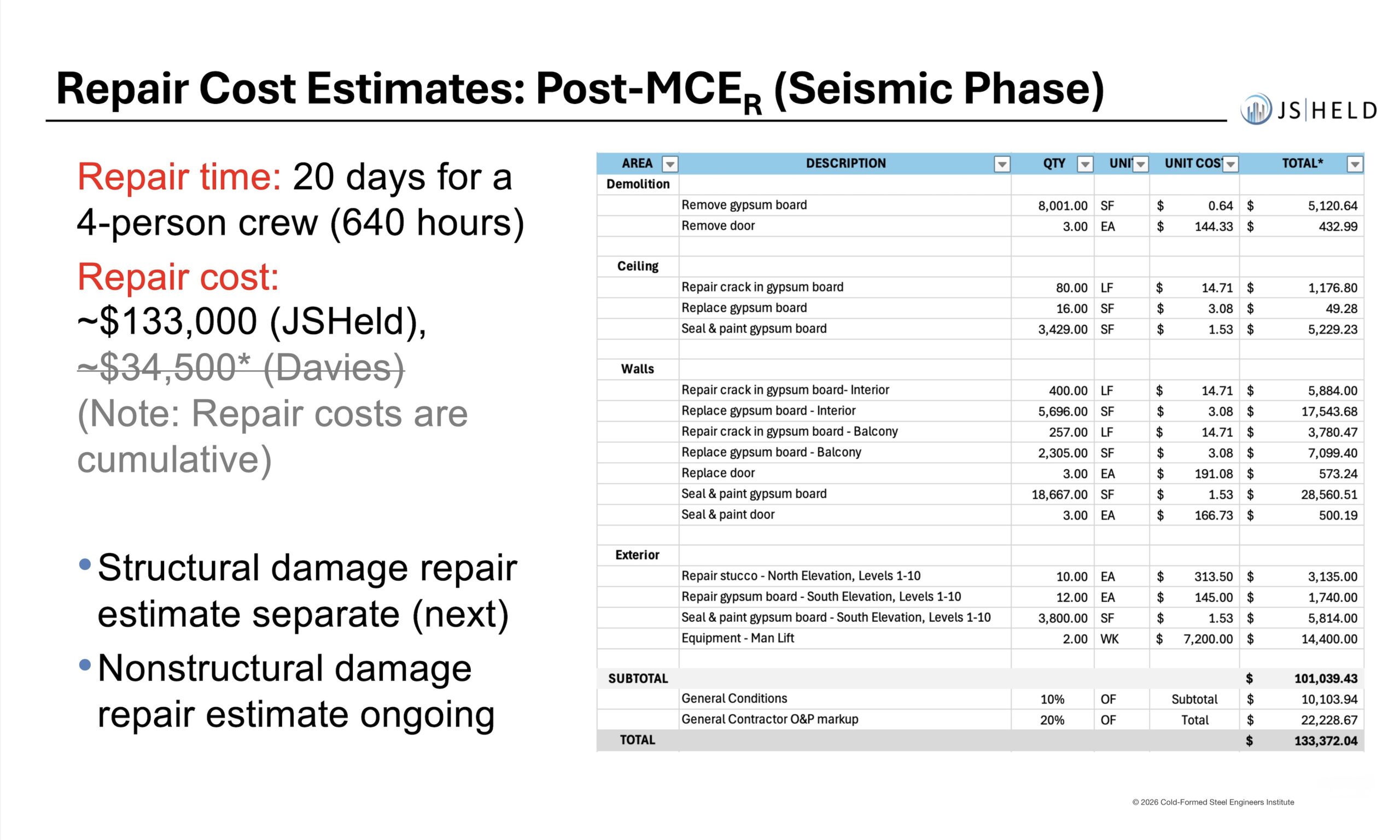
Amazingly, damage to CFS10 following seismic testing amounted to just over $133,000 — a relatively small repair bill for a building subjected to Maximum Considered Earthquake motions. Copyright 2026 Cold-Formed Steel Engineers Institute (CFSEI). Used with permission.
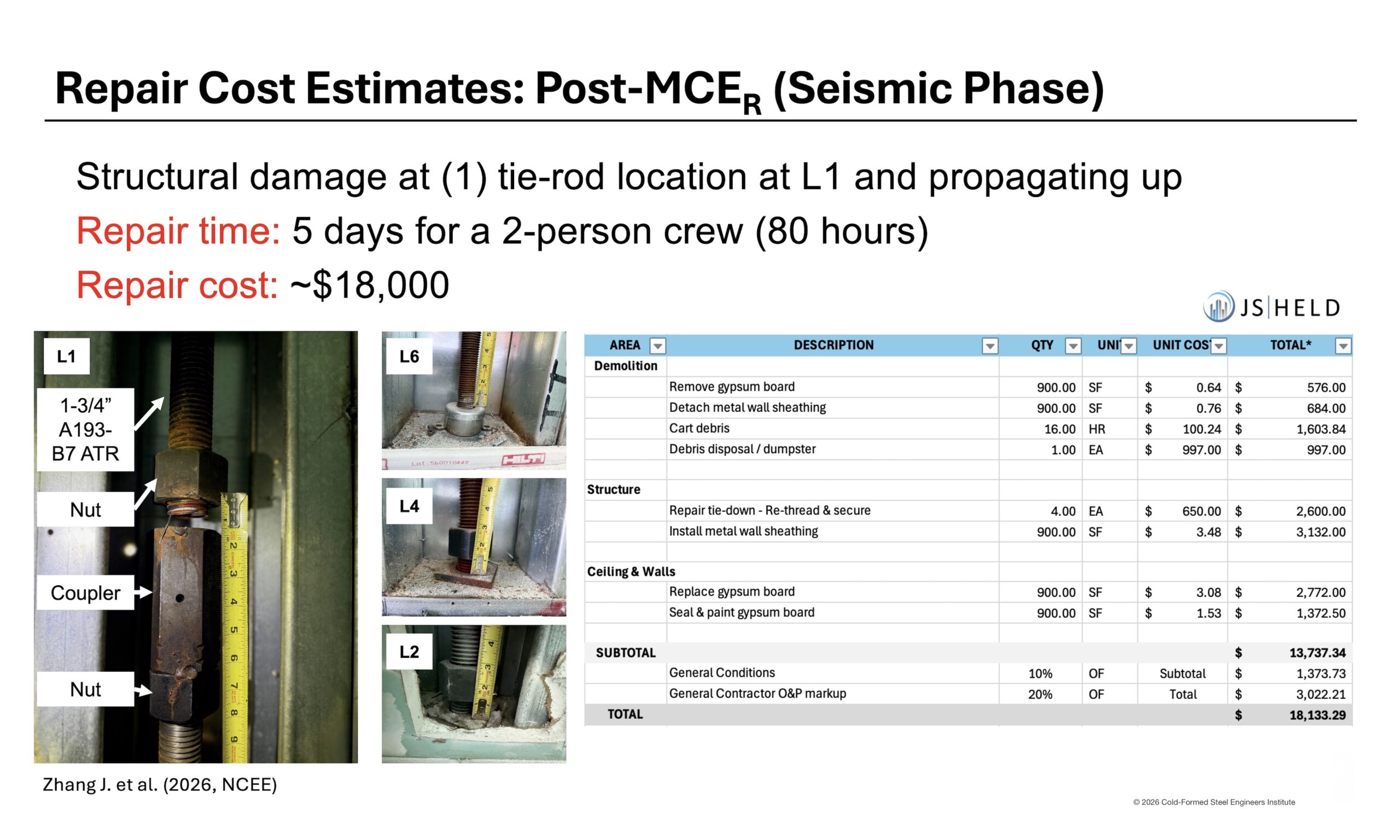
Researchers estimated that repairing damage to a Level 1 tie-rod connection and extending to levels above would cost about $18,000 with a two-person crew. Copyright 2026 Cold-Formed Steel Engineers Institute (CFSEI). Used with permission.
Only Modest Repair Costs
The team also evaluated repair costs and recovery implications following the Maximum Considered Earthquake motions.
According to Schafer, independent assessors reviewed the building after testing and estimated relatively modest repair costs despite the severity of the simulated earthquakes. The findings suggest that a cold-formed steel building designed and detailed similarly to CFS10 could remain highly functional following a major seismic event.
Schafer said independent assessments estimated less than $150,000 in repairs despite the structure experiencing two Maximum Considered Earthquake motions.
In the aftermath of a major California earthquake, he suggested, buildings with far more severe damage would receive priority attention from owners, insurers and repair contractors than would structures similar to CFS10 in design.
“The short version of it is, basically, after a real earthquake in California, it wouldn’t cost enough that you’d be able to get in the queue to fix this [CFS10] building,” Schafer said. “There would be so many other buildings that have issues.”
CFS10 Broadens the Definition of Resilience
Schafer argued that the results highlight a broader definition of resilience — one focused not only on life safety, but also on post-earthquake usability, repair cost and recovery time.
“When we say this building is resilient, what we mean is that it has low drift, low mass and has very little repair cost for maximum considered earthquakes,” Schafer said.
The findings could influence future discussions surrounding functional recovery, insurance risk, performance-based design and post-earthquake building recovery.
Fire Following Earthquake
The CFS10 project extended beyond seismic testing. Researchers also conducted fire-following-earthquake experiments within selected compartments of the building. The tests involved nearly 90-minute naturally cooled burns designed to examine the behavior of cold-formed steel assemblies after seismic damage.
The experiments generated valuable data on temperatures, floor deflections and structural response under post-earthquake fire conditions.
During some tests, the researchers observed floor deflections approaching 2.5 inches, Hutchinson said. Ongoing analysis will compare these results with conventional fire-testing approaches and improve understanding of compartment behavior, she added.
The fire-following-earthquake experiments provided a rare opportunity to study the behavior of earthquake-damaged cold-formed steel systems under realistic fire conditions, she said.
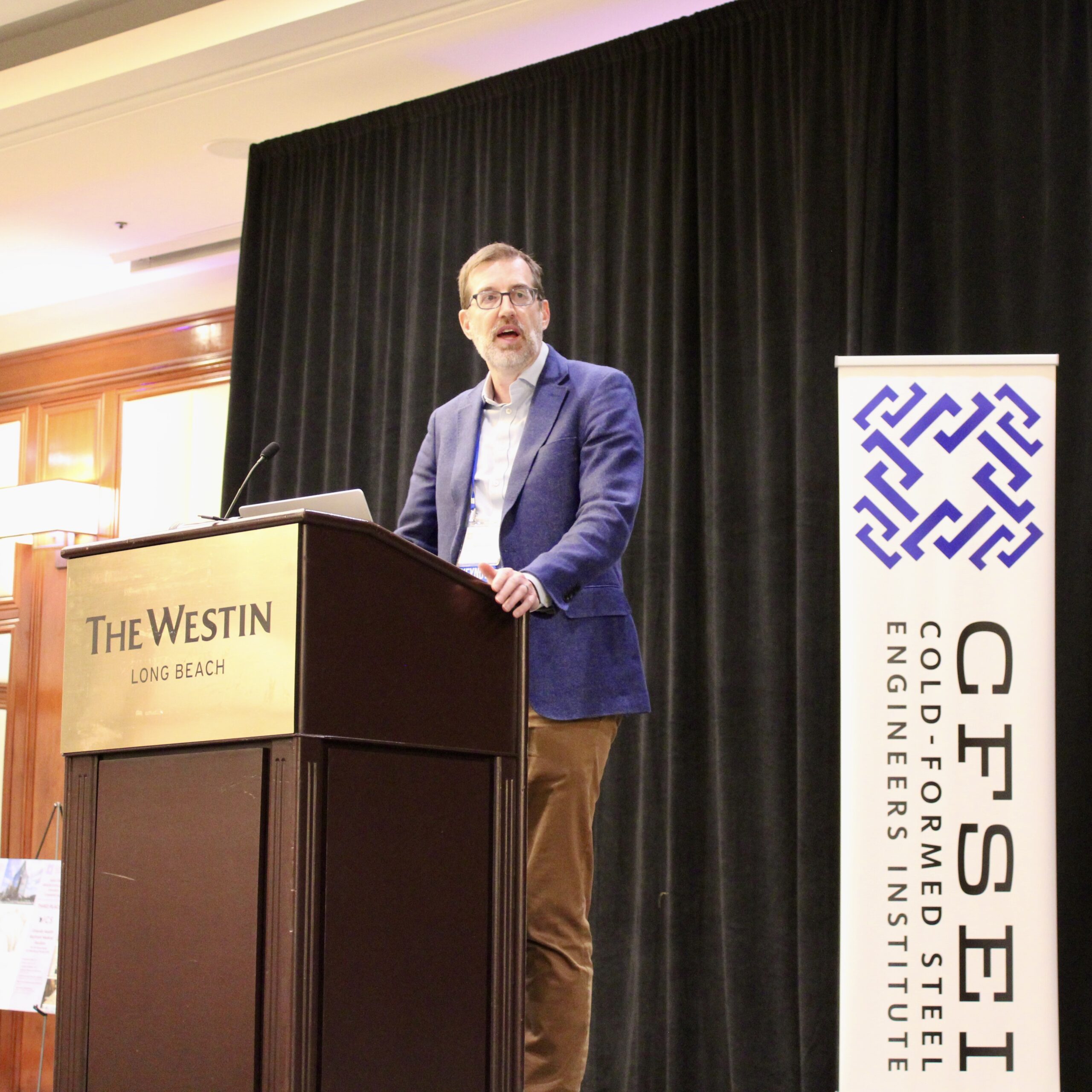
Ben Schafer said CFS10’s low drift, light weight and modest repair costs demonstrate how resilient cold-formed steel (CFS) buildings can perform. Photo: Marco Johnson
Validated Engineering Models to Come
Perhaps one of the most important outcomes of the program is the validation of numerical modeling tools.
For years, researchers have worked to develop models capable of accurately predicting the nonlinear behavior of cold-formed steel buildings, Schafer said. The CFS10 specimen provided a rare opportunity to compare predictions with full-scale experimental data.
According to Schafer, the results have been encouraging. Researchers developed both practice-oriented models suitable for engineering applications and highly detailed benchmark models intended for research purposes.
Comparisons between measured and predicted drifts showed strong agreement across service-level, design-level and maximum-considered-earthquake events.
“We’ve got confidence that we’re going to be able to give engineers models that can predict the nonlinear behavior,” Schafer said.
The validated models could support future code-development efforts and provide engineers with more reliable tools for analyzing cold-formed steel structures. This should also reduce the current code burden placed on CFS structures.
CFS10: Looking Ahead
Although the CFS10 testing phase has concluded, Schafer said the work is far from finished. The project has generated many years’ worth of data that researchers will continue to analyze. According to Schafer, the results are already contributing to ASCE 41-related efforts aimed at translating the research into tools engineers can use in practice.
For Schafer, however, the most important outcome may be the shift in perception surrounding cold-formed steel.
CFS Performs Well Under Severe Seismic Loading
The project demonstrated that lightweight, dry-constructed, resilient cold-formed steel systems can perform well under severe seismic loading, while supporting taller building configurations than many engineers previously considered practical in such cases.
The achievement required eight years of effort, extensive industry participation and contributions from researchers, manufacturers, engineers, contractors and students.
“We were able to demonstrate something that most people thought was not possible,” Schafer said.
As researchers continue analyzing the results, the CFS10 program may ultimately be remembered less for the earthquakes it simulated and more for the new possibilities it revealed for cold-formed steel design and construction.
 Mark “Marco” Johnson is editor of BuildSteel.org and a marketing communications consultant specializing in cold-formed steel (CFS) framing systems. He provides content development, digital marketing, video production and strategic communications services for the Steel Framing Industry Association (SFIA) and the Cold-Formed Steel Engineers Institute (CFSEI). He also writes regularly about CFS design, engineering, construction and industry research.

Cold-Formed Steel Engineers Institute
The Cold-Formed Steel Engineers Institute (CFSEI) comprises hundreds of structural engineers and other design professionals. Together, they are finding a better way to produce safe and efficient cold-formed steel (CFS) designs for commercial and residential structures.
CFSEI members develop industry standards and design methods. CFSEI issues technical bulletins, organizes seminars and provides online training so that engineers and design professionals can improve their knowledge and skills. CFSEI is part of the Steel Framing Industry Association (SFIA) family. For more information, visit www.cfsei.org.
Additional Resources
- Research, Resilience and Real-World Solutions Shape the 2026 CFSEI Expo in Long Beach, California
- Benjamin Schafer Receives CFSEI’s 2026 John P. Matsen Award for Distinguished Service
- More Than 250 Engineers Gather in Long Beach for 2026 CFSEI Expo (May 18-20)