
July 15, 2026 — The Cold-Formed Steel Engineers Institute (CFSEI) has updated a technical note examining a frequently debated design issue: which wind load level should be used to calculate roof-to-wall anchorage forces.
Tech Note L200-26, Roof Anchorage Forces: MWFRS or C&C, reviews applicable building code provisions, explains the distinction between Main Wind Force Resisting System (MWFRS) and Component and Cladding (C&C) wind loads. It discusses how each affects the calculation of roof uplift forces and the design of roof-to-wall connections for cold-formed steel (CFS) framing systems. This tech note updates and replaces L200-09.
Understanding MWFRS and C&C Wind Loads
The technical note explains that Section 1609.1.1 of the 2024 International Building Code requires designers to determine wind loads in accordance with ASCE 7-22. Although designers calculate both MWFRS and C&C wind pressures, questions frequently arise over which load level designers should use when determining roof-to-wall anchorage forces.
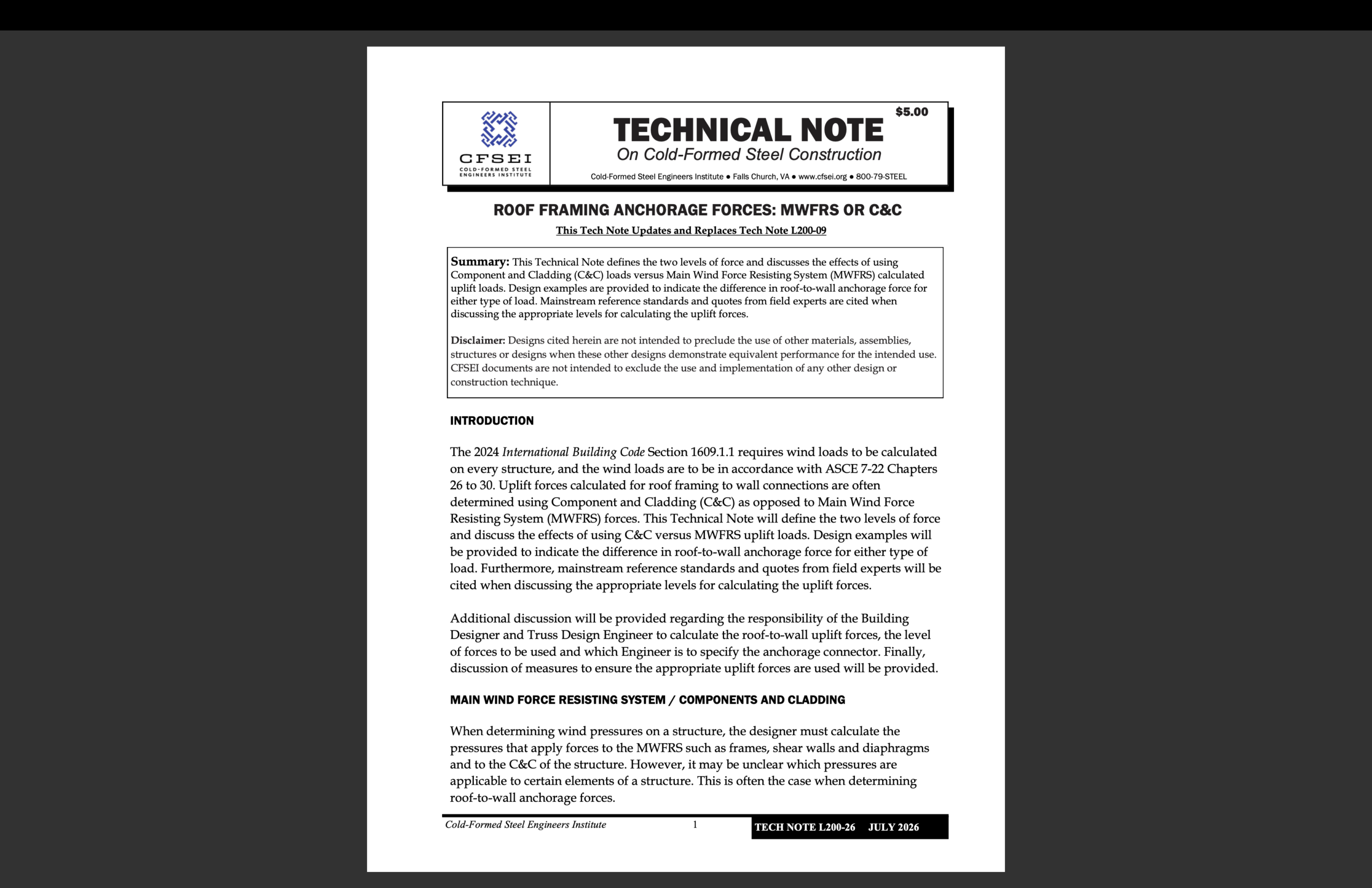
Tech Note L200-26, Roof Anchorage Forces: MWFRS or C&C
Drawing on ASCE 7 documentation, widely used industry references and commentary from recognized engineering professionals, Tech Note L200-26 concludes that MWFRS-level loads can be appropriate for calculating roof-to-wall anchorage forces in many applications. It also notes that using the higher C&C load levels for these connections may unnecessarily increase connector requirements. The latter could increase construction costs.
Responsibilities, Alternatives and an Example
The technical note discusses the responsibilities of the building designer and truss design engineer. It explains their roles in determining roof-to-wall uplift forces and identifying the required anchorage connection. Tech Note L200-26 also reviews situations where C&C-level loads may be appropriate. These include projects requiring enhanced structural performance, designs addressing localized wind effects, and cases where a building official requires them.
CFSEI Tech Note L200-26 explores alternative approaches. These include MWFRS pressures based on a higher Risk Category for greater mean recurrence intervals during design wind events. The publication also includes a residential design example.
Designers Determine Appropriate Uplift Loads
The CFSEI Tech Note L200-26 emphasizes that the selection of the appropriate uplift force remains a design decision to be made by the building designer and, where applicable, the authority having jurisdiction. The technical note is intended to provide technical guidance to support that engineering judgment.
- Tech Note L200-26 is available free of charge to CFSEI Corporate, Professional and Student Members
- Nonmembers: Tech Note L200-26 is available for purchase from the CFSEI On Demand web site
Industry experts write and update CFSEI Technical Notes to guide professionals in cold-formed steel design and construction.

Cold-Formed Steel Engineers Institute
The Cold-Formed Steel Engineers Institute (CFSEI) comprises hundreds of structural engineers and other design professionals. Together, they are finding a better way to produce safe and efficient cold-formed steel (CFS) designs for commercial and residential structures. CFSEI members develop industry standards and design methods. CFSEI issues technical bulletins, organizes seminars and provides online training so that engineers and design professionals can improve their knowledge and skills. CFSEI is part of the Steel Framing Industry Association (SFIA) family. For more information, visit www.cfsei.org.
Additional Resources
- Updated CFSEI Tech Note Explains Cold-Formed Steel Truss-to-Bearing Connections
- CFSEI Releases Tech Note J200-26: Vibration of Cold-Formed Steel Joist Framed Floors
- CFSEI Releases Updated Tech Note G500-25: Field Guide – Inspection Checklist for Structural CFS Framing
- CFSEI Releases Tech Note B011-25 for Engineers New to Cold-Formed Steel Framing Design
- CFSEI Publishes Tech Note F140-25: ‘Welding Cold-Formed Steel’
- CFSEI Publishes Tech Note L400-25: ‘Non-Bearing Cold-formed Steel Lateral Force Resisting Systems’
- CFSEI Publishes Tech Note on Evaluation and Remediation of Cold-Formed Steel Members and Connections
- CFSEI Publishes Tech Note on the Design of Cold-Formed Steel Bearing Stiffeners
- CFSEI Publishes Tech Note on Hole Reinforcement of Cold-Formed Steel Compression Members
- CFSEI Publishes Technical Note on Strap Braced Wall Design, Loose Strap Considerations