
July 15, 2026 — The Cold-Formed Steel Engineers Institute (CFSEI) has released an updated technical note explaining the role of truss-to-bearing connections in cold-formed steel framing systems.
Tech Note F501-26, Cold-Formed Steel Truss to Bearing Connections, provides educational guidance for building designers. It reviews the structural role of truss-to-bearing connections and the factors that influence their design. This updated tech note replaces F501-11.
The publication discusses the wind loads that truss-to-bearing connections may need to resist. It also examines responsibility for truss-to-bearing connection design. The technical note includes general design guidance and an illustrative design example, where the truss is bearing on a cold-formed steel (CFS) stud wall.
Understanding the Structural Load Path
Tech Note F501-26 begins with a simplified building example to explain how structural loads move through a building. It illustrates how roof diaphragms, walls and truss-to-bearing connections work together to resist wind loads. The example places the connection within the building’s overall structural load-resisting system.
The publication focuses on wind loading. It does not address loads resulting from seismic forces.
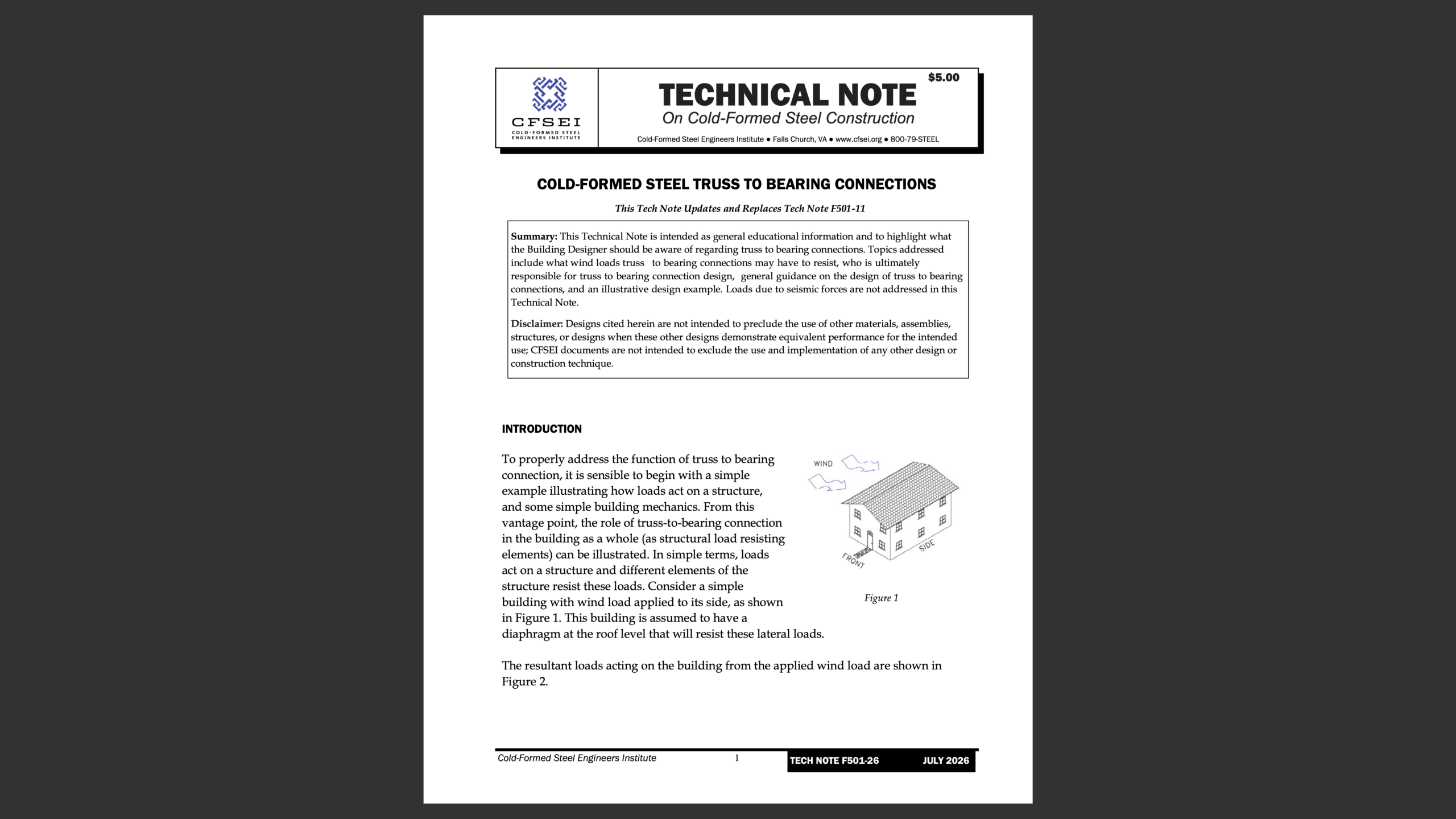
Tech Note F501-26, Cold-Formed Steel Truss to Bearing Connections
Guidance for Building Designers
The technical note highlights issues that building designers should consider when evaluating truss-to-bearing connections. It also explains how structural load paths affect connection design and overall building performance.
CFSEI emphasizes that the publication provides general educational guidance. It supports engineering judgment but does not establish mandatory design requirements. Building designers remain responsible for project-specific design decisions.
The organization also notes that the technical note does not preclude alternative materials, assemblies or design approaches that demonstrate equivalent performance for their intended use. The technical note is intended to provide technical guidance to support that engineering judgment.
- Tech Note F501-26 is available free of charge to CFSEI Corporate, Professional and Student Members
- Nonmembers: Tech Note F501-26 is available for purchase from the CFSEI On Demand web site
Industry experts write and update CFSEI Technical Notes to guide professionals in cold-formed steel design and construction.

Cold-Formed Steel Engineers Institute
The Cold-Formed Steel Engineers Institute (CFSEI) comprises hundreds of structural engineers and other design professionals. Together, they are finding a better way to produce safe and efficient cold-formed steel (CFS) designs for commercial and residential structures. CFSEI members develop industry standards and design methods. CFSEI issues technical bulletins, organizes seminars and provides online training so that engineers and design professionals can improve their knowledge and skills. CFSEI is part of the Steel Framing Industry Association (SFIA) family. For more information, visit www.cfsei.org.
Additional Resources
- New CFSEI Tech Note Addresses Roof-to-Wall Wind Anchorage Design
- CFSEI Releases Tech Note J200-26: Vibration of Cold-Formed Steel Joist Framed Floors
- CFSEI Releases Updated Tech Note G500-25: Field Guide – Inspection Checklist for Structural CFS Framing
- CFSEI Releases Tech Note B011-25 for Engineers New to Cold-Formed Steel Framing Design
- CFSEI Publishes Tech Note F140-25: ‘Welding Cold-Formed Steel’
- CFSEI Publishes Tech Note L400-25: ‘Non-Bearing Cold-formed Steel Lateral Force Resisting Systems’
- CFSEI Publishes Tech Note on Evaluation and Remediation of Cold-Formed Steel Members and Connections
- CFSEI Publishes Tech Note on the Design of Cold-Formed Steel Bearing Stiffeners
- CFSEI Publishes Tech Note on Hole Reinforcement of Cold-Formed Steel Compression Members
- CFSEI Publishes Technical Note on Strap Braced Wall Design, Loose Strap Considerations