
Photo: Middleton High School in Middleton, Wis., uses CFS framing designed by raSmith to back curtain walls and some extensive window penetrations.
Studies show that daylight in schools increase students’ test scores and promote better health and physical development. According to the U.S. Department of Education, classrooms with better lighting have a 26% better learning rate in math and a 20% better learning rate in reading.
To design the inclusion of natural light in a school, architects must have the flexibility to create buildings with the features necessary to allow a better learning experience. Cold-formed steel framing (CFS) provides architects with the freedom to support a wide variety of configurations to meet any required aesthetic feature or design challenge in a school structure.
Access to Daylight Improves Student Performance
By the time a student graduates from high school, he or she has spent 15,600 hours inside a school. That’s second only to the time spent at home, says the Harvard T.H. Chan School of Public Health. For more than 50 million K–12 students in the United States, the time spent in school is also a time of rapid physical growth, intense learning, and critical neurological and social development.

The U.S. Environmental Protection Agency estimates that 46% of U.S. public schools have environmental conditions that contribute to poor Indoor Environmental Quality.
According to the Harvard report, Schools for Health, many aspects of the health and performance of students can be negatively affected by chronic exposures to common environmental factors in school buildings, including indoor air pollution, mold, inadequate lighting and elevated noise levels.
The U.S. Environmental Protection Agency estimated in 2011 that more than 60,000 schools, or 46% of U.S. public schools, have environmental conditions that contribute to poor Indoor Environmental Quality, including exposure to toxins, poor indoor air quality and many other factors.
According to Solatube International, of the design options available to improve today’s classrooms, access to daylight is proven to have the most positive effect on student performance and health.
Intriguing Geometry at SOS Children’s Villages Features Steel
The award winning SOS Children’s Villages Roosevelt Square community center located in Chicago, Illinois is an 11,000-square-foot space completed in October 2020.The CFS engineer for the project, raSmith, designed the exterior CFS framing that supports the metal panel veneer.
The CFS framing system includes bypass framing attached to the CLT roof with deflection clips and hard clips, exterior openings and, most notably, support framing for the continuous sloping curtain walls.
Steel Framing Provides Freedom to Improve Daylighting
In addition to a student’s health and learning, daylighting in a school setting can impact the building’s lighting, heating and cooling costs for the lifecycle of operation, says Construction Specifier.
U.S. school systems spend approximately $8 billion each year on energy. According to the U.S. Energy Information Administration, about 26% of electricity consumed by a typical school is for lighting.
“With so much riding on the outcome—educationally, financially and physically—architects should weigh every daylighting choice with precision and technology when available,” says Thomas Renner, writer for the Construction Specifier.

Meadow View Elementary in Sun Prairie, Wis., designed by raSmith, features CFS-framed curtain walls and lots of window openings.
Increasingly, architects select CFS framing for its ease of installation, durability, design flexibility and cost-effectiveness. CFS framing can be used to meet standard design requirements and solve complex architectural challenges.
Architects specify CFS framing for many reasons, including:
- Innovative designs, such as the award winning SOS Children’s Villages Roosevelt Square in Chicago
- High strength-to-weight ratio, since steel expands the possibilities of adding function and space to a building
- Prefabrication, which can ensure that backup envelopes are properly framed and windows installed quickly and seamlessly
Altogether, the qualities of CFS framing make it an ideal building material to solve many design challenges and bring architects’ visions to life.
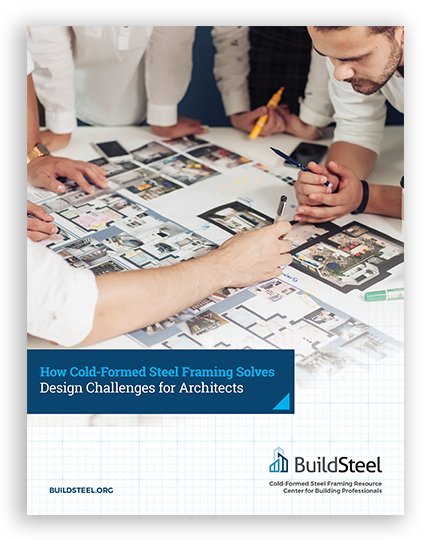
eBook: How Cold-Formed Steel Framing Solves Design Challenges for Architects
In architecture, material choice is key. It affects the overall look of a building, of course — but it can also help solve complex design challenges. The BuildSteel eBook, “How Cold-Formed Steel Framing Solves Design Challenges for Architects,” highlights five unique projects that were completed successfully with CFS framing.
In this eBook, you’ll learn how CFS framing can:
- Help quickly and cost-effectively raise the height of a building
- Create unique aesthetic features
- Reduce time to occupancy
- Enable prefabrication and facilitate design-build construction
Additional Resources
- 4 K-12 School Design Trends that Make Use of Steel Framing
- SFIA Releases Industry Environmental Products Declaration for Cold-Formed Steel Framing
- 3 Tips to Construct Greener Buildings with Steel Framing