
September 17, 2026 — The Steel Framing Industry Association spans the cold-formed steel (CFS) framing supply chain. Its members include steel mills, manufacturers and contractors that install framing systems. That reach gives SFIA a powerful platform for industry growth.
It also gives the association a complicated leadership assignment. Different members bring different business interests, market pressures and customer needs. SFIA Executive Director Don Allen addressed that challenge on FRAMECAD’s Steel Framing Connections podcast. FRAMECAD is an SFIA member.
Host Matt Stillwell explored Allen’s career and the forces shaping North American steel framing. Their conversation covered resilience, sustainability, workforce development, automation and off-site construction. Throughout the interview, Allen returned to SFIA’s role as an industry connector.
“What works for the roll formers and manufacturers doesn’t always work as well for the contractors or steel mills,” Allen said. “But our mission is to expand the market for steel framing.”

Don Allen, executive director of the Steel Framing Industry Association, joined host Matt Stillwell on FRAMECAD’s Steel Framing Connections podcast.
One Industry, Many Perspectives
Allen entered the industry in 1990 as a structural engineer with CFS manufacturer Unimast. He later worked for engineering firms, industry associations and Super Stud Building Products. Those roles exposed him to many perspectives within the steel framing business.
Now finishing his second year as SFIA’s executive director, Allen must align those perspectives. He sees a common message in steel’s speed, light weight and resilience. That message can move members toward shared goals instead of internal competition.
“We want something that is light, fast and resilient, and steel has a great story to tell,” Allen said. “By trying to get everybody focused on that message rather than fighting against each other, we can do some great things.”
SFIA extends that unifying approach beyond its membership. The association partners with groups that sometimes represent competing building materials. For example, SFIA works with the National Ready Mixed Concrete Association on noncombustible construction.
It also collaborates with the Metal Construction Association and Metal Roofing Alliance. Those partnerships promote buildings that resist fire and other hazards. SFIA also works with government agencies, educational organizations and trade schools.
“We can’t do it alone, so we partner with other organizations to educate people at every level,” Allen said. The association reviews curricula, conducts outreach to architects and general contractors, hosts webinars and publishes content on BuildSteel.org.
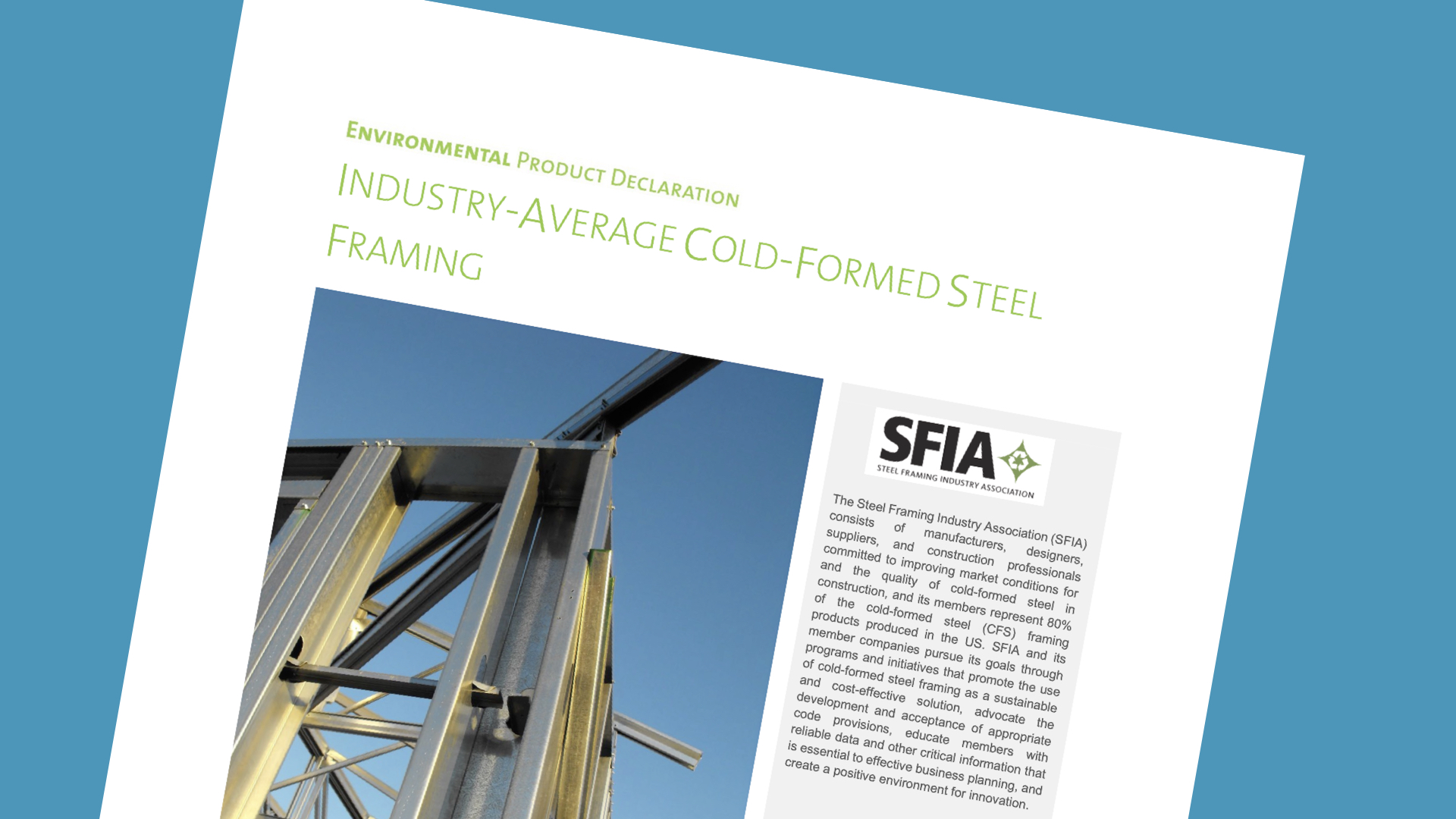
SFIA’s new industry-average EPD provides independently verified environmental impact data for cold-formed steel framing products.
SFIA EPD
The Steel Framing Industry Association (SFIA) Environmental Product Declaration for Cold-Formed Steel Framing (EPD) is a must-have tool for contractors, building owners, architects and others who strive to deliver advanced building designs that meet the latest LEED™ and other sustainable rating systems, programs and standards.
The SFIA EPD for CFS Framing can be seamlessly integrated into project specifications as an option with company-specific EPDs. SFIA offers a Specifications Review Service for steel framing, which is a completely free checkup.
Standards Create a Common Foundation
Education remains essential because many project teams still view CFS framing as unfamiliar. Allen said the industry already knows how to build successfully with the material. The larger challenge involves connecting that knowledge with new users.
Industry standards give those users a dependable starting point. Allen contrasted today’s market with the industry he joined in 1990. At that time, CFS framing lacked its own standards.
“It was a bit of the Wild West,” Allen said.
Today, SFIA operates a code compliance certification program. The SFIA label shows that products meet applicable requirements and material tolerances, he said.
That consistency supports wider adoption across markets. Allen estimated that about 90% of North American commercial projects use some steel framing. Residential construction, however, offers a much larger growth opportunity.
Allen placed CFS framing’s residential share at approximately 2% to 4%. Builders increasingly recognize its advantages in wildfire, high-wind and termite-prone regions. Hawaii and Florida have made particularly strong residential inroads, he said.
Steel does not feed fires, termites or vermin. It also resists mold growth and requires no special chemical treatments. Its light weight can support vertical additions with less reinforcement.
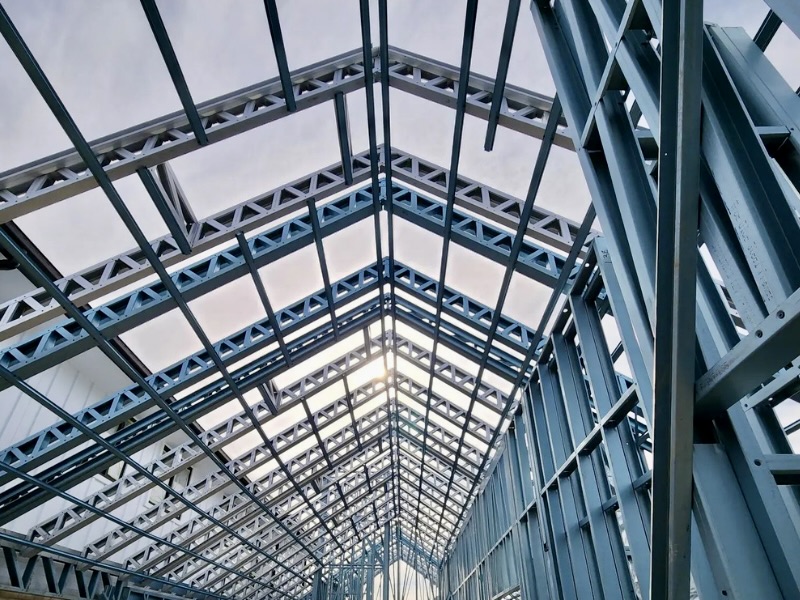
Don Allen discusses how industry unity can expand cold-formed steel (CFS) framing markets on a recent FRAMECAD podcast.
Connecting Technology, Labor and New Markets
SFIA also helps the industry respond to construction’s persistent labor shortage. The association reaches younger workers through schools, outreach programs and curriculum reviews. Allen sees CFS framing as a gateway into an increasingly high-tech industry.
Panelization creates a practical training path for new workers. Shops can produce marked components for assembly in controlled environments. Workers can learn there before advancing to more complex field installation.
Off-site construction provides another answer to field labor constraints. Steel’s straightness, dimensional stability and low weight suit factory panel production. Cut-to-length roll forming can also reduce framing waste to small punch-outs.
Allen connected that efficiency to steel’s broader sustainability story. Magnets make steel easy to separate from other materials during recycling. Manufacturing scrap retains value and can return to steel mills.
“Steel is infinitely recyclable,” Allen said.
He also noted that electric arc furnaces produce roughly 70% of North American steel. Those furnaces use more recycled material and support a circular economy.
New markets show what coordinated industry growth can deliver. Allen highlighted data centers, which require tall partitions and pressurized aisle enclosures. Those projects demand speed, durability and fire-rated assemblies.
SFIA can connect proven systems, qualified companies and reliable information across such markets. That coordinating role may prove essential as more project teams evaluate CFS framing.
“People don’t know what they don’t know,” Allen said. “That’s why online educational resources are important.”

Watch the interview and read FRAMECAD’s summary of podcast Episode 9, “Why CFS Is Growing with Don Allen.”

About SFIA
The Steel Framing Industry Association (SFIA), a unique organization representing steel mills, coil coaters, stud and connector manufacturers, component fabricators, Cold-Formed Steel Engineers Institute (CFSEI) members, suppliers/distributors, contractors and others, provides members with exclusive access to technical cold-formed steel (CFS) framing services, including CFS certification, environmental product declarations, market data and analysis, technical design guides, specification review services, architectural services, the Steel Framing Learning Portal, the SFIA Awards and more. SFIA is an accredited ANSI Standards Development Organization. Follow SFIA on LinkedIn, Facebook, Instagram and X.


About FRAMECAD
FRAMECAD is an advanced, end-to-end design and build system enabling the rapid construction of quality buildings for businesses, governments and communities worldwide. FRAMECAD offers all the design expertise, intelligent software, steel framing manufacturing solutions, building products and support needed to produce rapid, durable, cost-effective quality buildings. For more information, visit framecad.com
Additional Resources
- SFIA Releases New Industry-Average Environmental Product Declaration for Cold-Formed Steel Framing
- Data Center Growth Drives Steel Framing Demand, Says SFIA’s Don Allen
- CFS 101 In Practice: Real-World Examples of Project Teams Using Cold-Formed Steel