
September 10, 2026 — The sustainability conversation in construction is changing. It is no longer enough to call a building material resilient. Owners and designers increasingly want data showing the environmental impacts of building materials. They want to reduce embodied carbon and material waste while increasing end-of-life recovery.
For cold-formed steel (CFS) framing, that shift creates both an opportunity and a test. Steel offers strong recyclability. And off-site manufacturing can lower the generation of material waste.
“Cold-formed structural steel framing … has become one of the most defensible material choices for developers and contractors pursuing sustainable construction and credible ESG performance,” says a recent article on CFS sustainability by SFIA member Arkitech.
But project teams increasingly want evidence that quantifies those advantages. Arkitech acknowledges that no material, on its own, can “make a project or a company ESG compliant.”
Instead, Arkitech argues that project teams must evaluate framing within the context of the complete building. That means considering the quantities, circularity and manufacturing of the materials.
Credit for all images: Arkitech
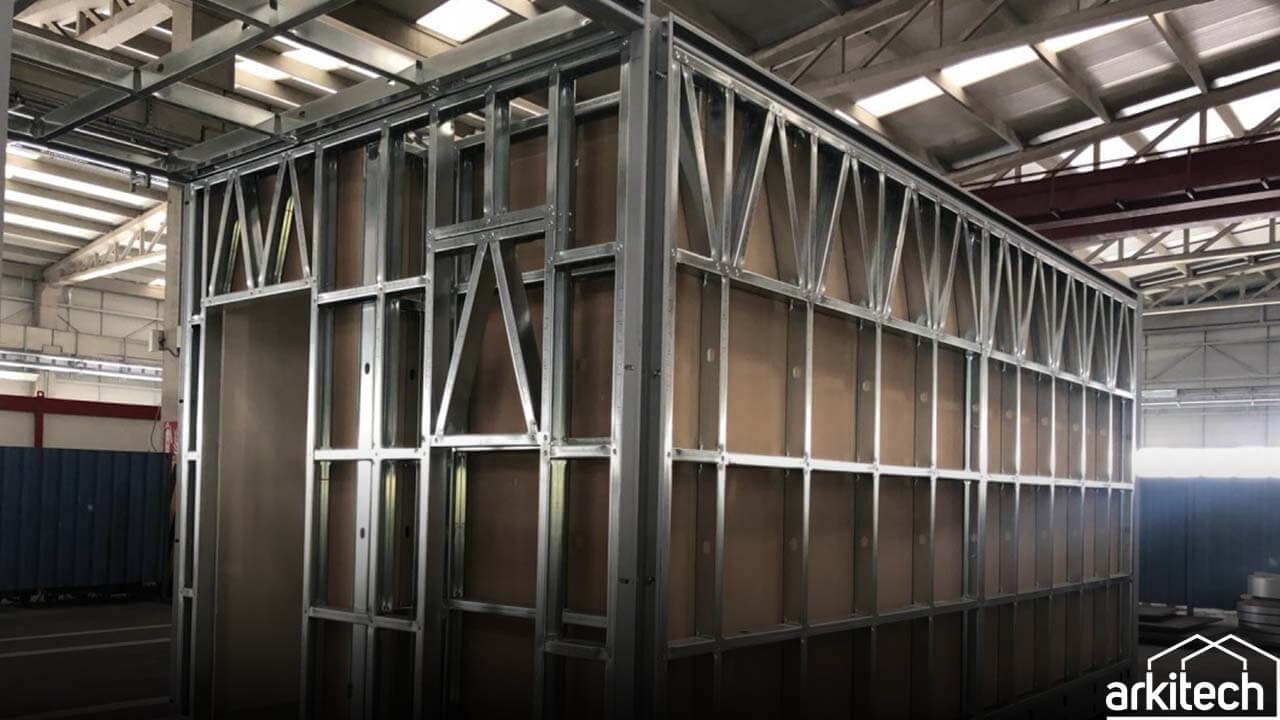
Cold-formed steel (CFS) framing combines the precision of off-site manufacturing with steel’s recyclability to reduce construction waste.
Material Quantities: Embodied Carbon Requires a Whole-Building View
The buildings and construction sector produces about 37% of global energy-related and process-related carbon dioxide emissions. Arkitech cites that figure from the United Nations Environment Programme.
“UNEP projects that as buildings become more energy efficient, operational emissions will fall from roughly 75% of the sector total toward 50%, pushing embodied carbon in materials into the foreground,” the Arkitech article says.
That shift puts greater scrutiny on concrete, steel, insulation and other construction products. It also changes how project teams compare framing systems. Arkitech cautions against comparing framing materials solely by carbon emissions per unit of weight. Such comparisons can overlook how much material a building actually requires.
Arkitech argues that teams should compare systems through whole-building life-cycle assessments. Those assessments can consider material quantities, structural requirements and related building components. Arkitech also notes that lighter structures such as cold-formed steel framing can reduce foundation loads.
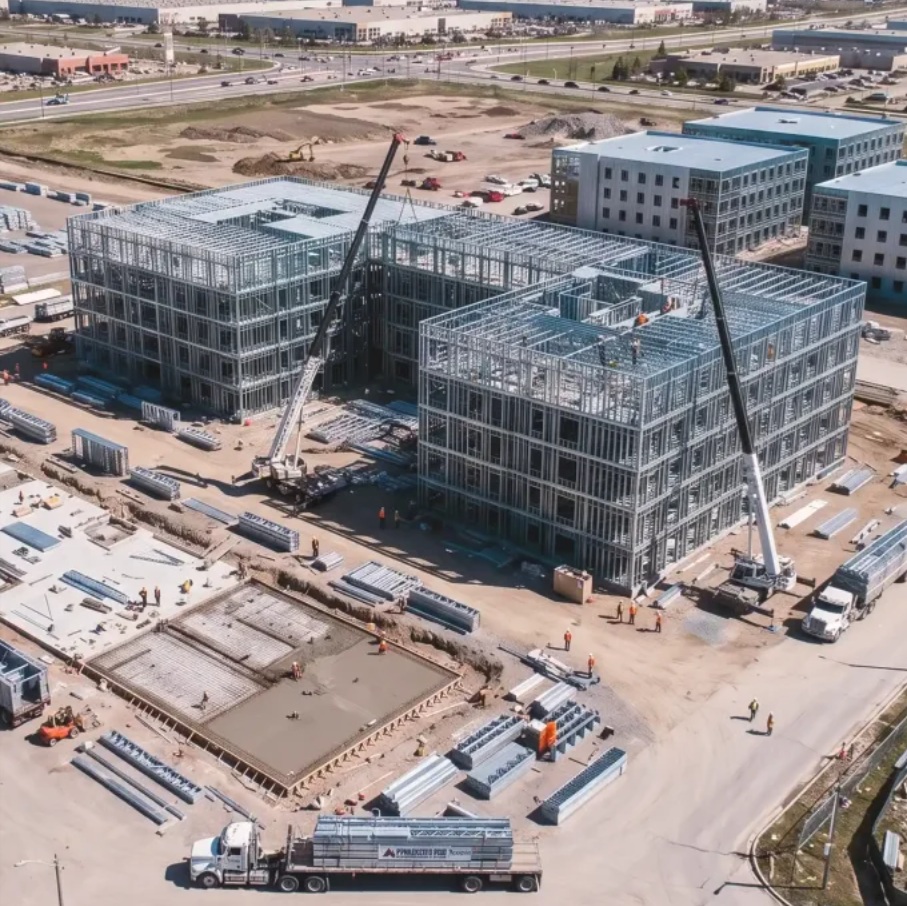
Cold-formed steel (CFS) framing can support whole-building life-cycle performance by reducing material weight and foundation loads while meeting structural requirements.
Steel Brings Circularity Into the Equation
Steel’s ability to return to the material stream strengthens its sustainability case. Arkitech calls circularity one of cold-formed steel’s strongest environmental attributes. Steel can undergo repeated recycling without losing its structural properties.
Still, Arkitech warns against using structural steel recycling rates for CFS framing. The distinction matters because different steel products have different recovery rates.
Arkitech cites an American Institute of Steel Construction report saying “around 98% of structural steel is recovered and recycled at the end of a building’s life.” The report says that recovery rate exceeds those of many competing structural materials.
BuildSteel reported a 74% recycling rate for steel used in general construction, based on a 2021 American Iron and Steel Institute report. That category includes cold-formed steel stud scrap.
Steel connections can also support disassembly and reuse. Arkitech notes that crews typically screw and bolt steel framing together. This approach can allow crews to dismantle components and potentially reuse some of them directly. Arkitech also cites research showing environmental benefits when life-cycle assessments account for easy disassembly.
Manufacturing: Off-Site Construction Can Reduce Waste
The sustainability case for CFS also extends into manufacturing. Cold-formed steel works well with digital design and automated production. Roll-forming equipment can form CFS components to precise dimensions before they reach the jobsite. That precision can reduce field cutting and material waste.
Arkitech cites research showing substantial waste reductions from modular and off-site construction.
- One study examined 59 building cases and found nearly 80% average waste reduction from modular construction
- Another analysis found modular methods reduced waste weight by as much as 83%
- Arkitech also cites studies reporting about 52% average waste reduction from prefabrication
Those figures describe modular and off-site construction broadly, not CFS framing alone. Even so, cold-formed steel “enables these highly controlled off-site workflows and can therefore participate directly in the waste reductions they deliver,” the Arkitech article says.
The connection between design and manufacturing matters to Arkitech’s own technology. Its systems connect structural design information with automated roll-forming equipment. The goal is to carry design data directly into manufacturing and preserve material efficiency from design through production.
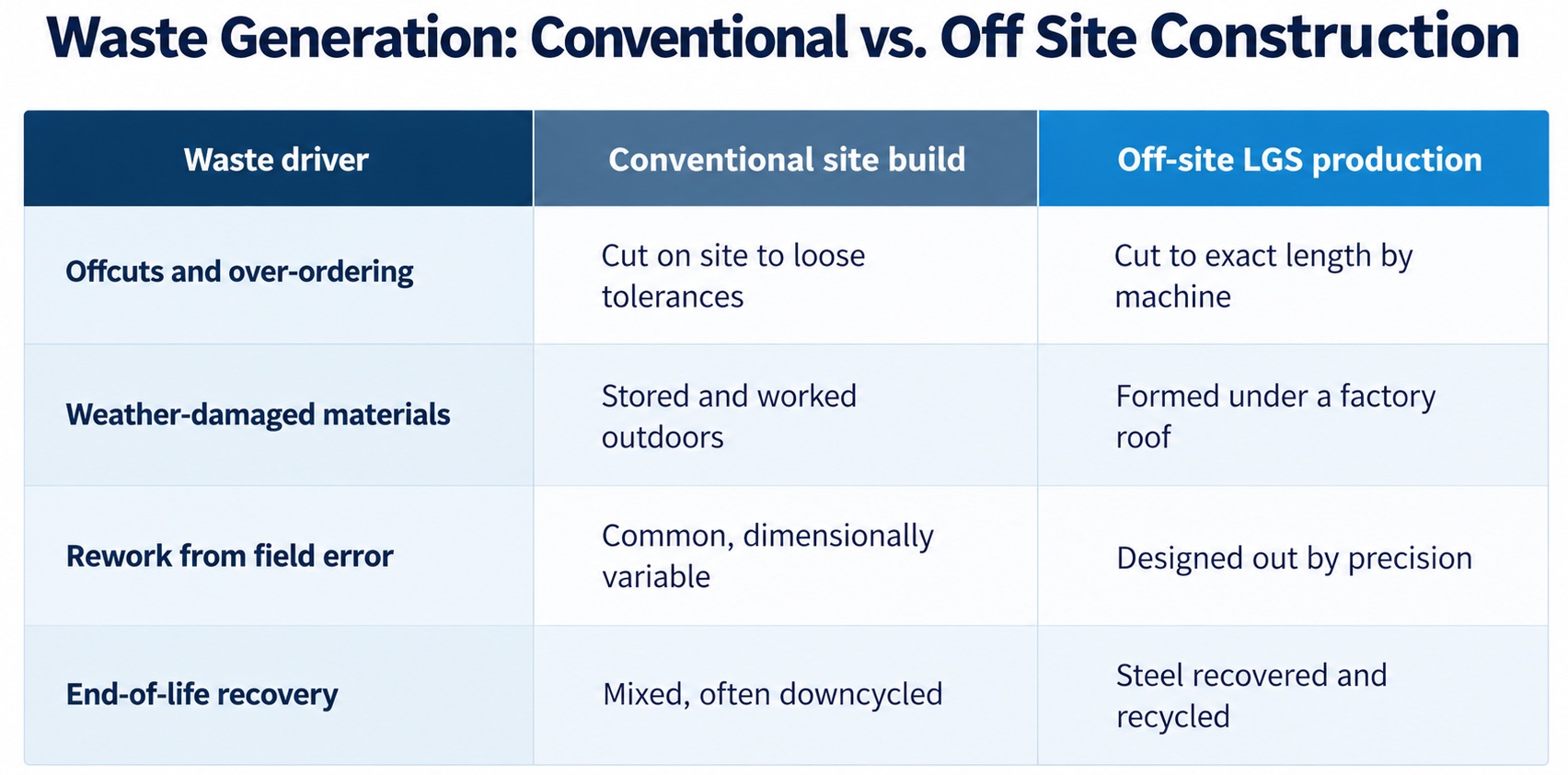
Sources: Arkitech; ASCE Journal of Management in Engineering (2024); Buildings (MDPI); AISC.
EPDs Put Numbers Behind the Claims
Environmental Product Declarations give project teams another way to measure material impacts. EPDs provide standardized environmental information based on life-cycle assessment. Arkitech identifies EPDs as a core tool for material transparency and sustainability reporting.
SFIA released a new industry-average EPD for CFS framing in August 2026. UL Solutions certified the Type III declaration. It covers structural and nonstructural CFS framing products for walls, roofs, floors and ceilings. Twelve manufacturers contributed production data to the underlying life-cycle assessment.
The EPD reports cradle-to-gate impacts for life-cycle stages A1 through A3. Those stages cover raw materials, transportation to manufacturing facilities and CFS product manufacturing. The declaration uses one metric ton of CFS framing products as its declared unit. WAP Sustainability conducted the life-cycle assessment.
The EPD gives project teams industry-average environmental data for North American CFS framing. It can support life-cycle assessments and project sustainability documentation. It also moves the discussion from general environmental claims toward measurable information.
SFIA’s new industry-average EPD provides independently verified environmental impact data for cold-formed steel framing products.
SFIA EPD
The Steel Framing Industry Association (SFIA) Environmental Product Declaration for Cold-Formed Steel Framing (EPD) is a must-have tool for contractors, building owners, architects and others who strive to deliver advanced building designs that meet the latest LEED™ and other sustainable rating systems, programs and standards.
The SFIA EPD for CFS Framing can be seamlessly integrated into project specifications as an option with company-specific EPDs. SFIA offers a Specifications Review Service for steel framing, which is a completely free checkup.
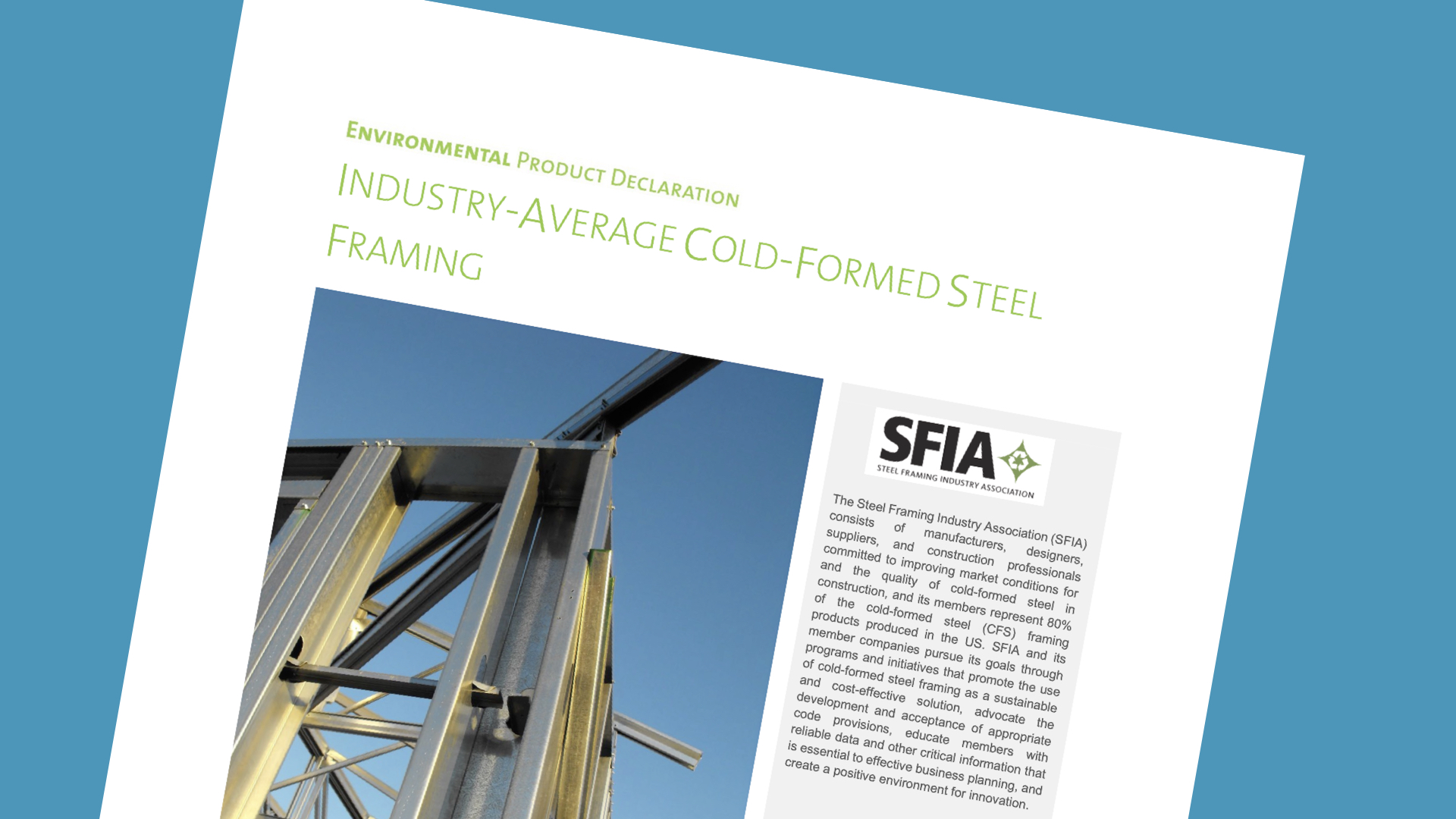
From Sustainability Claims to Measurable Performance
Arkitech’s analysis ultimately makes a qualified case for CFS framing. Steel offers strong recyclability, while off-site manufacturing can reduce material waste. But project teams still need to evaluate those advantages within the context of the complete building.
Whole-building life-cycle assessments, recycling data and EPDs give project teams tools to make those evaluations. They can quantify environmental impacts and put material claims into the context of actual building systems.
That may represent the larger sustainability opportunity for CFS framing. As owners and designers demand greater environmental accountability, broad claims will carry less weight. The sustainability case will increasingly depend on showing the numbers behind the claims.
Additional Resources
- SFIA Releases New Industry-Average Environmental Product Declaration for Cold-Formed Steel Framing
- Arkitech Highlights Manufacturing Trends Shaping Cold-Formed Steel Production
- 10 Reasons to Frame Your Next Project with Steel