
Once associated mainly with commercial construction, cold-formed steel (CFS) framing continues gaining ground in homes across the country.
In coastal Florida, builders use CFS to strengthen homes against hurricanes and extreme winds. In California, noncombustible steel adds fire resilience in wildfire-prone communities. In Hawaii, steel frames 70% of single-family homes because of its termite resistance and long-term durability.
Still, questions remain about building with steel instead of wood.
The article “Steel-Framed Homes: Your FAQs, Answered,” from Steel Framing Industry Association (SFIA) member ClarkDietrich, addresses 8 of those common questions. Here is a look at the answers and the performance benefits behind them.
Questions About Cost, Comfort and Resilience
1. Does steel framing cost more than wood?
Not always. Initial steel costs are comparable with wood, sometimes slightly higher, depending on regional market conditions.
With steel framing, however, bear this in mind:
- No termite treatment is required for steel
- Due to its dimensional stability, steel doesn’t warp, twist or shrink the way lumber can as it dries and settles
- Less movement can reduce drywall cracking, air leakage and related maintenance
- Precise manufacturing and prefabrication can reduce waste and improve consistency
Over a home’s lifecycle, these advantages can strengthen steel’s overall value and help offset any higher initial costs.
Related Resource: The True Cost of Cold-Formed Steel v. Wood Framing
2. How do you hang pictures or shelves on steel studs?
Homeowners can hang common items on steel-framed walls using familiar methods.
Lightweight objects can attach directly to drywall. Heavier objects can connect to steel studs using appropriate screws instead of nails. A strong magnet can also help locate steel studs behind drywall.
Steel framing does not limit normal decorating, shelving or storage options.
3. Will a steel-framed home feel cold, sterile or echoey?
No. The framing material does not determine a home’s comfort, warmth or acoustics. Insulation, drywall, flooring and interior finishes shape how a home feels and sounds.
When properly designed, CFS framed wall assemblies can insulate as effectively as wood-framed assemblies. They also accommodate standard batt insulation, sound-dampening materials and familiar interior finishes.
Homeowners can achieve the same comfort and character while gaining steel’s strength and durability behind the walls.
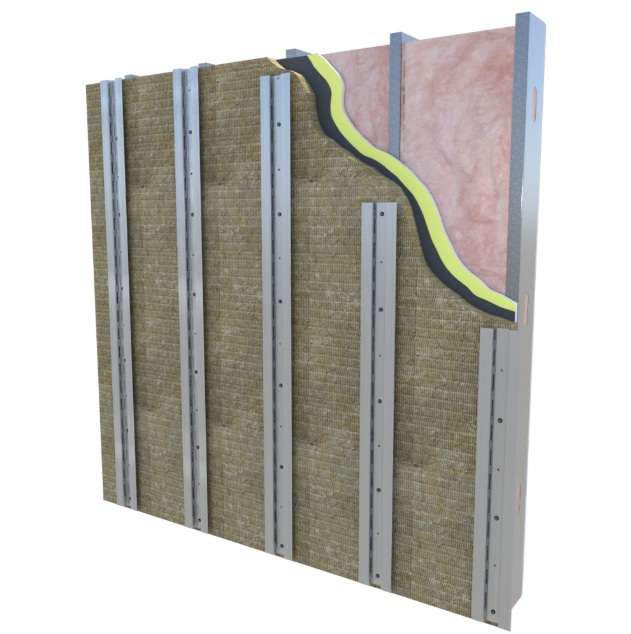
ProChannel Ci Vertical Cladding Support System is a thermally and structurally efficient exterior wall cladding support system utilizing the self-sealing Grip-Deck TubeSeal® fastening system from TruFast Walls.
4. How does steel framing perform during severe weather, fires or earthquakes?
Much better than wood. Steel framing offers strong resilience against many of the environmental threats homes face across the country.
Hurricanes: In hurricane-prone regions, engineers can design CFS framed homes to withstand wind speeds up to 190 mph. Designs include certified Category 5 hurricane protection.
Earthquakes: In earthquake zones, steel framing can flex and absorb force without snapping. Engineers can design steel systems for demanding seismic conditions, including Seismic Design Category E, which is reserved for structures near major, active faults.
Fire: Steel also tops wood for fire resilience. Steel does not contribute fuel to a fire as does wood. Properly designed assemblies can achieve fire ratings of up to four hours.
“This is especially noteworthy for wildfire-prone regions, where connective fuels (the flammable materials that let fire jump from point to point) are one of the biggest risk factors homes face,” the ClarkDietrich article says.
Across wind, fire and seismic risks, steel gives builders a durable framing system engineered for demanding conditions.
Related Resource: eBook – Strength in the Face of Disaster: How Cold-Formed Steel Framing Keeps Buildings Safe
How Cold-Formed Steel (CFS) Contributes to Resiliency
- CFS is highly ductile. CFS can easily bend or stretch without breaking when force is applied. This gives it a higher degree of resistance to lateral loads, uplift and gravity loading, such as those imposed on a structure by seismic or high wind events.
- CFS is non-combustible. According to the Steel Framing Industry Association, tests conforming to ASTM E119 show that both load-bearing and non-load-bearing CFS-framed assemblies remain fireproof for up to four hours.
- CFS is durable. CFS is corrosion resistant. It does not retain moisture and will not harbor mold growth. CFS uses zinc or similar coatings to boost durability. It resists corrosion for hundreds of years before its protective layer breaks down.
- CFS is impervious to pests. CFS is one of the few building materials completely impervious to termites and other pests in any climate or building type.
- CFS is a highly sustainable material. Steel framing contains on average a minimum of 25% recycled content and is 100% recyclable at the end of its life.
Questions About Insurance, Construction and Sustainability
5. Will homeowner’s insurance cost more with steel framing?
Steel can actually save money on builder’s risk insurance. Steel framing supports insurance savings because it is noncombustible and resists severe weather.
- Builder’s risk insurance savings for commercial projects can reach up to 75%, depending on location, building type and insurer policies
- The underlying logic extends to homeowners too
Some insurers offer discounts for homes with noncombustible or wind-resistant construction.
In wildfire-prone regions,discounted insurance rates for steel framing may also depend on landscaping, use of fire-resistent exterior materials and neighboring properties.
Ask insurers about discounts tied to fire-resistant and wind-resistant construction. Steel framing may help reduce risk and insurance premiums.
Related Resource: Insurance Costs Are Re-Shaping Construction Choices — And the Data Speaks for Itself
Surge in Fires: The Case for Steel Framing
Download this free article brief exploring the rise of fires in mid-rise wood construction across the U.S., highlighting incidents in California and Texas.
The report outlines the key advantages of steel framing as a noncombustible alternative to significantly reduce fire hazards.

6. Will steel framing limit siding choices?
Steel framing works with standard residential exterior materials. Builders can use stucco, fiber cement, brick veneer, vinyl, wood siding or stone.
Using noncombustible cladding can also strengthen overall fire resilience.
7. Does steel framing take longer to build?
Not necessarily. Construction speed often depends on contractor experience and the framing system selected.
CFS can arrive in stock lengths, custom-cut components, panelized assemblies or fully prefabricated systems. Prefabrication moves more work into controlled manufacturing environments. That can reduce field cutting, material handling and jobsite assembly time.
Steel framing is also lightweight, which can make components easier for crews to handle and position. Pre-engineered systems can improve dimensional accuracy, reduce waste and support more predictable installation.
As more contractors gain experience with CFS, these advantages can help accelerate construction and improve jobsite efficiency.
Related Resource: 5 Reasons Why Cold-Formed Steel Can Save Time and Money on Projects
8. Is steel more sustainable than wood?
Yes. Steel offers several sustainability advantages across a building’s lifecycle.
CFS framing contains recycled content and remains fully recyclable at the end of its useful life.
- Steel framing contains at least 25% recycled steel
- Steel can be recycled repeatedly without degrading its performance
- Steel framing scrap do not enter landfills
Precision manufacturing and prefabrication can further reduce construction waste by producing components closer to their required dimensions.
The industry is also reducing embodied carbon. ClarkDietrich, for example, offers framing products with up to 30% less embodied carbon than standard counterparts.
These benefits give builders more options to reduce material waste and lifecycle impacts while maintaining steel’s strength and durability.
Related Resource: 5 Ways to Sell the Sustainable Benefits of Cold-Formed Steel Framing
The Steel Framing Advantage
Cold-formed steel (CFS) leads the way as the preferred framing material for prefabricated structures for multiple reasons. CFS is:
- A pre-engineered material that can be cut to exact lengths
- Dimensionally stable and does not expand or contract with changes in moisture content
- Lightweight compared to wood and concrete
- Resilient and will not warp, split, crack or creep when exposed to the elements
- Sustainable and 100% recyclable
- Durable and has a high tensile strength
- Non-combustible and is a safeguard against fire accidents
A Stronger Case for Steel
Residential home framing must perform for decades after construction crews leave the site. That makes durability, resilience and lifecycle performance critical considerations.
The answers to the 8 questions above point toward a consistent conclusion. Steel resists termites, dimensional movement and combustion. Engineers can also design steel framing for demanding wind and seismic loads.
For builders and homeowners focused on long-term performance, CFS framing deserves a closer look. Steel represents a solid investment for the long run.
Additional Resources
- Fire Changes Everything: Why Cold-Formed Steel Is Reshaping Housing Construction
- Steel Stands Firm as Termites Threaten Homes, Real Estate Agents Say
- Homebuilders Embrace Steel as an Alternative to Wood Framing