
Images provided by The Steel Network.
Cold-formed steel (CFS) has become a cornerstone of modern structural framing. Despite a long history of reliable performance, misconceptions about load-bearing CFS remain. To help set the record straight, The Steel Network, a member of the Steel Framing Industry Association (SFIA), developed a list of the five most common myths surrounding load-bearing steel studs. Here’s a look at each myth—and the facts that prove otherwise.
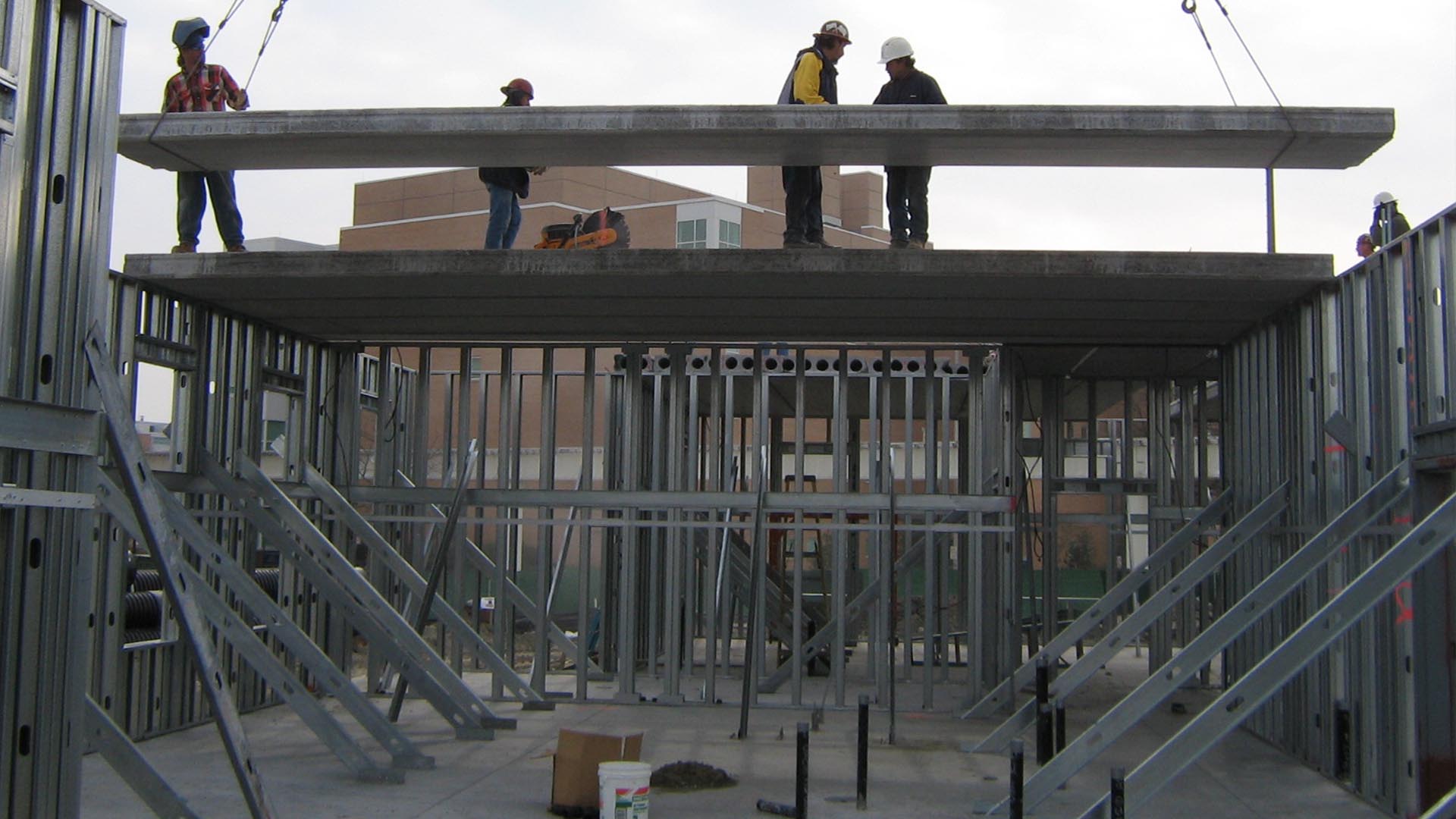
Old Dominion University’s Quad Housing, originally designed with concrete block, was redesigned using load-bearing cold-formed steel. The Steel Network’s SigmaStud® provided a faster, cost-effective solution.
5 Myths About Load-Bearing Cold-Formed Steel (CFS) Studs
Myth 1: Steel framing is too complex to design
- Fact: Modern design software and readily available load tables simplify steel design. In many cases, steel framing reduces RFIs and streamlines coordination
Myth 2: Steel is more expensive than wood
- Fact: While upfront material costs may be higher, steel’s strength, speed of installation, and reduced labor often lead to a lower total installed cost
Cost of Steel v. Wood
A recent study sponsored by the Steel Framing Industry Association (SFIA), “Costs to Build with Cold-Formed Steel Versus a Wood-Framed Building,” addresses framing costs on behalf of architects, building owners, and general contractors.
While the research was completed before the current spike in wood prices, “Costs to Build” establishes that CFS framing and wood framing costs in mid-rise structures are essentially the same, when construction insurance premiums associated with using the selected material are included.
Myth 3: Steel framing causes sound issues between units
- Fact: Proper detailing with resilient channels, clips, and insulation can effectively control sound and meet IIC and STC standards
Myth 4: Steel is difficult to work with on site
- Fact: CFS is engineered for efficiency, with consistent sizing, pre-punched holes, labeled parts and no need for acclimation or drying
Myth 5: Steel is prone to corrosion
- Fact: Galvanized steel offers built-in corrosion resistance. With proper detailing, corrosion risk is minimal even in coastal or high-humidity environments
Read the full article from The Steel Network.
The Steel Framing Advantage
Cold-formed steel (CFS) leads the way as the preferred framing material for prefabricated structures for multiple reasons. CFS is:
- A pre-engineered material that can be cut to exact lengths
- Dimensionally stable and does not expand or contract with changes in moisture content
- Lightweight compared to wood and concrete
- Resilient and will not warp, split, crack or creep when exposed to the elements
- Sustainable and 100% recyclable
- Durable and has a high tensile strength
- Non-combustible and is a safeguard against fire accidents
Additional Resources
- A Comprehensive Guide to Steel Framing
- Myth Versus Reality: Revealing the Curtain Wall Capabilities of Modern Steel
- Dispelling the Myths of Using Cold-Formed Steel as a Structural Material