
The development of two major building materials in the early 20th century — steel framing and gypsum panels — “marked a major departure from typical practices that dated back hundreds and thousands of years,” says Larry Williams, former executive director of the Steel Framing Industry Association (SFIA), in a Walls & Ceilings column.
The first innovation, the use of cold-formed steel (CFS) framing, was “most likely to mimic dimensioned wood studs,” says Williams in his column. It was followed by the use of “paper-faced gypsum panels to replace lath and plaster, a time-consuming craft that required skilled artisans.”
How has CFS framing evolved over the past 100 years? Williams offered insight on the significant transformations that occurred, driven by technological advancements, in his column, “Steel Framing Through the Years.”

Larry Williams, former SFIA executive director.
1920s: Cold-Formed Steel (CFS) in Construction
CFS has a history dating back to the early 20th century. Its first documented use as a building material was in the Virginia Baptist Hospital, built around 1925 in Lynchburg, Virginia.
However, CFS studs and track gained significant attention in 1933 at the Chicago World’s Fair, where it was showcased for its potential for “quick assembly to permit the building of staunch structures,” Williams says.
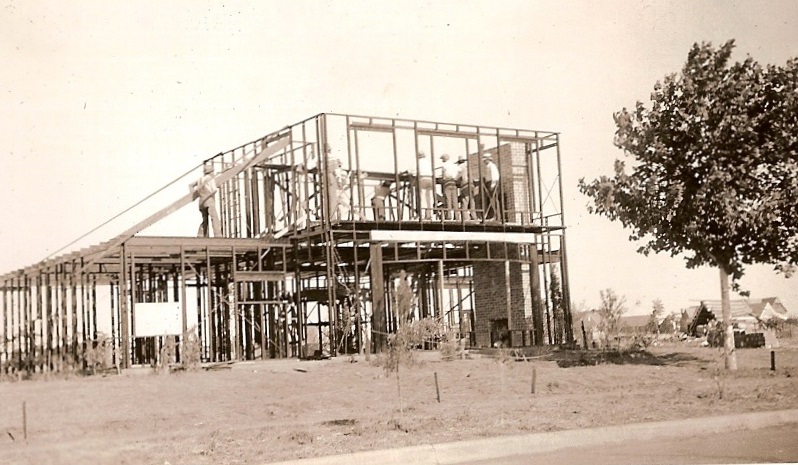
Cold-formed steel (CFS) framing made its grand debut in 1933 at the Chicago Century of Progress Exposition (World’s Fair). The Good Housekeeping/Stran-Steel House “Home of the Future” was completely framed with steel.
Despite early publicity and post-World War II demand for housing, CFS studs and track faced a number of constraints that sharply limited adoption.
“The difficulty in obtaining cold-formed [steel] studs and accessories and a total lack of any design, manufacturing or installation standards,” Williams says, “limited its use.”
Nonetheless, initiatives like Lustron Corp.’s mass production of CFS homes in the late 1940s and early 1950s introduced the concept of prefabrication, setting the stage for future innovations in construction.
1950s and ’60s: New Applications
Noncombustible CFS gained significant traction in nonresidential construction in the United States during the 1950s and 1960s, particularly for taller buildings, where safety and constructability were primary concerns. The combination of steel framing with drywall became standard practice during this time, offering efficient solutions for interior walls and ceilings.
Technological advancements in the 1950s, such as self-drilling screws and wire ties, made CFS easier and faster to use.
“The parallel development of tools to drive the screws made CFS even more attractive, and steel-framing manufacturers and suppliers began to pop up across North America,” Williams says.
In the 1960s, CFS found new applications in systems like curtain walls, exterior framing with brick veneer, and interior shaft walls.
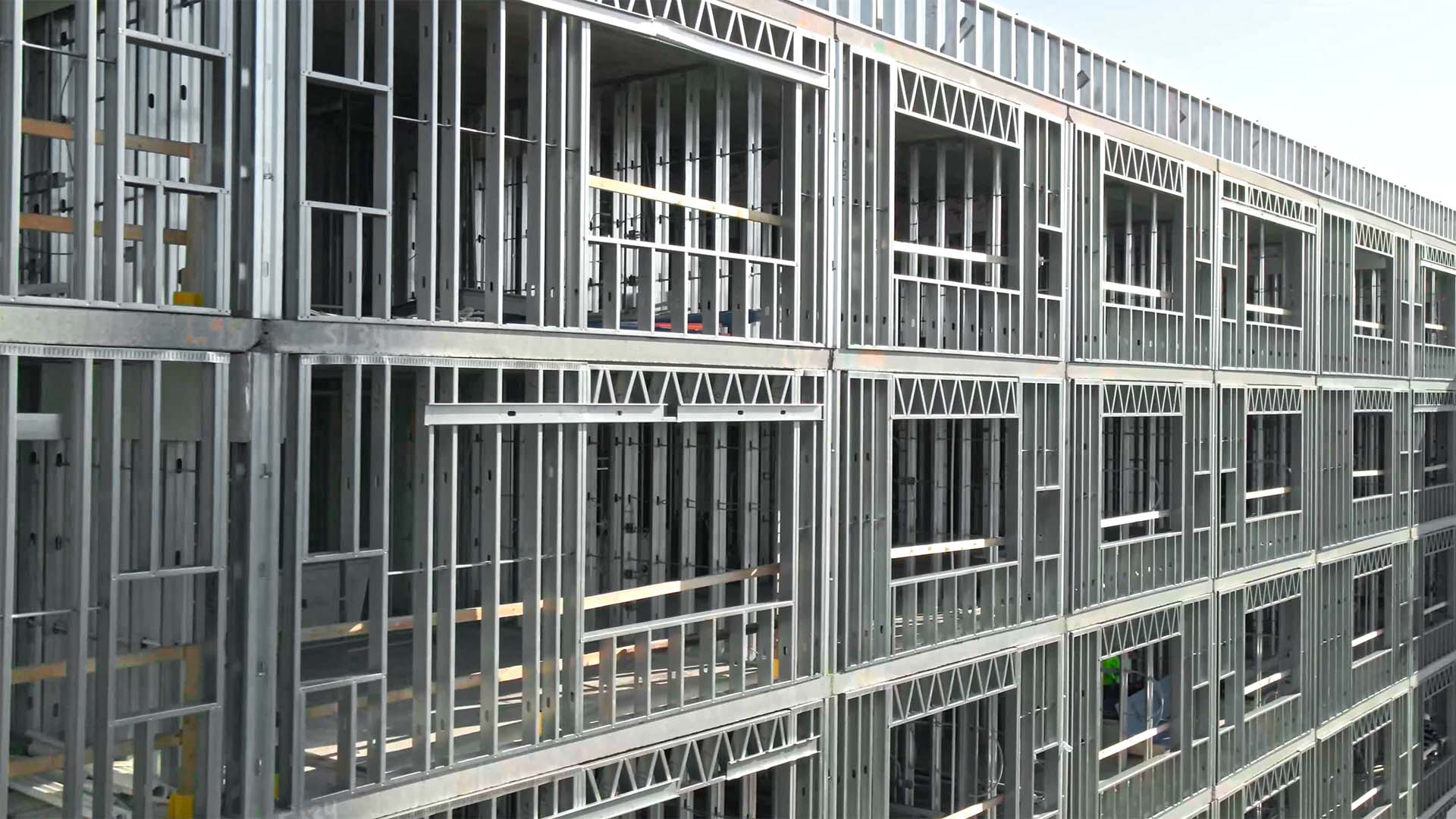
SFIA member the Steel Network supplied load-bearing cold-formed steel (CFS) framing for the construction of the Element by Weston Hotel in Chattanooga, Tennessee, saving 3 months of construction time.
Initially, CFS was primarily used in non-structural applications like partition walls. However, by 2011, there was a significant shift towards using CFS in load-bearing locations, exterior walls, floors and roofs, indicating its growing acceptance and utilization in structural applications as well.
Today: CFS in Offsite Construction, Sustainable Design
The wall and ceiling industry has seen significant evolution in recent decades due to advancements in materials, technology and building codes, with more innovations on the horizon.
“The need for faster and more efficient construction methods to meet the growing demand for housing and infrastructure fueled the growth of off-site construction and prefabricated panels,” Williams writes.
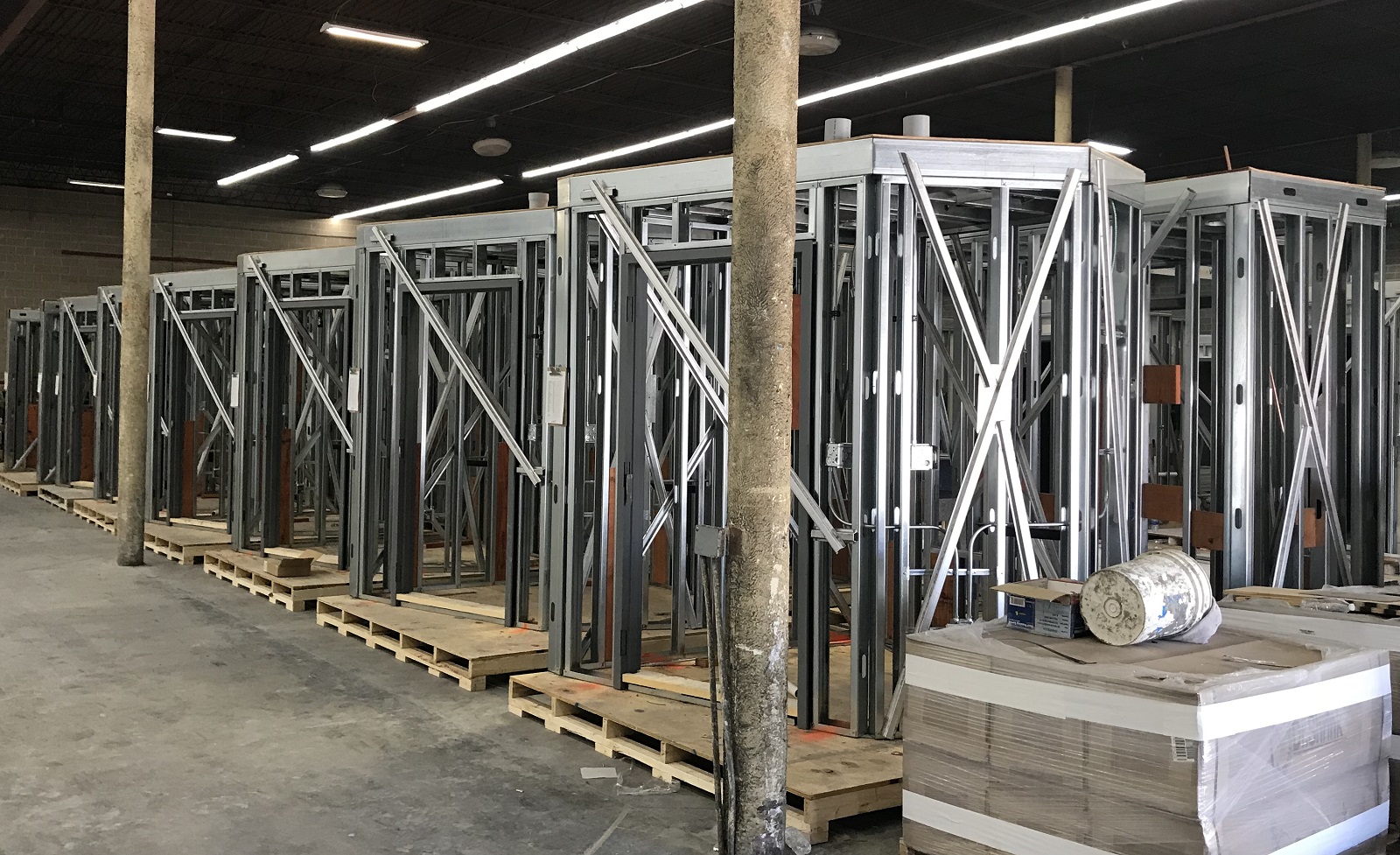
SFIA member T.J. Wies Contracting prefabricated and installed 294 modular bathroom PODs for the $550 million SSM Health Saint Louis University Hospital, reducing costs while increasing speed to occupancy for the project.
Technology like computer-aided design and robotics made offsite construction more feasible for complex designs, ensuring higher quality and reducing errors.
Modern building designs now include various architectural features, acoustical considerations, and energy efficiency requirements, with a focus on sustainable practices.
“Prefabricated panelized construction aligns with these goals,” said Williams. “The off-site manufacturing process generates less construction waste and allows for better management of materials.”
Tomorrow: Labor Shortages, More Innovation
“One of the greatest challenges in the construction industry today is the persistent shortage of labor,” Williams says.
In a recent survey by the Associated General Contractors, 88 percent of construction firms reported having difficulty in filling positions, and 61 percent said this is causing project delays.
Despite these challenges, the wall and ceiling industry continues to transform, driven by technological advancements, changing practices and evolving architectural trends.
Additional Resources
- SFIA: Setting the Bar for Quality
- Prefabrication with Steel Framing: Centuries in the Making
- A History of Cold-Formed Steel