
Featured image, “Resilient channels” inset, courtesy of Gypsum Association, GA 600
Resilient channels, often used in construction to reduce sound transmission between rooms and floors, can present a challenge when it comes to hanging wall cabinets.
The Steel Framing Industry Association (SFIA) guide, Four Frequently Asked Questions about Cold-Formed Steel (CFS) Resilient Channels (RC101-24)*, prepared by Robert Grupe, SFIA general manager, architectural services, asks and answers this question: How do you go about hanging wall cabinets off resilient channels?
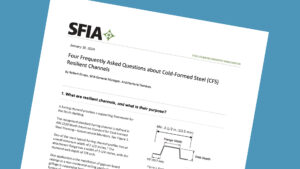
Hanging Wall Cabinets Off Resilient Channels
Resilient channels should be able to accommodate common wall cabinets. At the very least, additional channels must be installed to accommodate those cabinets that are meant to be mounted on the wall.
However, an analysis should be done to assure that the resilient channel has the capacity to carry the induced load. The following are considerations to review:
1. Channel Capacity
Does the channel itself have the capacity to transfer the load back to framing?
2. Fastener Capacity
Does the fastener(s) (shear and pullout) have the capacity to transfer that same load?
- Fastener that attaches cabinet to channels.
- Fastener that attaches channels to the framing.
3. Framing Capacity
Does the framing have the capacity to transfer load back to structure?
Observe These Referenced Standards
- AISI S220 North American Standard for Cold-Formed Steel Framing—Nonstructural Members
- ASTM C11 Standard Terminology Related to Gypsum and Related Building Materials and Systems
- ASTM C754 Standard Specification for Installation of Steel Framing to Receive Screw-Attached Gypsum Panel
- ASTM C840 Standard Specification for Application and Finishing of Gypsum Board
- ASTM C954 Specification for Steel Drill Screws for the application of Gypsum Panel Products or Metal Plaster Bases to Steel Studs from 0.033 in. (0.84 mm) to 0.112 in. (2.84 mm) in Thickness
- ASTM C1002 Standard Specification for Steel Self- Piercing Tapping Screws for Application of Gypsum Panel Products or Metal Plaster Bases to Wood Studs or Steel Studs
- GA 600 Fire Resistance and Sound Design Manual
Download the the SFIA guide, Four Frequently Asked Questions about Cold-Formed Steel (CFS) Resilient Channels (RC101-24), for a complete set of questions and answers on the subject of resilient channels.
Robert Grupe, SFIA General Manager, Architectural Services
Robert Grupe
SFIA General Manager, Architectural ServicesRobert Grupe is general manager, architectural services at the Steel Framing Industry Association (SFIA), managing the SFIA’s Architectural Services Team nationwide. Grupe is a 40-year-plus industry veteran and popular seminar and webinar presenter. He spent over 38 years with United States Gypsum Company in various technical and management positions, including product and system design and technical consultation to the AEC community.

Steel Framing Industry Association
The Steel Framing Industry Association (SFIA) provides its members with exclusive access to technical cold-formed steel (CFS) framing services, including the SFIA Steel Framing Learning Portal. SFIA member services include access to market data, market analysis, technical design guides, architectural services, environmental product declarations, CFS certification, the SFIA Awards and more.
Additional Resources
- SFIA Releases Guide to the Performance-Based Nonstructural Partition Selection of Metal Framing
- Sorting Apples from Oranges — Comparing Evaluation Services with Third-Party Certification
- SFIA Releases Updated Technical Guide with the Most Up-to-Date CFS Load and Span Tables in the Industry
- 5 Need-to-Knows about Building Codes and Cold-Formed Steel
* SFIA RC101-24 is intended as a general guide. The Steel Framing Industry Association has tried to ensure the accuracy of the information and makes no representation, warranty or guarantee, and expressly disclaims any liability or responsibility for failure resulting from use of this information. SFIA Certified products should only be used with an independent evaluation by a qualified engineer or architect to verify suitability.