
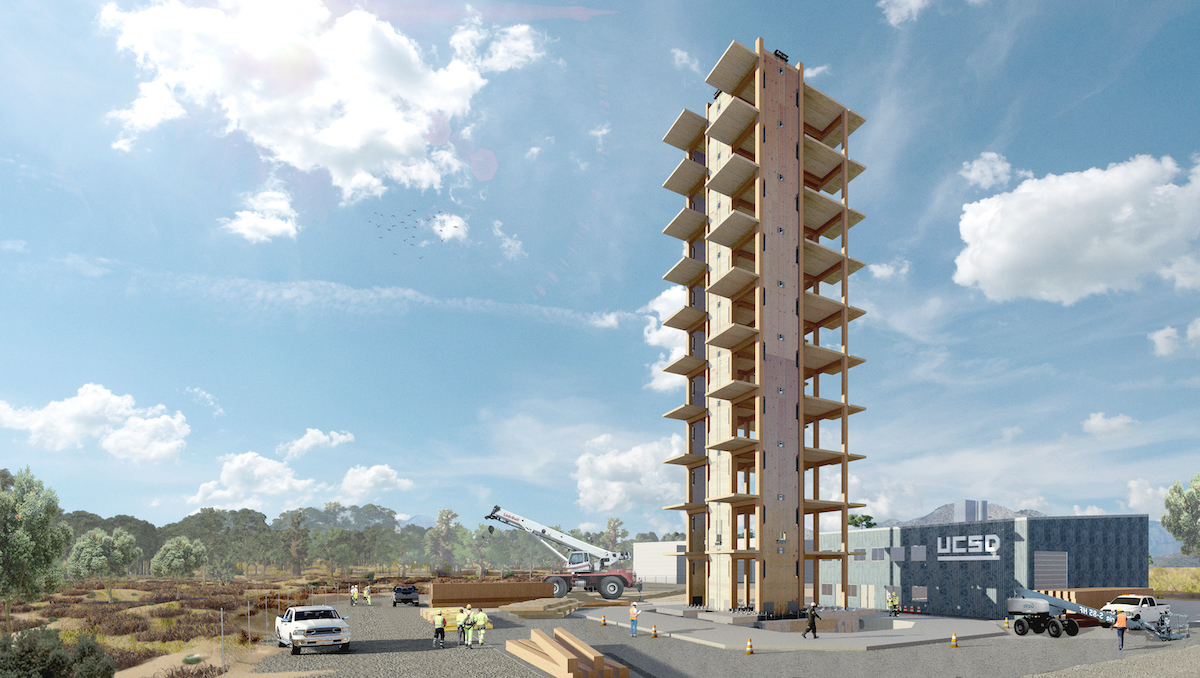
Featured Image: The 10-story NHERI Tallwood, featuring cross-laminated timber and cold-formed steel (CFS), was tested for seismic safety on May 9, 2023. Courtesy UC San Diego Jacobs School of Engineering
A 10-story building made of cross-laminated timber and cold-formed steel (CFS) interior framing was recently tested on one of the world’s largest earthquake simulators at the University of California San Diego as part of a media day event.
The Natural Hazards Engineering Research Infrastructure (NHERI) Tallwood project is the tallest full-scale building ever to be constructed and tested on an earthquake simulator or shake table.
BuildSteel has reported on the NHERI Tallwood project’s wall systems design and features, which include interior nonstructural steel stud framing and steel connectors.
The tallest full-scale building ever built on an earthquake simulator was tested May 9, 2023.
6.7 and 7.7 Magnitude Simulations
The test occurred May 9, 2023, when the shake table simulated earthquake motions recorded during prior earthquakes covering a range of earthquake magnitudes on the Richter scale.
The building underwent two tests that are the equivalent of the …
- 6.7 magnitude 1994 Northridge earthquake that struck Los Angeles
- 7.7 magnitude 1999 Chi Chi earthquake that took place in Taiwan
The Steel Framing Industry Association (SFIA) is a NHERI Tallwood project design and construction partner. SFIA members CEMCO and Simpson Strong-Tie Co., Inc. are industrial partners on the project, supplying a variety of SFIA-certified CFS products such as metal studs and connectors.


The UC San Diego earthquake simulator is one of the two largest shake tables in the world. It has recently been upgraded to move in 3D with 6 degrees of freedom — longitudinal, lateral, vertical, roll, pitch and yaw.
The earthquake simulations were achieved by accelerating the table to at least 1g, which accelerated the top of the building to as much as 3gs. For reference, an average modern roller coaster produces 4gs of peak acceleration.
So Far, Tallwood Handled the ‘Earthquakes’
“What we can tell so far is that the building met its design expectations. There is no damage,” said Shiling Pei, principal investigator and associate professor of civil and environmental engineering at Colorado School of Mines, in an interview posted on YouTube. “I think it’s pretty fun to see a big building shake and dance back and forth.”

Professor Shiling Pei from the Colorado School of Mines is the principal investigator for the NHERI Tallwood project. Courtesy of Shiling Pei/Colorado School of Mines
The Tallwood building was built at full-scale, meaning that it is indeed 10 stories tall, topping off at 116 feet, or about 35.5 meters — roughly one–fifth of the height of the National Monument in Washington, D.C.
Due to this seismic movement induced by the rocking system, resilience-critical nonstructural components within and covering the building had a big ride.
Update: After three months of testing and more than 100 simulated earthquakes, one 10-story building has demonstrated the impressive seismic resilience of mass timber buildings.
Top 25 Newsmakers
In January 2024, Pei and his engineering team were recognized by Engineering News Record as one of the 2023 Top 25 Newsmakers.

“Ling had the most difficult position of all,” said Reid Zimmerman, a structural engineer on the NHERI team. “He led a large, diverse team, including six universities, to design, supply, fabricate and construct the tallest shake-table test in the world.”
Pei leveraged multiple funding sources and numerous supplier donations while building consensus.
Pei will be honored be honored at the Award of Excellence Gala on April 11, 2024 in New York City.
NHERI Tallwood on UC San Diego’s shake table. Courtesy LEVER Architecture
NHERI/UC San Diego Shake Table
The University of California San Diego shake table, located at the Englekirk Structural Engineering Center, can carry and shake structures weighing up to 2000 metric tons, or 4.5 million pounds–roughly the weight of 1300 sedan cars. This makes it the earthquake simulator capable of carrying the largest payload in the world. It’s also the only large-scale earthquake table in the world located outdoors.
The shake table is part of the Natural Hazards Engineering Research Infrastructure, or NHERI, network — eight experimental facilities supporting research for mitigating damage caused by earthquakes, tsunamis, landslides, wind storms, storm surge and flooding.
The shake table was recently upgraded thanks to $17 million in National Science Foundation funding. It is now able to reproduce the full 3D ground motions that occur during earthquakes, when the ground is moving in all six degrees of freedom — longitudinal, lateral, vertical, roll, pitch and yaw.

Additional Resources
- CEMCO and Simpson Strong-Tie Support NHERI 10-Story, Mass-Timber Building Shake Tests
- Recent Studies Confirm the Durability and Seismic Performance of Cold-Formed Steel Sheathing
- eBook: How Cold-Formed Steel Framing Keeps Buildings Safe