
The construction industry is notoriously slow when it comes to adopting new technologies. However, certain technologies, off-site construction processes and the growing use of cold-formed steel (CFS) are modernizing the industry.
“To minimize change orders, increase efficiency, improve their return on investment and enhance the quality of their projects, … designers have turned to several new trends and technologies,” says an article in Forbes. .
1. Prefabrication
The construction industry is struggling with a labor shortage, which has intensified since the 2008 economic recession. New Equipment Digest says about 2 million construction workers were let go in the United States following the recession, and the industry has still not fully recovered.
Faced with a reduced labor force, a growing number of architects and engineers are specifying prefabricated cold-formed steel (CFS) building components. CFS framing is the ideal choice for prefabricated construction because it is non-combustible, lightweight and can be cut to precise specifications.
An example is South Valley Prefab’s work at Catbird, a seven-story, 165-unit, extended-stay hotel in Denver, Colorado.
- South Valley Prefab prefabricated 277 individual CFS exterior finish panels a month prior to installation
- Only six installers were needed on site, whereas normally it would take up to 70 people to complete the panel installations
- The use of CFS eliminated 90 percent of on-site labor required by traditional construction practices
Steel Framing for Off-Site Construction
Cold-formed steel (CFS) is the preferred framing material for prefabricated structures for many reasons. CFS is:
- A pre-engineered material. CFS can be cut to exact lengths
- Dimensionally stable. CFS does not expand or contract with changes in moisture content
- Lightweight. Compared to wood and concrete, CFS framing can significantly lower the weight and cost of a structure
- Resilient. CFS will not warp, split, crack or creep when exposed to the elements
2. Sustainability
Many people worry about climate change and actively try to manage their own carbon footprints. The architect and engineering community mirrors this concern by adopting materials that offer environmentally-friendly construction solutions, says Forbes. Many turn to the most recycled material on the planet — steel.

Photo courtesy of U.S. Steel
Steel framing contains a minimum of 25% recycled steel and is continually and completely recyclable.
Recognized in all green building standards, CFS framing is recyclable, durable, requires less overall construction material and is dimensionally stable. The American Iron and Steel Industry reports:
- Steel framing contains a minimum of 25% recycled steel and is continually and completely recyclable — that is, “remade without any loss of quality”
- Most other construction products can only be down-cycled into lower-quality products
- While construction sites generate waste, steel framing minimizes site waste since steel can be recycled and, AISI says, “become tomorrow’s refrigerator, soup can or car door”
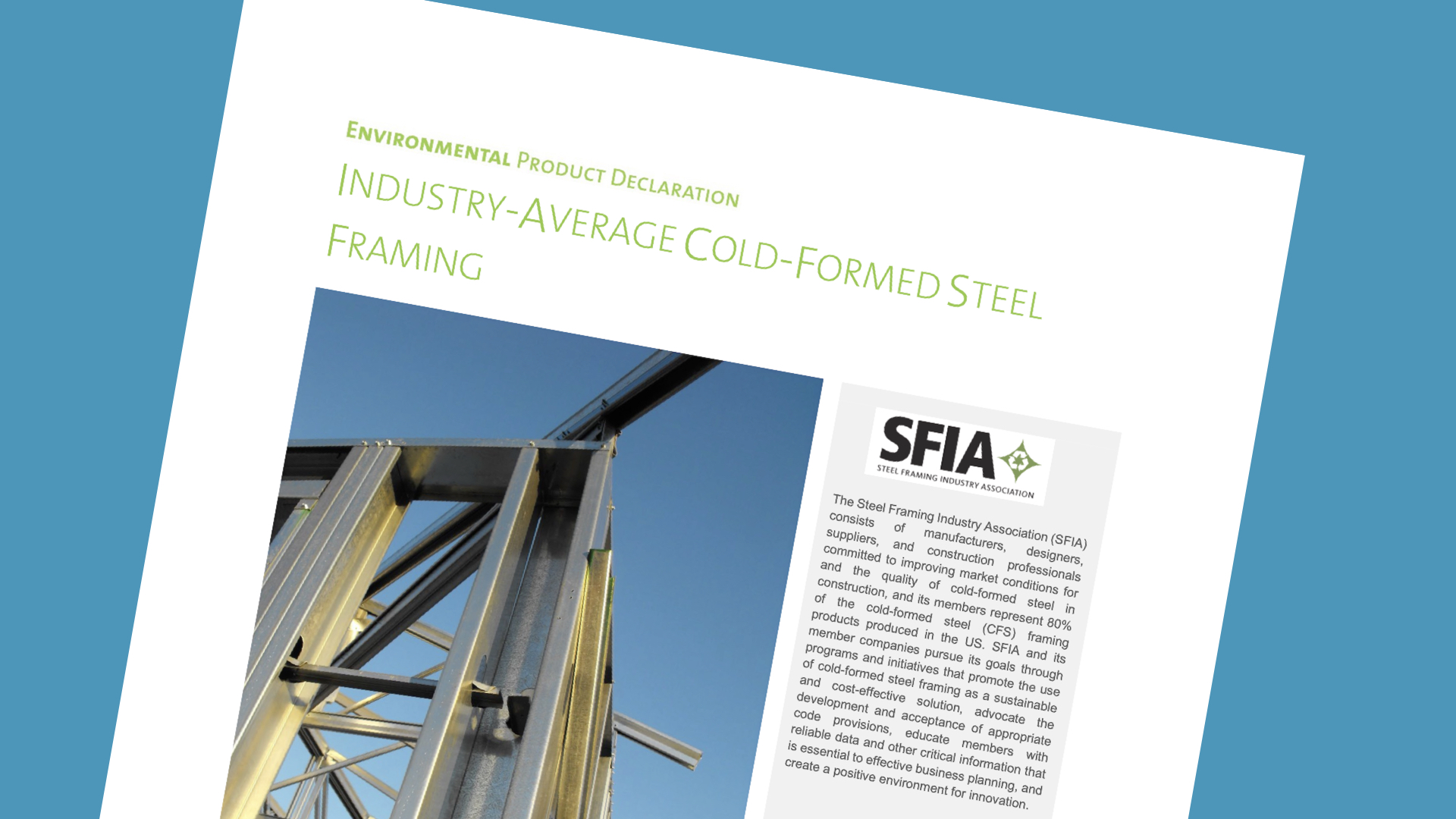
SFIA’s new industry-average EPD provides independently verified environmental impact data for cold-formed steel framing products.
SFIA EPD
The Steel Framing Industry Association (SFIA) Environmental Product Declaration for Cold-Formed Steel Framing (EPD) is a must-have tool for contractors, building owners, architects and others who strive to deliver advanced building designs that meet the latest LEED™ and other sustainable rating systems, programs and standards.
The SFIA EPD for CFS Framing can be seamlessly integrated into project specifications as an option with company-specific EPDs. SFIA offers a Specifications Review Service for steel framing, which is a completely free checkup.
3. Resiliency
Climate change is also driving the use of resilient and redundant systems, says Forbes. Climate change makes severe weather events much more likely, which increases the risk of flooding, earthquakes and wind damage.
Because CFS is a ductile material, it provides a high degree of resistance to lateral loads such as those imposed by seismic or high wind events. It also gives CFS framed wall and ceiling assemblies a higher resistance to uplift and gravity loading.
3 Reasons CFS Contributes to Resiliency
- CFS is highly ductile. CFS can easily bend or stretch without breaking when force is applied. This gives it a higher degree of resistance to lateral loads, uplift and gravity loading, such as those imposed on a structure by seismic or high wind events.
- CFS is non-combustible. According to the Steel Framing Industry Association (SFIA), both load-bearing and non-load-bearing CFS-framed assemblies are fireproof up to four hours when subjected to tests conforming to ASTM E119.
- CFS is durable. CFS is corrosion resistant. It does not retain moisture and will not harbor mold growth. CFS uses zinc or similar coatings to boost durability and will last hundreds of years before its corrosion resistance deteriorates.
The Steel Framing Industry Association (SFIA) has developed an issues paper, CFS and Resiliency, that relates resiliency to the inherent properties of steel framing.
The paper refers to the comprehensive definition for resiliency developed by the Department of Homeland Security in partnership with the National Institute of Building Science in High Performance Based Design for the Building Enclosure – A Resilience Application Project Report. The document also provides design guidelines for developing resilient exterior envelopes.
Free Assistance Adopting CFS Technology
According to Forbes, engineering organizations and owner-operators at the forefront in adopting technologies see improved results, while lowering construction costs, increasing job site safety and increasing their returns on investment.
Are you interested in embracing these trends by using CFS, but have questions or need support? BuildSteel offers free project assistance for building professionals in the U.S. and Canada:
- Consultation on code-compliant design of non-residential and multi-family structures
- Industry experts with decades of knowledge on CFS
- National network of manufacturers, suppliers and contractors (U.S. and Canada)
Submit your project or question.
Additional Resources
- Panels to Pods: Prefabricated Steel Building Components Expected to Grow
- EQ Metal Studs Help Designers Build Sustainable Structures
- 5 Reasons CFS Contributes to Building Resiliency