
The built environment generates 40% of annual global CO2 emissions, according to Architecture 2030. Of those total emissions, building operations are responsible for 27% annually, while building materials and construction, or embodied carbon, are responsible for an additional 13% annually.
Today, the steel industry has made the reduction of C02 emissions a priority by developing tools and resources for building professionals to develop projects that have a reduced carbon footprint.
In fact, the American steel industry is the cleanest and most energy efficient of the leading steel industries in the world, according to the American Iron and Steel Institute. Of the seven largest steel-producing countries, the U.S. has the lowest CO2 emissions per ton of steel produced and the lowest energy intensity.
Within the built environment, building owners and designers are turning to cold-formed steel (CFS) to develop sustainable projects. Steel is recognized in all major green building standards and rating programs, including the National Green Building Standard (ICC-700) for residential buildings, ASHRAE Standard 189.1 for commercial construction, and the U.S. Green Building Council’s LEED program, which covers all types of buildings.
Here are some of the tools building professionals can use to help reduce the carbon footprints of their projects:
Tool 1: EPDs for Steel Framing
The Environmental Product Declaration for Cold-Formed Steel (CFS) Framing — SCS-EPD-07103 (version Apr. 11, 2025) — is good through May 27, 2026.
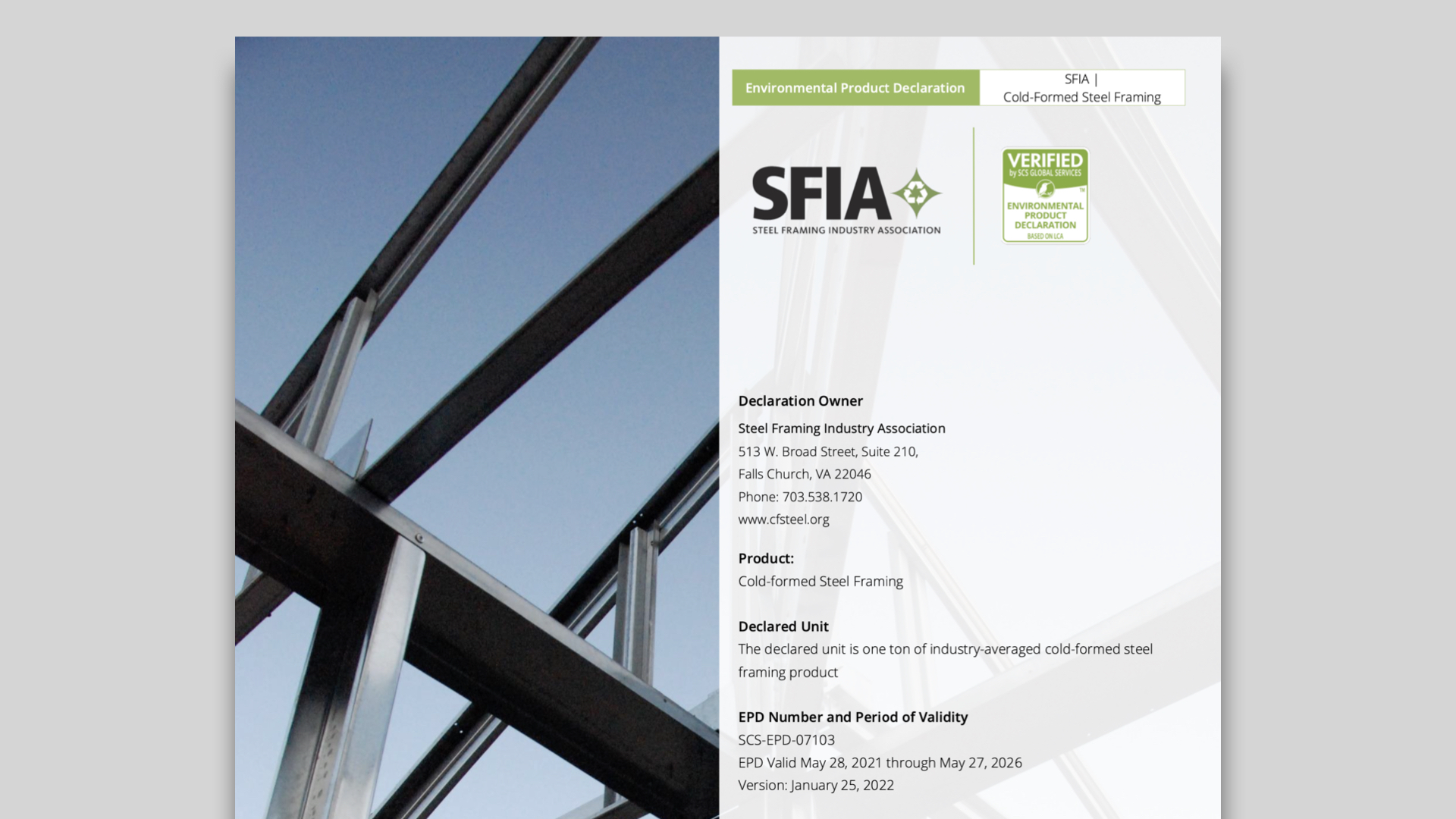
The Steel Framing Industry Association (SFIA) developed an Environmental Product Declaration for CFS framing, the latest tool for contractors, building owners, architects and others who strive to deliver advanced building designs that meet the latest LEED™ and other sustainable rating systems, programs and standards.
The SFIA EPD for CFS Framing can be seamlessly integrated into project specifications as an option with company-specific EPDs.
SFIA also offers a Specifications Review Service for this task. Architects can request the SFIA Specifications Review Service for steel framing, which is a completely free checkup.
Operational vs. Embodied Carbon
Operational carbon describes the emissions that result from keeping the building operational, such as keeping the lights on and the building cool.
Embodied carbon is the sum of all greenhouse gas emissions (mostly carbon) resulting from the construction lifecycle of a building. This includes emissions from material extraction and transportation, the construction phase, keeping the building operational (such as refurbishment) activities, and ultimately the end of life stage through demolition and material disposal or processing.
Tool 2: Energy Standards for Building Envelopes
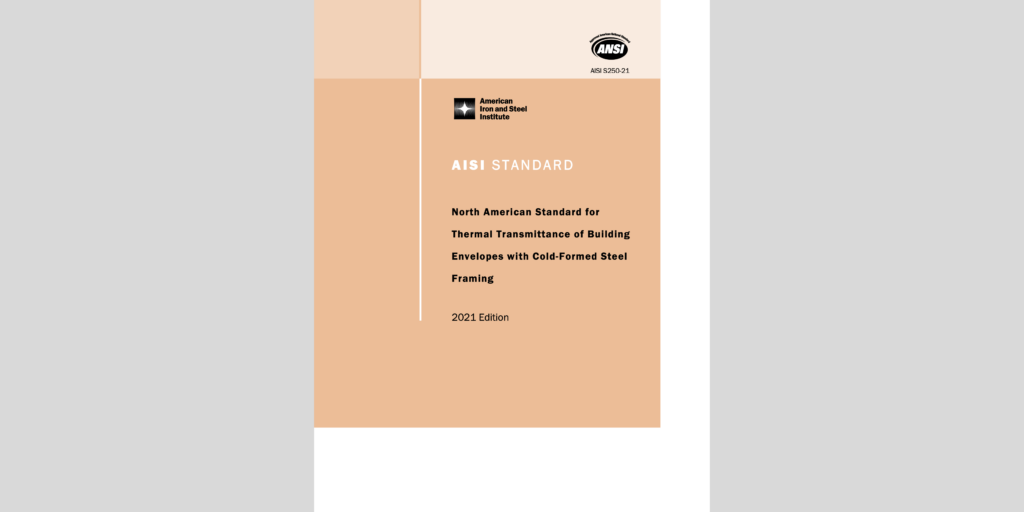
AISI S250-21, North American Standard for Thermal Transmittance of Building Envelopes With Cold-Formed Steel Framing
Thermal performance is increasingly influencing material selection in building design and construction. To address thermal performance, the Standards Council of the American Iron and Steel Institute formed a new group responsible for the ongoing development of AISI S250, North American Standard for Thermal Transmittance of Building Envelopes With Cold-Formed Steel Framing.
The group is recognized as a consensus body by the American National Standards Institute. It is comprised of staff from the American Iron and Steel Institute and experts from the steel construction industry, and will:
- Develop and maintain methods for determining heat transfer through building envelopes for assemblies containing CFS and other materials
- Develop prescriptive and performance solutions for code compliance, construction details, and installation quality standards
- Address other similar issues that impact CFS in the energy codes and standards arena
- Ensure that CFS is a viable option for those targeting advanced or net-zero buildings by 2030
Tool 3: Next Generation of Steel Framing
EQ (Equivalent) studs are nonstructural CFS framing members with performance similar to traditional CFS members. They have a reduced base metal thickness, but a higher strength steel.
- Nonstructural EQ studs take advantage of the availability to roll steel with a higher yield strength (ksi) than traditional steel formulations
- Framing contractors can build a quality wall using EQ studs
- See page 8 of the SFIA eBook: Specifying Cold-Formed Steel Framing: A Guide for Architects and Engineers
EQ studs are the product of improvements in manufacturing technology, changes in stud profile designs and the use of higher strength steel.
Tool 4: Free Assistance for Adopting CFS Technology
Are you interested in embracing CFS to reduce your next project’s embodied-carbon footprint but have questions or need support? BuildSteel offers free project assistance for building professionals in the U.S. and Canada:
- Consultation on code-compliant design of non-residential and multi-family structures
- Industry experts with decades of knowledge on CFS
- National network of manufacturers, suppliers and contractors (U.S. and Canada)
Submit your project or question.
Steps to Reduce Embodied Carbon
According to the American Institute of Architects, there are several steps building owners, designers, architects and contractors can take to make significant upfront impacts to reduce a project’s embodied carbon footprint, including:
Reuse Buildings Instead of Constructing New Ones.
- Renovation and reuse projects typically save between 50-75 %o of the embodied carbon emissions compared to constructing a new building
Reuse Materials
- Salvaged materials typically have a much lower embodied carbon footprint than newly manufactured materials, since the carbon to manufacture them has already been spent
Maximize Structural Efficiency
- Because most of the embodied carbon is in the structure, value engineering is an effective way to maximize structural efficiency and minimize material use
Minimize Waste
- Designers and contractors can reduce waste by streamlining the installation process by manufacturing building components off-site, cutting materials to precise specifications, which further eliminates material waste
Additional Resources
- Update #8 | Sustainability News from FrameCAD, Cleveland-Cliffs and ArcelorMittal Dofasco
- Update #7 | Sustainability news from ArcelorMittal, SDI and U.S. Steel
- Update #6 | Sustainability news from Cleveland-Cliffs, Worldsteel and U.S. Steel
- Update #5 | News from Nucor, Cleveland-Cliffs and a New Low-Emissions Steel Coalition
- Update #4 | Steel Framing Industry Sustainability Initiatives
- Update #3 | Steel Framing Industry Sustainability Initiatives
- Update #2 | Steel Framing Industry Sustainability Initiatives
- Update #1 | Steel Framing Industry Sustainability Initiatives