
The U.S. General Services Administration announced a pilot program that contains new requirements for procuring lower-embodied carbon construction materials for federal building projects funded by the Inflation Reduction Act of 2022. The 6-month pilot program consists of 11 GSA construction and modernization projects, which together are expected to use more than $300 million worth of lower-embodied-carbon materials.
“Today’s announcement marks a major step forward in our efforts to use the federal government’s buying power to catalyze innovation and strengthen American leadership in clean manufacturing and jobs,” said GSA administrator Robin Carnahan.
The Steel Framing Industry Association (SFIA) EPD for steel framing is a key tool that can be seamlessly integrated into project specifications to meet the new GSA requirements.

Steel framing is recyclable, durable, dimensionally stable, and requires less overall material than wood.
Accelerating Progress Toward Climate Goals
The pilot program is part of the Biden administration’s “Buy Clean” initiative, which aims to use the purchasing power of the federal government to spur the markets for materials that have lower levels of embodied carbon, or greenhouse gas emissions, associated with manufacturing, transportation and construction.
The pilot will generate insights into regional market availability of qualifying products and materials, and inform adjustments that may be needed for GSA’s final set of material requirements for its IRA-funded projects.
“We look forward to acting on what we learn from this pilot to accelerate progress toward the government’s urgent climate goals, and achieve the sustainability triple-win of good jobs, value for taxpayers and a healthier planet for future generations,” said Carnahan.
Pilot Covers 11 Projects
New Construction Projects
- Land port of entry (San Luiz, Arizona)
- Food and Drug Administration laboratory (Lakewood, Colorado)
- Cybersecurity and Infrastructure Security Agency’s HQ (Washington, D.C.)
- Land port of entry (Dunseith, North Dakota)
Renovation Projects
- Federal building garage (Detroit, Michigan)
- Facade upgrade to a federal courthouse (Kansas City, Missouri)
- Alexander Hamilton U.S. Custom House (New York, New York)
- Window replacement at a federal courthouse (Richmond, Virginia)
Paving Projects
- World Trade Bridge Land Port of Entry (Laredo, Texas)
- Kika de la Garza Land Port of Entry (Pharr, Texas)
- Land port of entry (Ysleta, Texas)
EPDs are Key for IRA Funding
The pilot signals to manufacturers that GSA requires Environmental Product Declarations for materials procured using IRA funding. EPDs are a key tool for gaining visibility into a product’s environmental impacts through its entire lifetime in a standard, third party-verified format.
Some product categories, such as hollow structural sections and structural steel plates produced in integrated steel mills, have not yet published EPDs. The GSA pilot program provides additional time for manufacturers to gather and publish their data.
Once adequate data is available in the market, GSA plans to establish GWP limits for individual manufacturing processes (i.e., integrated mills and electric arc furnaces) to promote innovation throughout the industry and lower emissions from all processes. The pilot also implements EPA’s Interim Determination, which establishes the definition of “substantially lower” greenhouse gas emissions based on EPDs.
Several industry groups have developed EPDs for their associated products, including:
- Steel Framing Industry Association EPD includes structural and nonstructural framing components for walls, floors, ceilings, and roofs composed of hot-dipped-galvanized cold-formed steel members and flat straps used for bracing
- American Institute of Steel Construction EPD includes fabricated hot-rolled structural sections, fabricated steel plate, and fabricated hollow structural sections.
- Steel Deck Institute EPD includes steel roof and floor decks
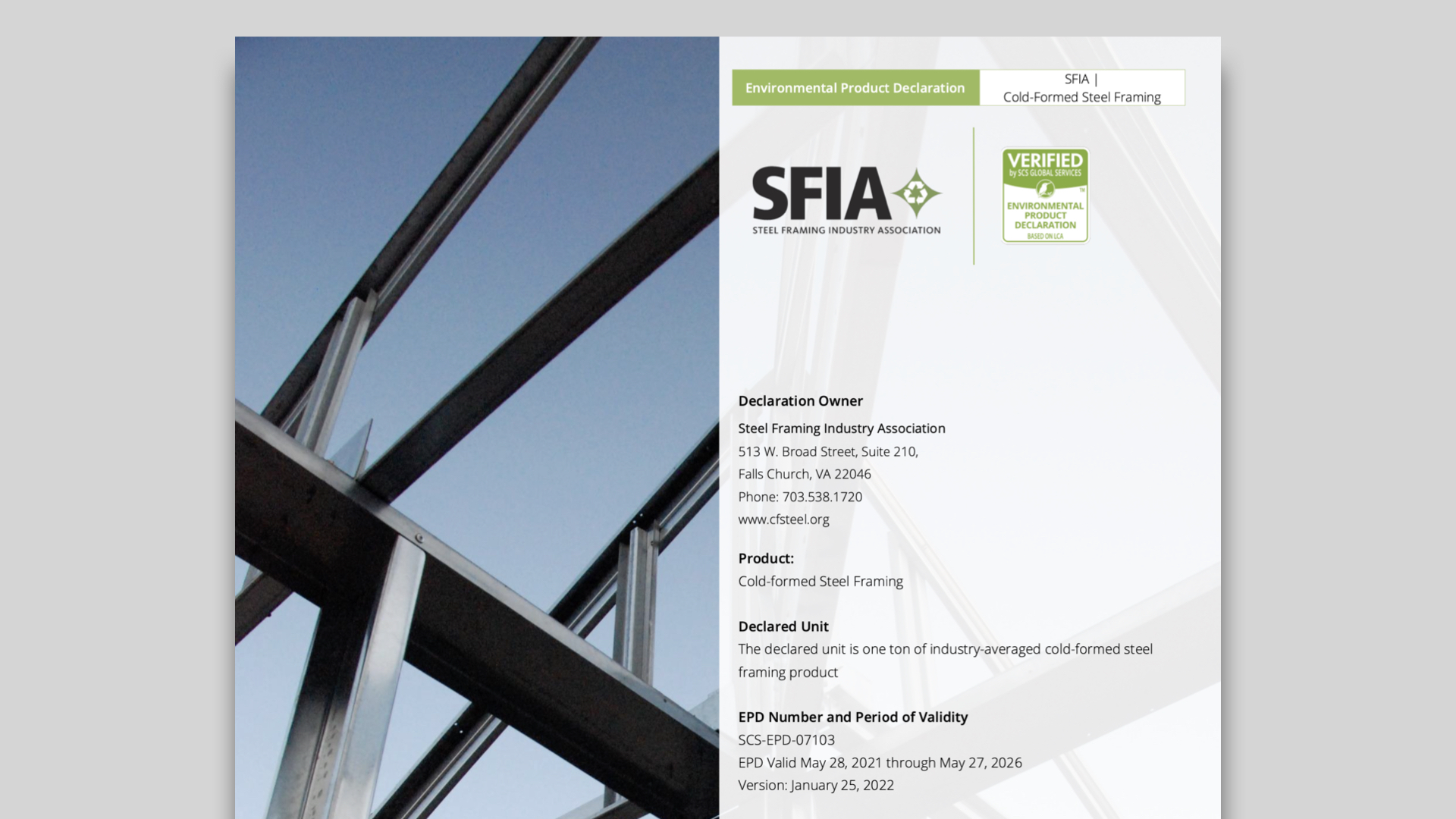
The Environmental Product Declaration for Cold-Formed Steel (CFS) Framing — SCS-EPD-07103 (version Apr. 11, 2025) — is good through May 27, 2026.
The Steel Framing Industry Association (SFIA) has released a new Environmental Product Declaration for Cold-Formed Steel (CFS) Framing, the latest tool for contractors, building owners, architects and others who strive to deliver advanced building designs that meet the latest LEED™ and other sustainable rating systems, programs and standards.The new SFIA EPD for CFS Framing can be seamlessly integrated into project specifications as an option with company-specific EPDs. SFIA offers a Specifications Review Service for this task. Architects can request the SFIA Specifications Review Service for steel framing, which is a completely free checkup.
Tax Credits for Domestic Steel
Steel manufacturers who qualify can receive tax credits. According to The Fabricator, “If you are involved in a project that qualifies for the production tax credit and investment tax credit and you meet the domestic content requirement for steel and iron, you can get a significant 10% increase to either or both the credits according to the Internal Revenue Service, which released guidelines on May 12.”
“Notice 2023-38 clarifies that all manufacturing processes with respect to any steel or iron items that are components of an energy project must take place in the U.S.,” says The Fabricator. “However, metallurgical processes involving refinement of steel additives are not required to be performed in the U.S.”
Additional Resources
- Steel Framing Industry Offers 4 Tools to Help Reduce Construction’s Carbon Footprint
- SFIA Releases Industry Environmental Products Declaration for Cold-Formed Steel Framing
- Why Building with CFS is the Most Sustainable Solution in Construction