
Steel Framing Inspection with Radar and AI
A University of Houston engineering team developed a method to detect hidden damage in cold-formed steel (CFS) framing within walls. The approach combines ground penetrating radar with artificial intelligence to locate and assess concealed studs and joists.
CFS framing plays a major role in many nonresidential buildings, yet inspecting it has required costly wall removal. This research highlights structural inspection and data driven analysis as key skills advancing steel evaluation, with findings reported in the American Society of Civil Engineers Journal of Computing in Civil Engineering.
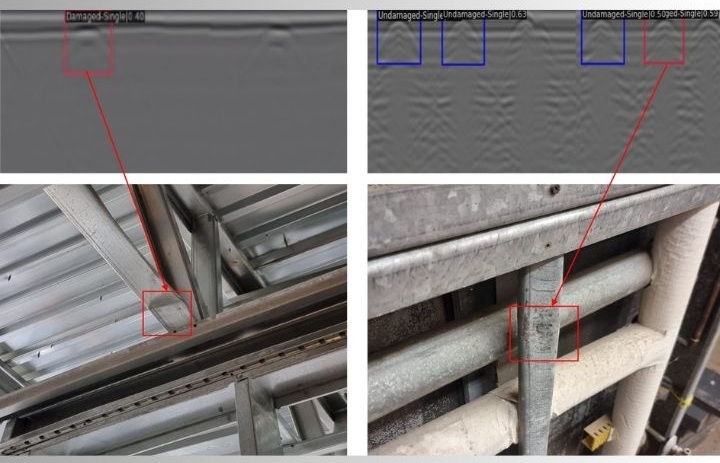
At top, radar images of cold-formed steel (CFS) studs behind common wall claddings as scans capture the damaged and undamaged studs. At bottom, the damaged stud and truss as predicted in the scan. Image Credit: University of Houston
The system uses radar scans to capture internal wall conditions and AI to interpret patterns linked to steel presence and damage. Researchers created a dataset of radar images showing different layouts and damage scenarios. They also introduced a training method that improves accuracy under real world conditions. The AI identifies issues such as buckling by recognizing changes in echo patterns and marking areas for targeted inspection. This reduces unnecessary demolition and focuses effort where it is needed.
The framework supports faster, scalable assessments for maintenance and post disaster evaluation. By limiting disruption and lowering costs, it improves how teams manage aging or damaged structures.
Steel Stud Innovation Changes Jobsite Cutting
SFIA member Grabber Construction Products introduces TrueShear, a tool that shears cold-formed steel (CFS) studs instead of cutting them with saws. It is designed for use across demanding jobsites, including data centers, occupied buildings and hospitals. The tool reflects a shift in how crews approach steel stud cutting, with a focus on controlled shearing rather than friction based methods.
TrueShear applies 12 tons of force to shear steel studs 54 mils (16 gauge) to 33 mils (20 gauge). The process eliminates sparks and reduces the need for fire watch and permits. It also produces a consistent edge without burrs. Lower noise levels make it more suitable for spaces where limiting disruption is important.
The change from saw cutting to shearing alters jobsite conditions and workflow. Crews can avoid hazards tied to sparks and reduce secondary tasks related to cleanup and safety monitoring. The cleaner edge also reduces finishing work. This approach supports more predictable steel stud installation in controlled environments.
Learn more from Grabber Construction Products.
Spazzer Bar Cuts Steel Installation Time
As labor pressures increase, cold-formed steel (CFS) framing contractors must balance precision and speed. Walls must stay plumb while crews work efficiently. SFIA member ClarkDietrich’s Spazzer Bar provides a continuous steel bridging solution that integrates into the framing process. It moves through pre-punched stud knockouts to help maintain alignment and resist stud rotation.
Spazzer Bar reduces the complexity of traditional clip and channel systems. It eliminates many components and removes clips in non-load-bearing applications, which reduces handling and fastening in the field. Internal data shows crews can, depending on conditions, install the system significantly faster than conventional U-channel systems. Integrated notch spacing also helps crews maintain consistent layouts and improve wall alignment.
Spazzer Bar supports a range of stud sizes and applications, allowing contractors to standardize across projects. Spazzer 5400 and 9200 configurations provide flexibility, including use in load-bearing conditions with added fastening.
“Once it’s on the job, the guys go, go, go, and it makes us look really good with the general contractor,” says Jonathan Lamb of Millard Drywall & Acoustical Construction.
Read the full article from ClarkDietrich.
Additional Resources
- Update #7: ClarkDietrich’s iTools, Scottsdale’s Roll Forming Videos, U.S. Steel’s Learning Mill All Help Transform CFS
- Update #6: T.J. Wies Redefines Hospital Prefab, Contractors Back Steel Growth, U.S. Steel Invests in the Future
- Update #5: U.S. Steel Upgrades, Nucor Mill Targets 2027 Launch, Startup Reinvents Housing
- Update #4: L&W Supply Expands in Oregon, CEMCO Adds ArcelorMittal’s Magnelis® Coating, ClarkDietrich Obtains Connector Certification
- Update #3: Grabber Introduces New Fastener, TSN Expands in Texas, ClarkDietrich Connector Reduces High-Rise Noise
- Update #2: CEMCO Reaches 50, FRAMECAD Unveils New CFS Platform, ClarkDietrich Adds Sustainability Glossary
- Update #1: BlazeFrame® Tape, Bridging Connectors and Steel-Framed Glass Curtain Walls