
Images provided by FRAMECAD.
When selecting construction materials, the strength-to-weight ratio is essential for maximizing efficiency and performance. Understanding this ratio allows building professionals to choose materials that ensure projects are structurally sound, cost-efficient and sustainable. Among the available options, cold-formed steel (CFS) framing excels by offering a strength-to-weight ratio that surpasses wood and concrete.
In the article, “Why Cold-Formed Steel’s Exceptional Strength-to-Weight Ratio Outshines Traditional Building Materials,” FRAMECAD, an SFIA member, compares CFS framing to wood and concrete, demonstrating how steel’s superior strength-to-weight ratio leads to more efficient construction, reduced material costs and enhanced sustainability.

Cold-formed steel (CFS) framing offers a strength-to-weight ratio that surpasses wood and concrete.
Importance of Strength-to-Weight Ratio
The strength-to-weight ratio is critical to evaluating construction materials, as it measures how strong a material is relative to its weight. A higher ratio signifies a material that delivers exceptional strength without unnecessary weight, a key advantage in building structures. This property is particularly important in seismic zones, where lighter materials reduce a building’s mass and inertia, minimizing excessive swaying and mitigating the forces experienced during shaking, the FRAMECAD article says.
Steel stands out as a leader in strength-to-weight ratio among commonly used construction materials. Steel framing’s strength-to-weight ratio significantly exceeds that of wood or concrete, providing exceptional structural performance while being relatively lightweight.
- CFS uses less material to achieve the same structural goals
- Steel reduces resource consumption
- Steel contributes to sustainable construction
When steel sheets are rolled into structural forms like C-studs, the bending of the steel act as a stiffener. This dramatically increases steel’s strength. The enhanced strength of CFS enables CFS framing systems to reduce a building’s total load, reducing the costs of a building’s foundation. The combination of strength, efficiency and sustainability makes CFS framing an ideal choice for creating resilient, environmentally conscious buildings.
Why Steel Outperforms Wood and Concrete
Steel vs. Wood
Steel outperforms wood in strength, resisting tension, compression and shear forces more effectively. Despite being denser, steel creates lighter structures by requiring less material, thus reducing overall building loads. Unlike wood, CFS doesn’t warp, rot or fall prey to pests. Steel’s resilience is long-term, unlike wood.
Safety is also a key factor in choosing CFS framing. Unlike other construction materials, steel studs are 100% noncombustible, making them eligible for use in Type I buildings where fire-resistance standards are most stringent.
Steel vs. Concrete
Concrete excels in compression but requires steel reinforcement to handle tension. Steel offers excellent tensile strength and greater flexibility for diverse applications. Because concrete is heavier, it demands more substantial foundations and higher transportation costs. Steel is lighter, easy to transport and better equipped to withstand seismic forces.
5 Reasons to Use Steel for Fire Safety
- Steel is noncombustible
Steel can’t burn. It contains no elements that can serve as fuel for a fire to start. Steel does not contribute to fire growth or fire spread and will not generate smoke and other toxic combustion products during fires.
- Steel maintains its noncombustibility
Steel remains noncombustible throughout the entire lifecycle of the building — during building construction, occupation and future renovation and repair.
- Steel-framed buildings lower the fire risk to workers and occupants
Decades of research has given designers the confidence to engineer buildings that will provide optimum fire safety. Fire resistance-rated walls and floors help limit or slow the spread of flames and maintain the integrity of a structure.
- Steel-framed buildings lower the impact on municipal fire services
Recent building code changes that permit increased building heights and areas for wood framing have had devastating results. A rash of catastrophic wood-frame building fires in Canada and the United States have destroyed entire complexes. Such fires have challenged the resources of fire services. Some cities, such as the affluent Atlanta suburb of Sandy Springs, are working to ban combustible framing above three stories.
- Steel-framed buildings tend to cost less to insure
Insurers traditionally offer steel-framed structures lower builders risk and general liability premiums compared to structures framed with wood.
Source: Steel Framing Industry Association (SFIA) fire safety reports
Housing Project Benefits from CFS Strength
CFS framing’s high strength-to-weight ratio was essential to meeting the height and structural requirements of a 363,000 square-foot student housing project in Charlottesville, Virginia. CFS allowed for lighter yet stronger structures, enabling the construction of a seven-story building — a height that exceeds the limits of traditional wood framing.
The strength and durability of CFS ensured the building could support its substantial weight while maintaining structural integrity. Additionally, the steel’s inherent flexibility reduced the need for numerous load-bearing walls, creating opportunities for greater interior design versatility. This allowed for easier adjustments to room sizes and layouts, meeting both aesthetic and functional goals.
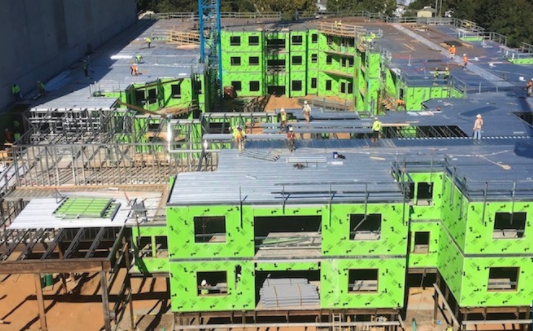
Cold-formed steel (CFS) framing’s high strength-to-weight ratio was essential to meeting the height and structural requirements of a student housing project in Charlottesville, Virginia.
‘Steel Framing Empowers Developers’
Using materials with superior strength-to-weight ratios unlocks new opportunities for innovation in construction.
“Steel framing empowers developers to deliver projects that are not only cost-effective and efficient but also align with modern sustainability goals,” the FRAMECAD article says. “Choosing steel isn’t just about improving performance — it’s about setting a new standard for forward-thinking and environmentally conscious building practices.”
Read the full FRAMECAD article.
Additional Resources
- Building Stronger, Safer Structures: How Cold-Formed Steel Excels in Hurricane Zones
- Top 5 Reasons Steel Framing Can Keep a Building Safe During an Earthquake
- FRAMECAD Launches Residential Steel Framing Customer Service Center