
November 11, 2026 — New research in Nature Communications projects that fire risk to U.S. buildings could nearly triple by 2060.
The November 2026 research paper, “Fire risk to U.S. structures nearly triples by mid-century,” analyzes historical fire activity, development patterns and structural losses. Led by Virginia Iglesias of the University of Colorado Boulder, researchers analyzed historical data through 2023.
The findings identify growing challenges as development expands into fire-prone landscapes. Researchers emphasize proactive mitigation, improvements to existing buildings and policies that address future fire exposure.
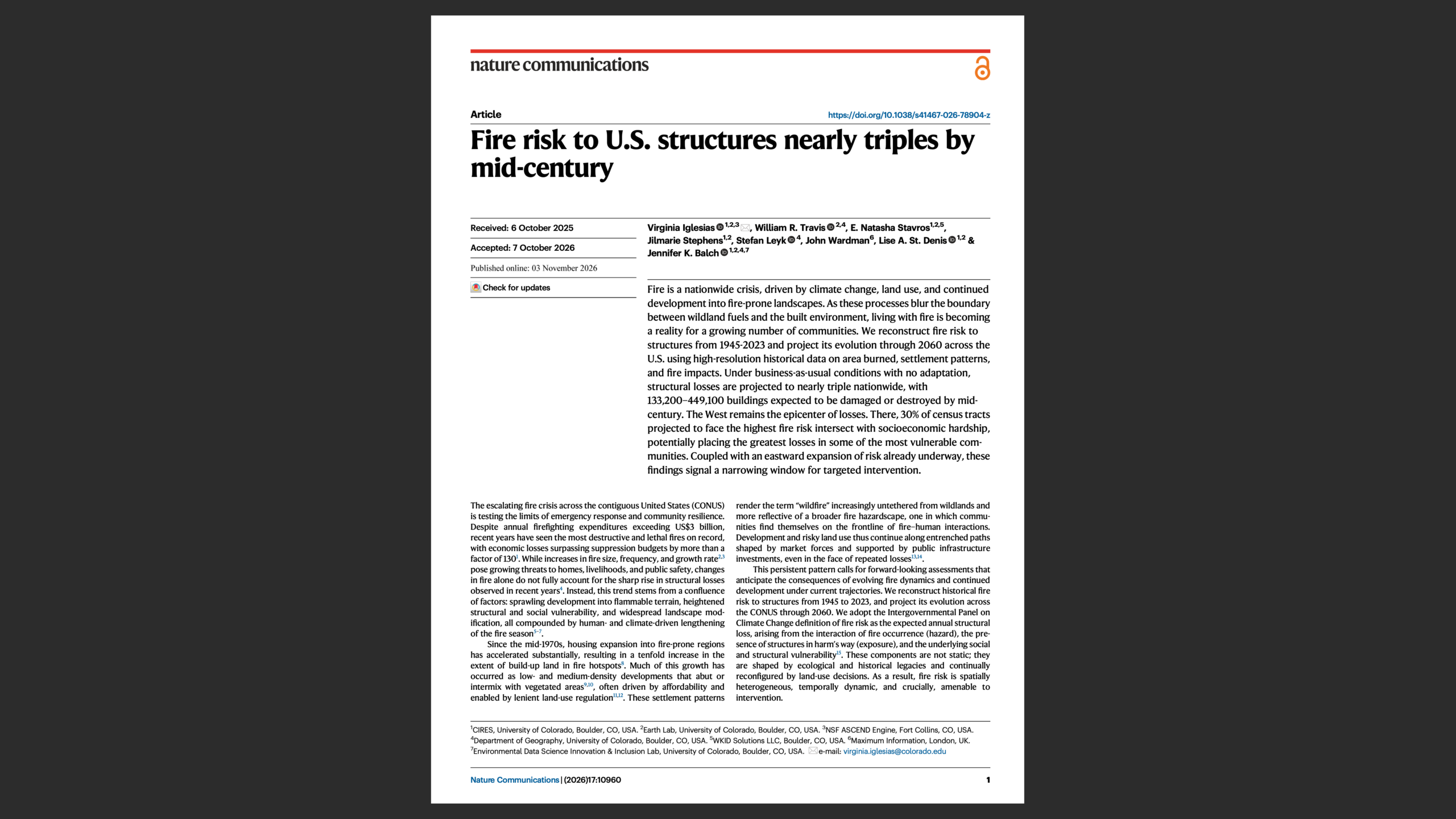
New research published in Nature Communications projects that fire risk to U.S. buildings could nearly triple by 2060.
Growth in Fire Risk
The researchers combined historical fire records, development patterns and climate projections to assess future risks to buildings. Their analysis considered fire activity, structural exposure and vulnerability to damage.
Under business-as-usual conditions, the study projects fire could damage or destroy 133,200 to 449,100 structures. These losses span the years 2024 to 2060. These estimates represent modeled scenarios rather than precise forecasts and assume no additional adaptation.
The study identifies several key regional findings:
- Western United States: Annual structural fire risk could increase 2.2 to 3.7 times, depending on the climate model. California remains a major center of projected structural losses
- Central United States: The study projects increasing fire risk across 84.1% of census tracts by 2051–2060
- Eastern United States: Fire risk is expanding into areas with historically lower exposure, creating new challenges for communities
Development patterns also influence structural losses. Continued construction in areas with flammable vegetation increases the number of buildings exposed to fire. Socioeconomic conditions can compound these risks by limiting communities’ ability to prepare and recover.
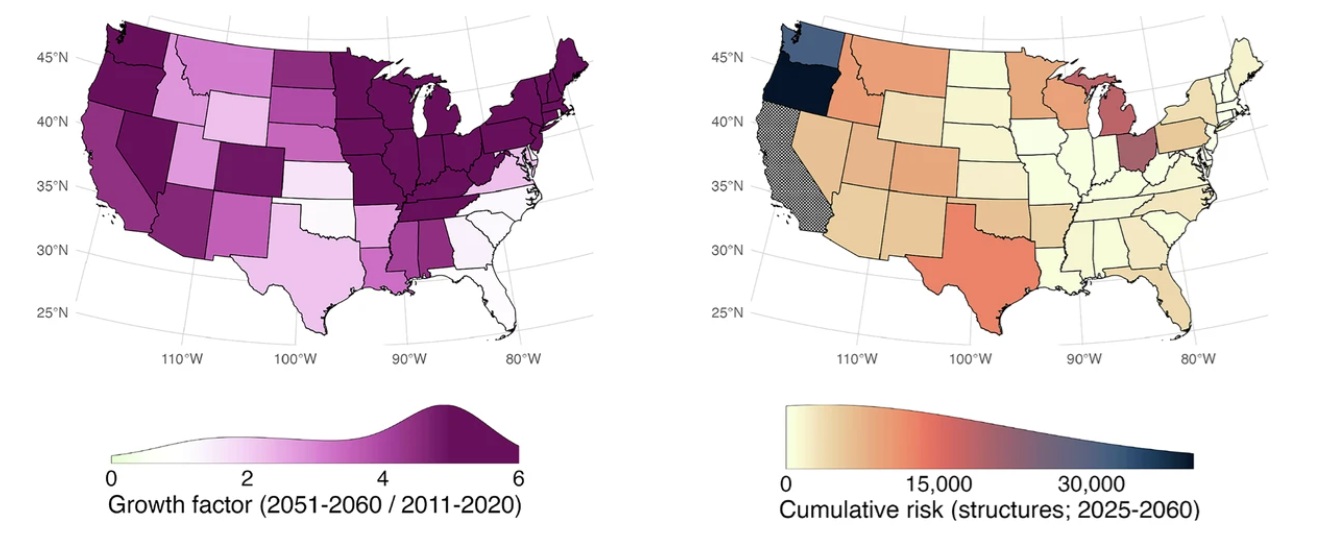
Future State-Level Fire Risk to Private Structures. The maps show projected changes in annual fire risk and cumulative structural losses through 2060. Source: Iglesias, V., et al. (2026). “Fire risk to U.S. structures nearly triples by mid-century.” Nature Communications, 17, Article 10960. https://doi.org/10.1038/s41467-026-78904-z. © The Author(s) 2026. CC BY-NC-ND 4.0. Reproduced with permission from Springer Nature.
Proactive Fire Mitigation
The study emphasizes that communities must address more than changing fire conditions to limit losses. Historical development patterns, land-use decisions and structural vulnerabilities also influence fire risks.
The researchers discuss several approaches to improving community resilience:
- Home improvements: Retrofit existing homes to reduce their vulnerability to fire
- Defensible space: Manage vegetation and combustible materials surrounding buildings
- Building codes: Strengthen construction requirements through climate-informed building codes
- Land-use planning: Consider fire exposure when making decisions about future development
- Community preparedness: Improve early warning systems, risk communication and investments in critical infrastructure
These measures highlight the importance of coordinated planning and continued investment. No single strategy can address the growing risks associated with fire activity and development.
CFS Supports Fire-Resilient Construction
As fire risk grows, building professionals can incorporate noncombustible materials into their designs to improve resilience. Cold-formed steel (CFS) framing offers a noncombustible option for residential, commercial and institutional construction.
- Steel is Noncombustible: Steel can’t burn, because it contains no elements that can serve as fuel.
- Steel Maintains its Noncombustibility: Steel remains noncombustible throughout the entire lifecycle of a building — during construction, occupation and renovation and repair
- Steel Framing Supports Fire-Resistant Assemblies: Fire-rated assemblies help contain flames and preserve the integrity of a structure.
- Steel-Framed Buildings Reduce the Impact on Municipal Fire Services: Fires strainfire departments. Many municipalities have adopted stronger site-safety regulations for buildings.
- Steel-Framed Buildings Tend to Cost Less to Insure: CFS framing saved $1.32 million in builders risk insurance premiums over the 24-month construction of a four-story, 400-unit hotel — plus $66,000 annually in property insurance premiums — compared to wood framing.
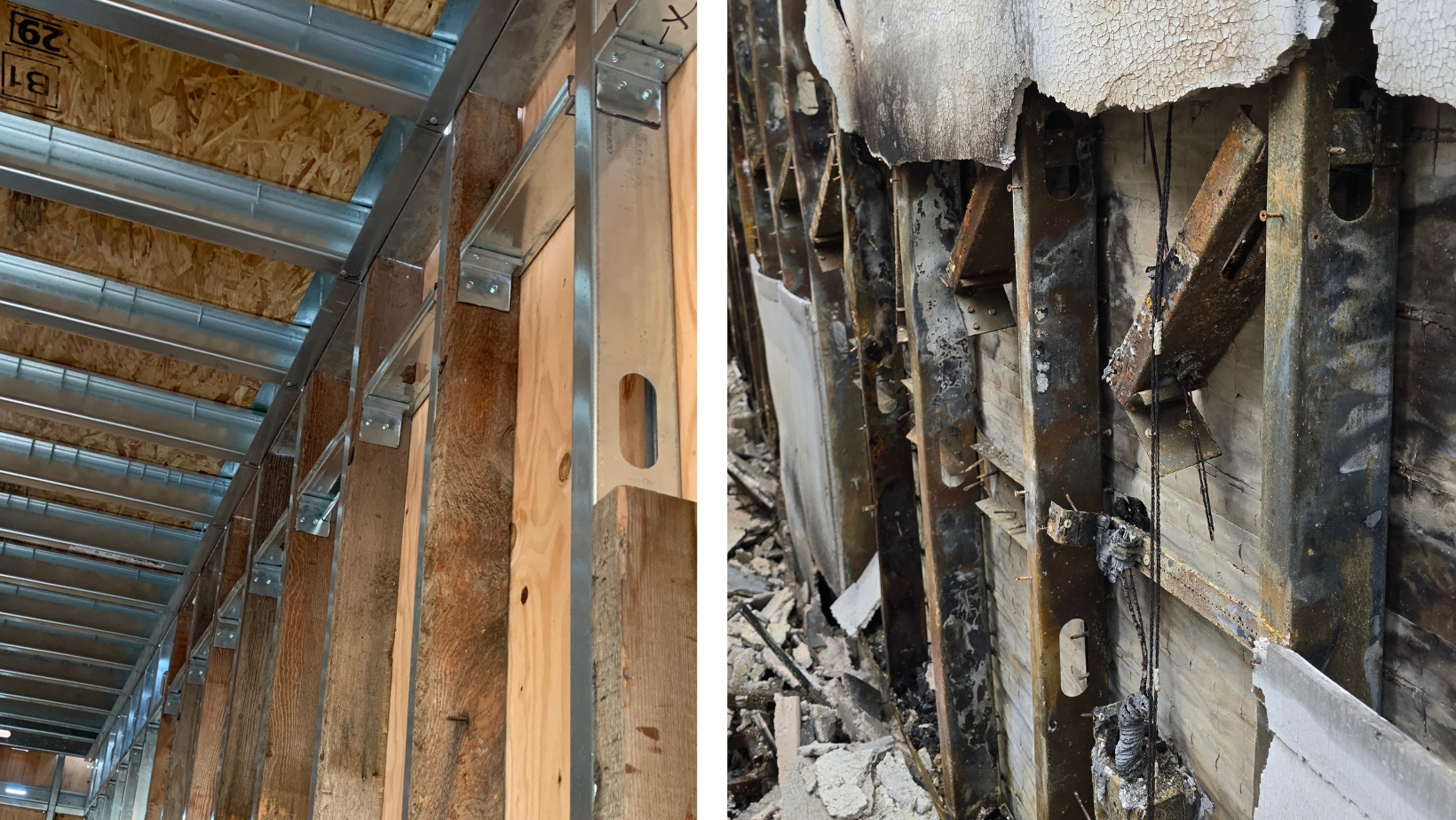
In the Palisades Fire, a home’s wood studs and plywood (left) burned away completely (right), leaving only cold-formed steel (CFS) framing, nail heads and the back of the exterior stucco.
These characteristics support the use of CFS framing as part of fire-resilient building design. However, steel framing alone does not make a building wildfire-resistant or fireproof. Overall building performance also depends on other building materials, construction details and surrounding conditions.
The Nature Communications study did not evaluate CFS framing or compare construction materials. These benefits reflect steel framing characteristics rather than findings from the research.
Addressing Future Fire Risks
The Nature Communications research identifies a growing challenge for communities across the United States. Rising fire activity, continued development and existing vulnerabilities could substantially increase structural losses over the coming decades.
The findings reinforce the importance of coordinated mitigation, updated building practices and long-term planning. Noncombustible materials such as CFS framing offer an option to consider in comprehensive fire-resilient building design.
Read the full Nature Communications study.
Research Source and Attribution
This BuildSteel article independently summarizes research from Nature Communications. It also includes separate commentary on cold-formed steel (CFS) framing. The original research did not evaluate CFS framing or compare construction materials.
Original research: Iglesias, V., Travis, W. R., Stavros, E. N., Stephens, J., Leyk, S., Wardman, J., St. Denis, L. A., and Balch, J. K. (2026). “Fire risk to U.S. structures nearly triples by mid-century.” Nature Communications, 17, Article 10960.
Copyright and license: © The Author(s) 2026. The original study uses a Creative Commons Attribution-NonCommercial-NoDerivatives 4.0 International License. This BuildSteel summary does not reproduce the study’s original maps, figures or other visual materials.
Additional Resources
- Cold-Formed Steel Framing 101 — A Practical Guide for Designers, Builders and Owners
- 10 Ways Cold-Formed Steel Framing Creates Safer Job Sites
- Home Builders Turn to Steel as Wildfire Threats Intensify