
In modern building design, continuity of fire resistance is a life safety imperative. The International Building Code spells out how certain walls and partitions must extend vertically and horizontally through a structure. The question is: how do you meet these continuity requirements without compromising structural performance?
That’s the challenge addressed in a new Steel Framing Industry Association (SFIA) white paper, Frequently Asked Questions Regarding Continuity of Fire Resistance in Cold-Formed Steel Structures (SFIA F101-25), authored by Robert Grupe, SFIA general manager of architectural services.
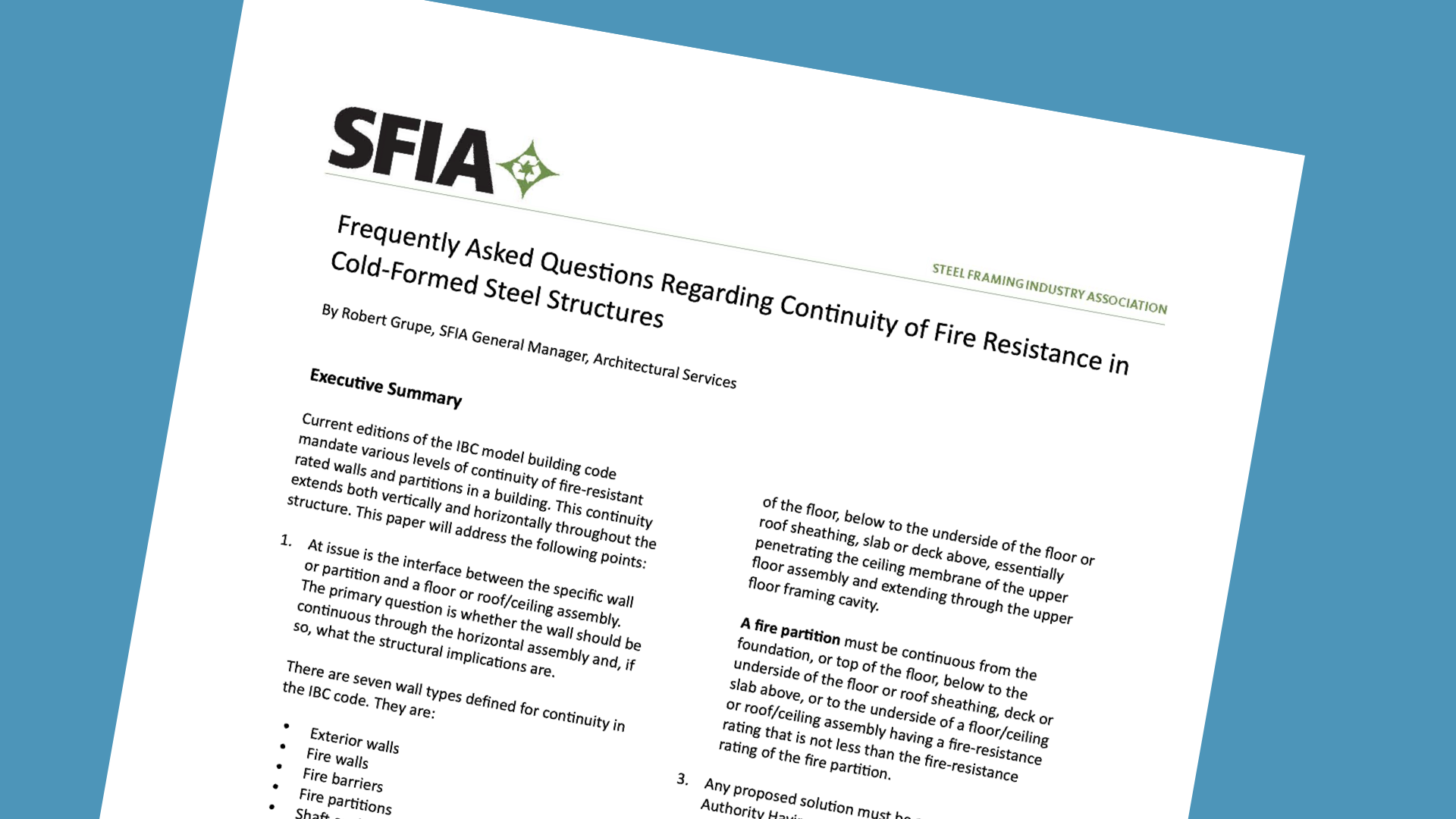
“Frequently Asked Questions Regarding Continuity of Fire Resistance in Cold-Formed Steel Structures”
The paper explores the code provisions, design conflicts and potential solutions for maintaining continuity in mid-rise cold-formed steel (CFS) construction — particularly for fire walls, fire barriers and fire partitions. While the principles are rooted in the IBC, the implementation is often a matter of engineering judgment and approval by the Authority Having Jurisdiction.
5 FAQs on Continuity of Fire Resistance
Chapter 7 of the 2024 IBC, Fire and Smoke Protection Features, defines the requirements for seven wall types. These seven types include exterior walls, fire walls, fire barriers, fire partitions, shaft enclosures, smoke barriers and smoke partitions.
For certain wall types, “continuity” means extending from the foundation or lower floor assembly up through an upper floor or roof assembly. Horizontal continuity may also be required. The goal is clear: prevent the spread of fire and smoke through joints, penetrations, or changes in construction.
CFS construction requires steel-to-steel contact — such as a stud directly connected to a joist — for structural load transfer. But a literal reading of the fire-resistance provisions could place a layer of gypsum wallboard between these elements. That may satisfy the fire membrane requirement, but it creates a structurally untenable condition.
Grupe points out that, in practice, structure takes precedence.
“An appropriate CFS-framed structural connection requires two steel components in direct contact,” he writes. That means designers and contractors must balance both requirements and seek AHJ approval for any solution.
Key Continuity Questions
To help designers and contractors, SFIA F101-25 answers 5 key questions:
- What is continuity?
- What are the different options to achieve continuity?
- What are the ramifications for cold-formed steel in Option 1 | Fire Wall?
- What are the ramifications for cold-formed steel in Option 2 | Fire Barrier?
- What are the ramifications for cold-formed steel in Option 3 | Fire Partition?
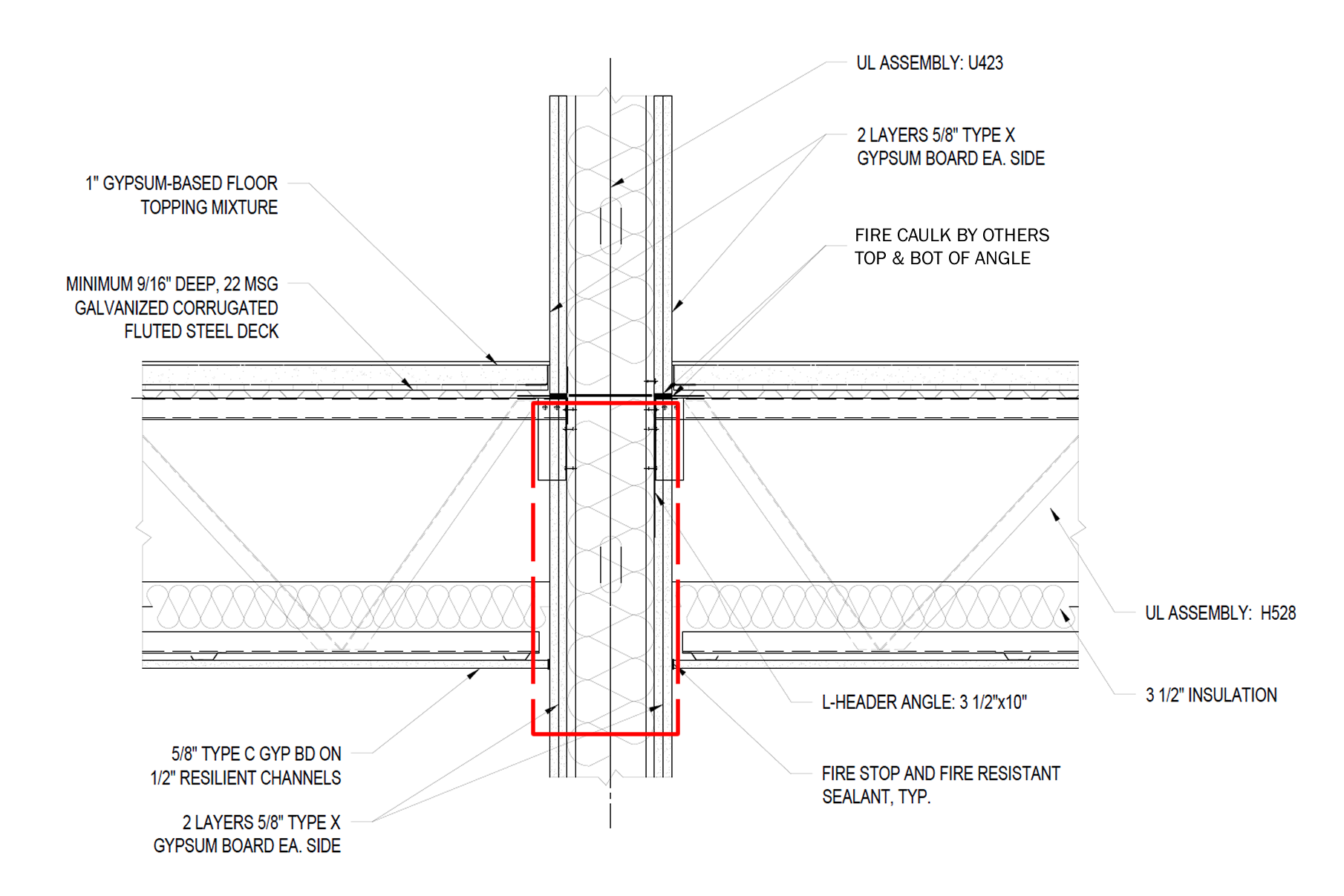
The Fire Barrier continuity option — one of 3 presented in SFIA F101-25 — shows the fire-resistive gypsum wallboard installed on the wall framing continuously through the plane of the ceiling. Detail provided courtesy of BYLD, Inc.
3 Continuity Options for CFS Framing
The IBC outlines three distinct continuity conditions for the wall types most relevant to mid-rise CFS projects. Grupe’s paper examines each in detail, including code definitions, applications and structural implications:
- Fire Walls (IBC Section 706) — These must run continuously from foundation to (or through) the roof, creating two structurally independent buildings. In CFS framing, the fire wall itself is usually nonstructural, flanked by load-bearing walls on either side. This approach ensures stability even if construction on one side collapses during a fire.
- Fire Barriers (IBC Section 707) — These run vertically from floor assembly to floor (or roof) assembly above, penetrating the ceiling membrane and extending through the floor framing cavity. The floor framing often must be perpendicular to the barrier and still act structurally — requiring solutions that maintain both structural load paths and fire continuity.
- Fire Partitions (IBC Section 708) — These may terminate at the underside of a floor/ceiling or roof/ceiling assembly with an equal or greater fire rating, or extend to the underside of the sheathing, deck, or slab above. In CFS framing, the structural load path must still be established, often requiring the ceiling to be broken for joist-to-stud bearing.
The paper discusses the continuity ramifications for each of the three continuity options named above.
“The IBC defines three levels of continuity. Each is unique and separate from the other two forms of continuity, while serving a very specific function,” Grupe writes. “Solutions are available for each form, and any potential solution must be found acceptable to the Authority Having Jurisdiction over a given project.”
Why This Matters for CFS Designers and Contractors
Cold-formed steel offers inherent advantages — noncombustibility, precision and strength. But as Grupe notes, these benefits don’t eliminate the complexity of integrating fire-resistive assemblies with structural framing. Missteps in detailing can lead to costly redesigns, delayed approvals, or worse — compromised safety.
Understanding the subtle differences between fire wall, fire barrier and fire partition continuity is critical. Designers, engineers and contractors must know not only the code text but also how to apply it in real CFS construction scenarios.
Get the Full Report
This article scratches the surface of Grupe’s detailed exploration of continuity in CFS structures. The full SFIA paper includes:
- IBC definitions and continuity language
- Illustrations showing correct structural connections
- CFS-specific ramifications for 3 continuity options
The paper reinforces the notion that early coordination between the design, engineering and inspection teams is essential.
Download SFIA FAQ F101-25 to access all the details, diagrams and practical considerations.
“Frequently Asked Questions Regarding Continuity of Fire Resistance in Cold-Formed Steel Structures”
Robert Grupe
SFIA General Manager, Architectural ServicesRobert Grupe is General Manager, Architectural Services at the Steel Framing Industry Association (SFIA), managing the SFIA’s Architectural Services Team nationwide. Grupe is a 40-year-plus industry veteran and popular seminar and webinar presenter. He spent over 38 years with United States Gypsum Company in various technical and management positions, including product and system design and technical consultation to the AEC community.

About SFIA
The Steel Framing Industry Association (SFIA), a unique organization representing steel mills, coil coaters, stud and connector manufacturers, component fabricators, Cold-Formed Steel Engineers Institute (CFSEI) members, suppliers/distributors, contractors and others, provides members with exclusive access to technical cold-formed steel (CFS) framing services, including CFS certification, environmental product declarations, market data and analysis, technical design guides, specification review services, architectural services, the Steel Framing Learning Portal , the SFIA Awards and more. SFIA is an accredited ANSI Standards Development Organization. Follow SFIA on LinkedIn, Facebook, Instagram and X.

Additional Resources
- FAQ: Where and How Do You Install Cold-Formed Steel (CFS) Resilient Channels?
- FAQ: What Are Resilient Channels, and What Is Their Purpose?
- Designers: Update to SFIA’s 2024 Tech Guide for the Latest CFS Load and Span Tables