
November 6, 2026 — New cold-formed steel (CFS) framing standards and the growing integration of CFS with structural steel were the focus of a technical session at the Canadian Steel Conference in Vancouver, British Columbia, Nov. 3-4.
Don Allen, executive director of the Steel Framing Industry Association (SFIA), and Sarah Majlesi, senior engineer for cold-formed steel at the Canadian Institute of Steel Construction (CISC ICCA), presented “Integrating Cold-Formed Steel and the Future of North American Standards.”

The session followed SFIA’s completion of the review and approval process for 6 CFS framing standards and 13 CFS test standards. All 19 are now American National Standards, with updated documents expected to be available for download by the end of November.
Beyond standards development, Allen and Majlesi explored differences in Canadian and U.S. engineering requirements and the growing integration of CFS framing with structural steel in building construction.
SFIA Advances 19 American National Standards
Allen outlined SFIA’s expanded standards development role following the American Iron and Steel Institute’s (AISI) decision to discontinue its construction-related standards activities at the end of 2023.
SFIA became an accredited American National Standards Institute (ANSI) standards development organization in July 2024. The association subsequently assumed responsibility for standards previously administered by AISI.
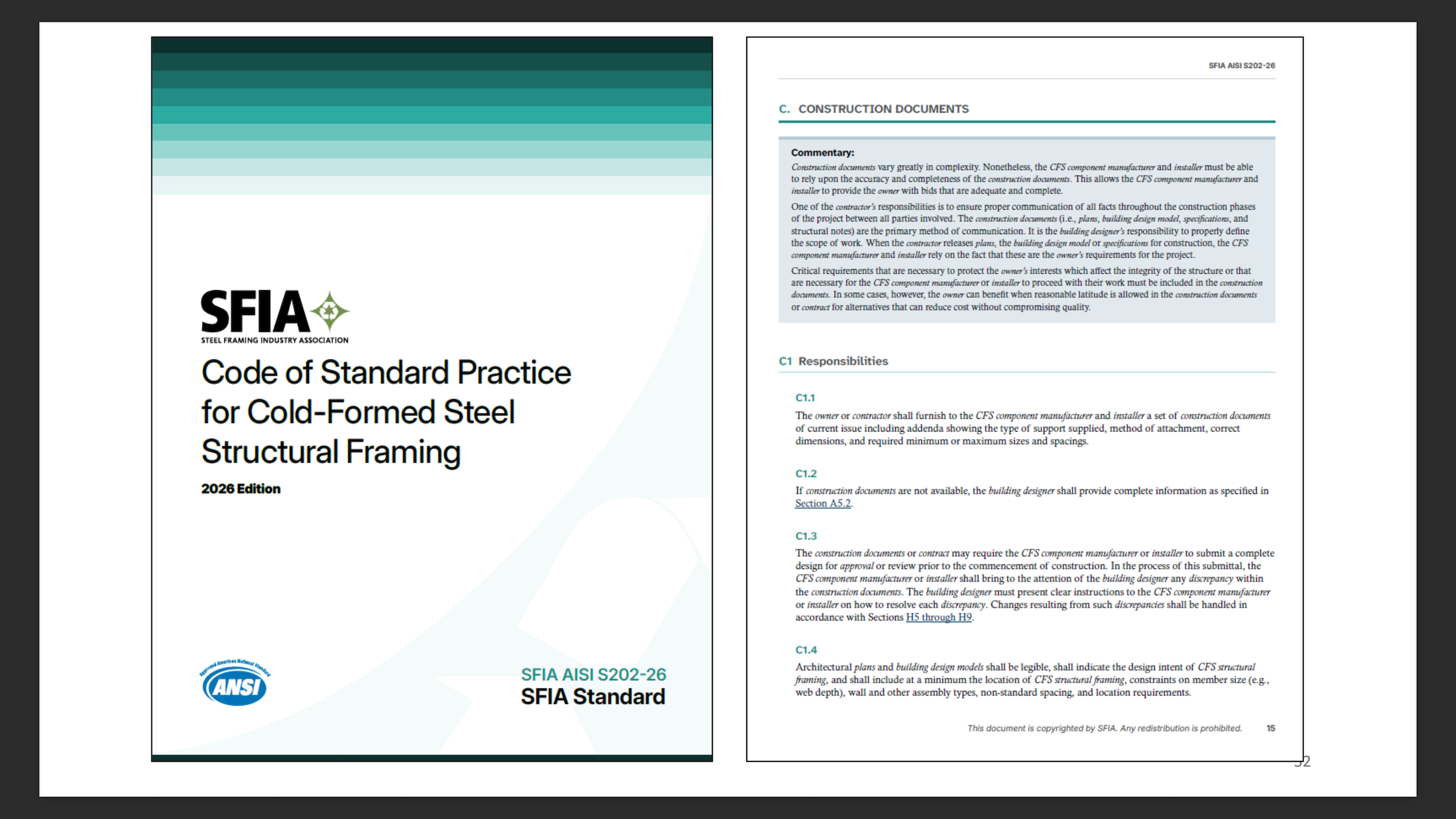
SFIA AISI S202-26 is among 19 newly approved American National Standards for cold-formed steel (CFS) framing. The updated standards are expected by late November, with a new document design planned.
The 6 CFS framing American National Standards are:
- SFIA AISI S202: Code of Standard Practice
- SFIA AISI S220: Nonstructural Framing
- SFIA AISI S230: Prescriptive Method
- SFIA AISI S240: Structural Framing
- SFIA AISI S250: Thermal Transmittance
- SFIA AISI S400: Seismic Design
Thirteen additional standards establish testing methods for CFS products, members and assemblies. All 19 American National Standards are expected to be available for download by the end of November 2026.
Allen said SFIA is maintaining an open, consensus-based development process that includes Canadian participation and other international stakeholders.
That collaboration is important because Canadian building codes reference several of the standards now administered by SFIA.
For example, the National Building Code of Canada references S220 for nonstructural framing. Meanwhile, the primary North American specification for CFS structural member design, formerly AISI S100, is being updated through CSA as S136.
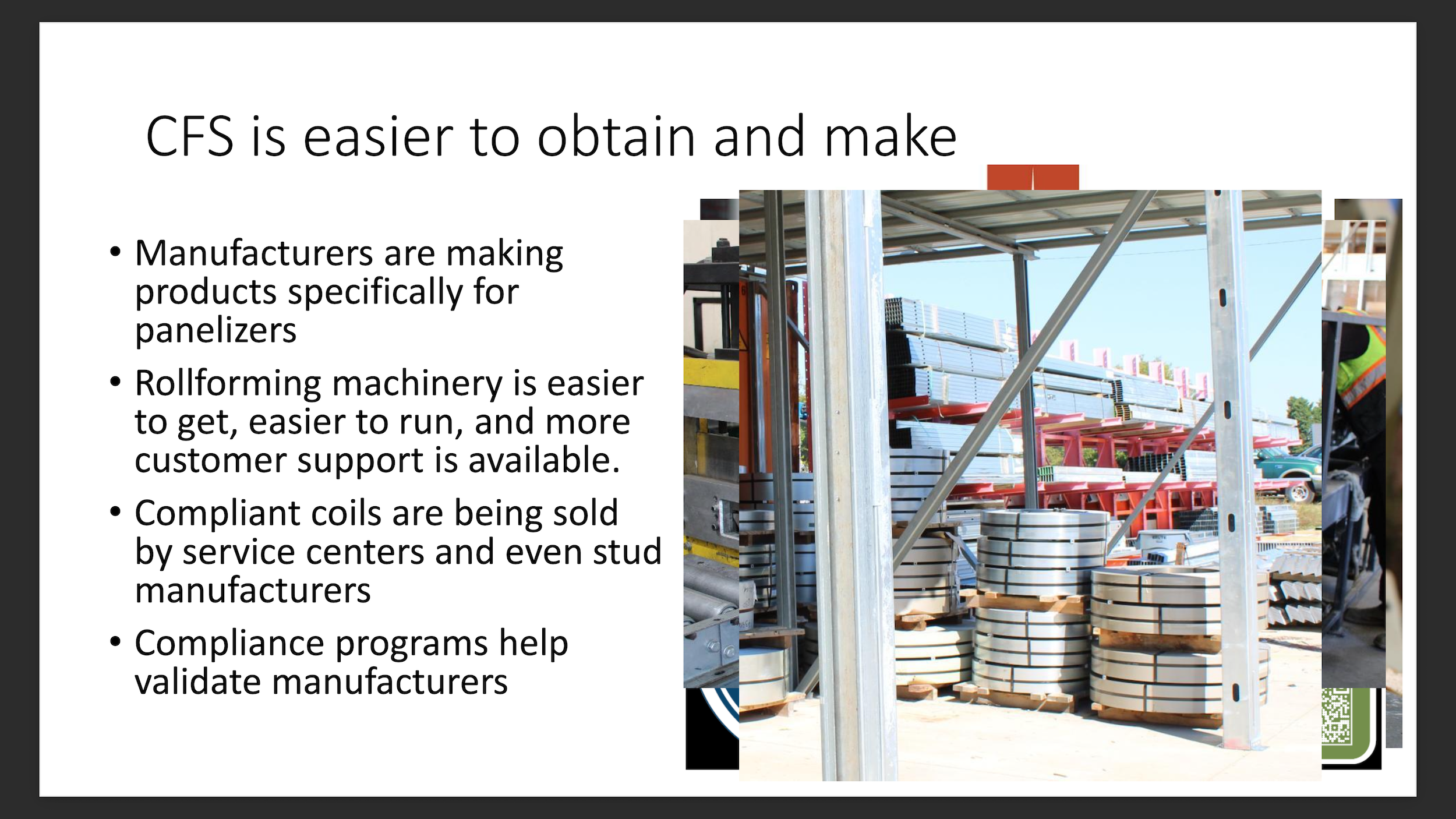
Don Allen’s presentation highlighted how accessible cold-formed steel (CFS) manufacturing has become, with improved roll-forming equipment, greater material availability and increased manufacturer support.
Engineering CFS Buildings Across Borders
Majlesi demonstrated how engineers apply North American CFS standards through a comparative design exercise involving Toronto, Ontario, and Buffalo, New York.
The hypothetical four-story mixed-use building featured three residential levels above ground-floor commercial space. Its structural system combined CFS load-bearing walls, deep composite steel deck floors and X-braced steel strap walls for seismic resistance.
Majlesi explained how the same building configuration must accommodate different loading requirements under Canadian and U.S. building codes. For example, the specified interior wall pressure was 10 pounds per square foot in Toronto, compared with 5 pounds per square foot in Buffalo.
Her presentation followed the engineering process from preliminary layouts and floor system selection through structural analysis, member design and connection detailing.
Majlesi also addressed seismic design, diaphragm performance, stud and track selection, and fire-resistance and acoustic-rated assemblies. The exercise demonstrated the importance of evaluating framing members, connections and floor systems as an integrated structural system.
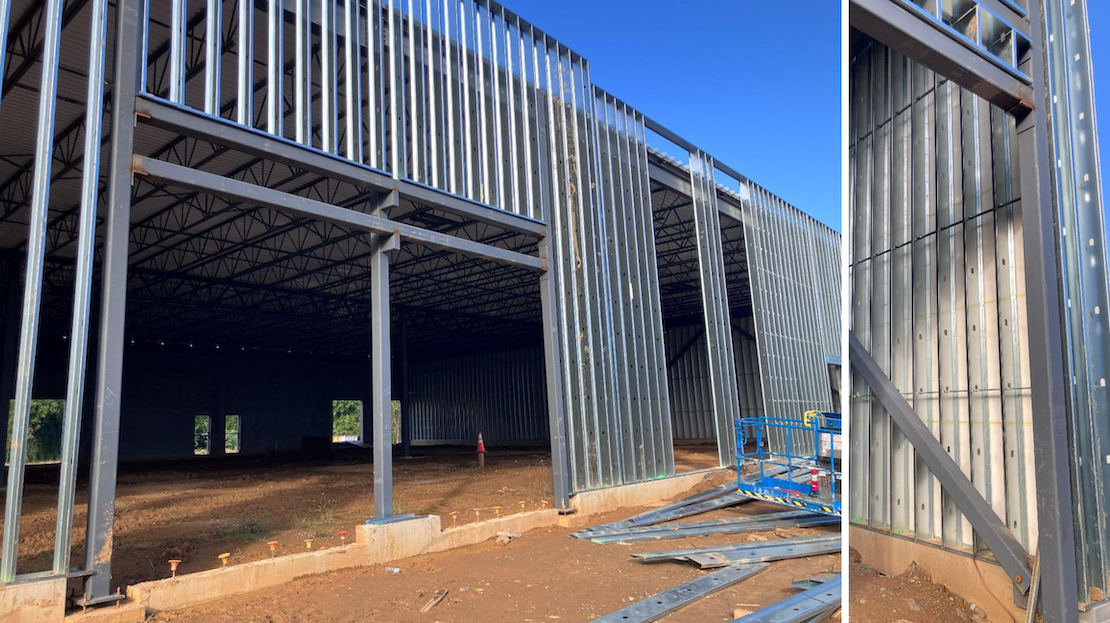
Structural steel framing and cold-formed steel (CFS) wall framing work together on a commercial construction project, demonstrating the benefits of hybrid steel construction.
Structural Steel and CFS Work Together
Allen highlighted projects demonstrating how CFS framing and structural steel complement one another.
CFS commonly forms walls and accommodates smaller openings. Structural steel can provide additional capacity around larger openings, at heavily loaded locations and where load paths require additional support.
One example was 7 Alma Crescent in Halifax, Nova Scotia, a project involving Stronghold LGS. The company manufactures CFS framing in-house. Various projects incorporate the assemblies and structural steel at concentrated load locations. These include podium structures and locations where load paths do not align.
“As our projects grow in size, we are using structural steel more frequently,” said Khalid Al-Hammadi of Stronghold LGS. Al-Hammadi was quoted in Allen’s presentation.
Other examples included Aljoya Apartments in Mercer Island, Washington; 92 West Paces Ferry in Atlanta; and Poly Canyon Village student housing in San Luis Obispo, California.
The projects illustrated how designers can combine steel framing systems to address different structural requirements within a building.
Off-Site Construction Expands Opportunities
Allen also discussed how advances in manufacturing technology are expanding opportunities for CFS framing. Roll-forming equipment, improved manufacturer support and the availability of compliant steel coils are making CFS production more accessible to fabricators and panel manufacturers.
CFS framing also offers advantages for off-site construction. These include its dimensional stability, consistent material properties and the ability to manufacture components to specified lengths.
Allen noted that product identification and compliance programs help manufacturers verify material properties and maintain production consistency.
The Canadian Steel Conference session emphasized two developments shaping steel construction:
- The modernization of North American CFS standards
- The increasing integration of CFS framing with structural steel
For engineers, fabricators and contractors, both developments create opportunities to apply steel framing systems across a broader range of building applications.
To access SFIA’s updated standards when published, visit SFIA’s ANSI Information page.

About SFIA
The Steel Framing Industry Association (SFIA), a unique organization representing steel mills, coil coaters, stud and connector manufacturers, component fabricators, Cold-Formed Steel Engineers Institute (CFSEI) members, suppliers/distributors, contractors and others, provides members with exclusive access to technical cold-formed steel (CFS) framing services, including CFS certification, environmental product declarations, market data and analysis, technical design guides, specification review services, architectural services, the Steel Framing Learning Portal, the SFIA Awards and more. SFIA is an accredited ANSI Standards Development Organization. Follow SFIA on LinkedIn, Facebook, Instagram and X.

Additional Resources
- SFIA Completes Review and Approval of Cold-Formed Steel Framing Standards and Test Standards
- SFIA Advances Cross-Border Collaboration at Canadian Steel Construction Summit
- SDI Transfers 12 S900 Test Standards to the SFIA Standards Committee