
When building with cold-formed steel (CFS) framing, engineers, architects and builders must choose between 16” on center (o.c.) and 24” o.c. stud spacing based on a project’s structural, financial and performance goals.
“We are frequently asked to help clients weigh these options and optimize framing designs for efficiency and cost-effectiveness,” says Josh Garton, P.E., S.E., project manager at McClure, an engineering company and member of the Cold-Formed Steel Engineers Institute (CFSEI), in a recent article.
While 16” o.c. is the traditional spacing, 24” o.c. can offer improved cost efficiency and shorter construction timelines, among other advantages, Garton says.
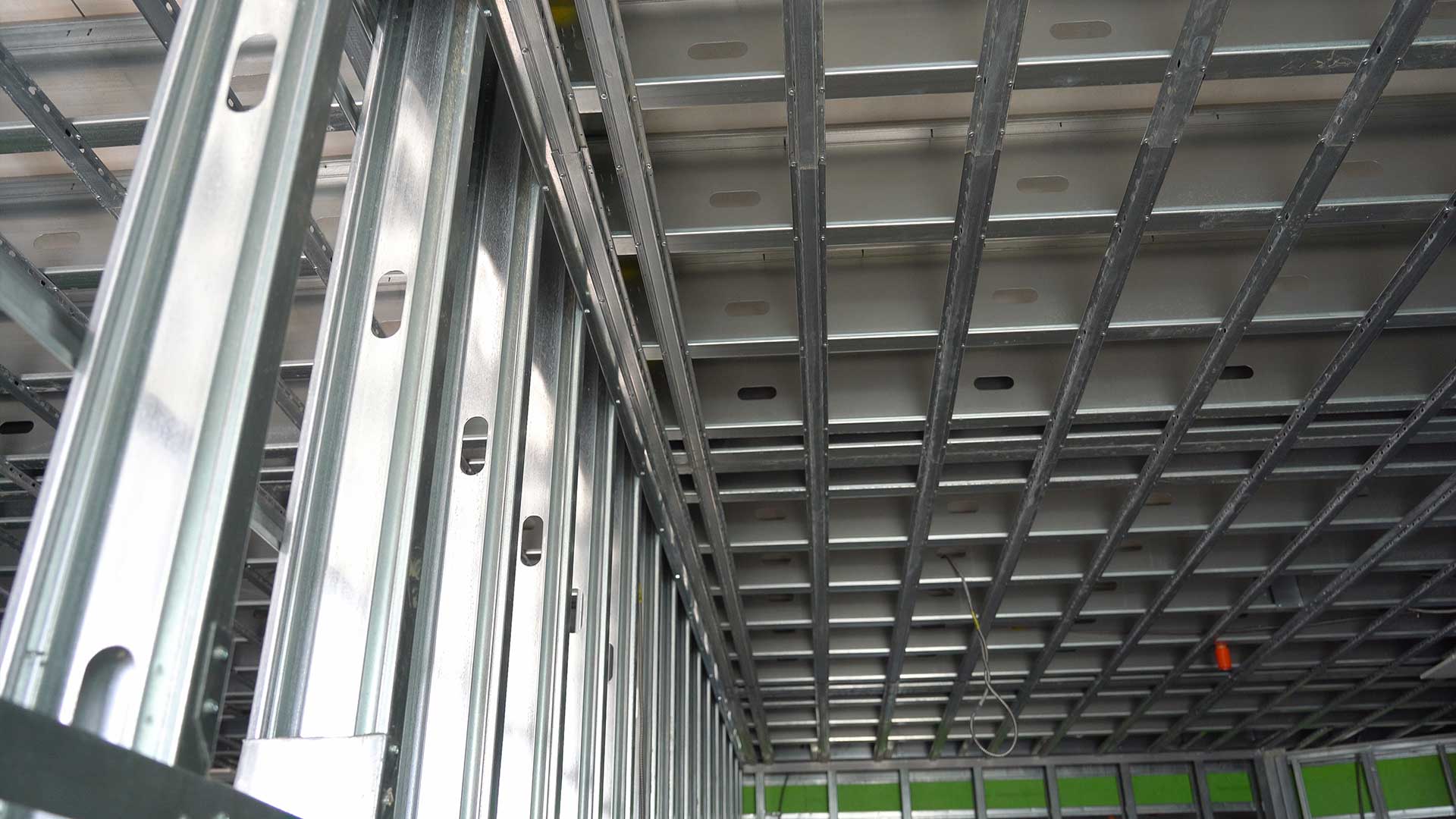
Load bearing cold-formed steel floor joists. Image Credit: The Steel Network
7 Advantages of 24″ CFS Stud Spacing
- Material Cost Savings: 24” o.c. could reduce the total number of studs and thus potentially lowering material costs, especially in projects where specific minimum sizing requirements are being enforced.
- Labor Cost Savings: By decreasing the number of studs, attachments and clips needed, less labor is required. Additionally, less studs mean 30% fewer screws are required for sheathing, streamlining both installation and finishing work.
- Improved Alignment with Floor Systems: Load-bearing floor framing systems are often CFS joists, CFS trusses or other floor systems. When they are CFS systems, and they are framed at 24” o.c. and match the wall framing at 24” o.c., the installation trades can vertically align the framing. This eliminates the need for a load-distributing member on top of the wall.
- Code Compliance: Building codes permit 24″ o.c. spacing as long as performance requirements, including wind, gravity, and deflection limits, are met. There is no 16” spacing limitation imposed by the International Building Code (IBC), American Society of Civil Engineers or American Iron and Steel Institute codes, which contain numerous references supporting 24” o.c. spacing.
- Greater Energy Efficiency: Fewer studs result in less thermal bridging, where heat is conducted through the metal studs and lost to the outside environment. Reducing the number of studs increases the insulation area, which can improve the wall’s overall thermal performance.
- Improved Acoustical Performance: Acoustical transfer between partition walls can achieve a higher acoustical rating. Sound transmits most effectively through solid objects, so minimizing contact between surfaces reduces noise transfer.
- Fire Rating Flexibility: Most UL ratings are based on studs at 24” o.c., but if the architect selects a UL rating requiring 16” o.c., numerous alternative UL options are available that have minimal impact on building costs.
Finding the Right Balance
The choice between 16” o.c. and 24” o.c. spacing in CFS structures requires balancing material costs, labor savings, code requirements and project-specific factors such as structural loads and energy efficiency goals.
“We work with our clients to evaluate these factors holistically, ensuring each project achieves the right combination of performance and cost-effectiveness,” says Garton.
Ultimately, choosing the right stud spacing in CFS structures is about finding the balance that maximizes both performance and cost-effectiveness, tailored to the unique needs of each project.
Read the original article from McClure.
Additional Resources
- How to Engineer Subfloors and Cold-Formed Steel Floor Joists for a Little Peace and Quiet
- SFIA 105: Energy Codes and Cold-Formed Steel Structures (On-Demand Course)
- Designers: Update to SFIA’s 2024 Tech Guide for the Latest CFS Load and Span Tables