
SFIA member Scottsdale Construction Systems offers a guide to steel framing design in high wind zones. Image credit: Scottsdale
After decades of success in commercial projects, cold-formed steel (CFS) is now setting a new standard in homebuilding. Louisiana Builders are turning to steel-framed homes.
Known for its strength, resilience and precision, metal framing is uniquely suited to hurricanes, wildfires and other climate challenges. Unlike wood framing, CFS does not warp, rot or attract termites. It is a durable and sustainable option for homeowners. As insurance costs soar and weather risks intensify, builders increasingly recognize steel as a smarter way to frame homes.
In The Advocate, “Steel-framed houses are rare. Here’s why this Louisiana developer wants to change that,” reporter Rich Collins profiles how Louisiana builders are leading this transition. The South Central Planning and Development Commission, Houma, Louisiana, is investing $4.5 million to design and manufacture steel-framed homes. The initiative gained urgency after Hurricane Ida ripped through south Louisiana in 2021. The storm’s devastation continues to reveal the risks of traditional wood construction, with widespread destruction, skyrocketing insurance costs. It also highlights a growing recognition that steel offers a stronger, more resilient alternative.
Steel-framed houses are rare. Here’s why this Louisiana developer wants to change that. https://t.co/eagJzTFY7q
— The Advocate (@theadvocatebr) September 25, 2025
Rising From the Storms
Hurricane Ida is a turning point for housing in south Louisiana. Homes built with Wood-framed homes remain vulnerable to high winds, flooding and termites that thrive in the humid climate. Communities face billions in damages and homeowners struggle under the weight of soaring insurance premiums. For the South Central Planning and Development Commission (SCPDC), it is clear that a different approach was needed.
“We went out and studied different building methods and procedures used around the country to see what fit our need — to withstand salt water, salty air, high winds, fire and termites,” says SCPDC CEO Kevin Belanger.
That research lead the commission to steel.
“We decided to invest in our own device to turn cold-rolled steel into 2x4s,” says Belanger.
By choosing steel, the commission is creating housing that prioritizes strength and resilience.

Cold-formed steel (CFS) framing provides superior wind resistance and strong structural integrity, making it an ideal alternative to traditional wood materials. Image Credit: FRAMECAD
85% Insurance Savings with Steel
From a converted warehouse, the South Central Planning and Development Commission trains a 16-person team. They learn to fabricate steel framing and build durable homes.
The first project, a three-bedroom elevated home in Houma, is nearing completion. Beyond its structural strength, the home demonstrates how cold-formed steel (CFS) framing directly reduces costs for families.
“The typical home costs $225,000 to $250,000. And you can expect to pay $8,500 to $10,000 annually on insurance,” says Belanger. “The first [insurance] estimate we get for this new house is about $1,200 a year.”
That dramatic difference is more than savings — it represents security for homeowners who would otherwise be priced out of coverage. It shows how steel outperforms wood in durability and affordability. And it’s a reason why Louisiana Builders are turning to steel-framed homes.
Homes Framed in 24 Hours with Steel
Private developers are also turning to steel in response to the same challenges. New Orleans developer Jamie Neville adopts steel framing for his 45-unit Blueberry Hill project, citing the precision and predictability of the material.
“There’s no human error in these homes,” says Neville. “They are all built with 90-degree angles, so the cabinets, door and windows all fit perfectly.”
Equally important, steel construction reduces costly delays.
“One day an 18-wheeler shows up and the house goes up like an Erector Set,” says Neville. “They have wall panels A, B, C and D and the house is framed by the end of the day.”
In a region where weather halts wood framing for days, this advantage is critical. Although upfront costs are higher, Neville finds long-term gains through reduced waste, faster timelines and sturdier construction.
BOXY, a Louisiana-based construction technology company, specializes in off-site modular unit construction using cold-formed steel (CFS) framing. While not part of the SCPDC program, BOXY’s approach highlights how CFS is advancing off-site construction in Louisiana.
How Cold-Formed Steel (CFS) Contributes to Resiliency
- CFS is highly ductile. CFS can easily bend or stretch without breaking when force is applied. This gives it a higher degree of resistance to lateral loads, uplift and gravity loading, such as those imposed on a structure by seismic or high wind events.
- CFS is non-combustible. According to the Steel Framing Industry Association, tests conforming to ASTM E119 show that both load-bearing and non-load-bearing CFS-framed assemblies remain fireproof for up to four hours.
- CFS is durable. CFS is corrosion resistant. It does not retain moisture and will not harbor mold growth. CFS uses zinc or similar coatings to boost durability. It resists corrosion for hundreds of years before its protective layer breaks down.
- CFS is impervious to pests. CFS is one of the few building materials completely impervious to termites and other pests in any climate or building type.
- CFS is a highly sustainable material. Steel framing contains on average a minimum of 25% recycled content and is 100% recyclable at the end of its life.

Backed by Steel Framing Industry Alliance (SFIA), UC San Diego researchers tested a 10-story cold-formed steel (CFS) structure with 18 simulated earthquakes and fire. The building stood strong — a breakthrough for building taller and safer with steel framing.
Building at Scale With Steel
Other Louisiana builders are using panelized steel walls. These systems are pre-loaded with utilities, echoing techniques common in commercial construction.
Chris Dupre, RNGD project manager, sees this as the only way forward.
“If we’re trying to solve the housing affordability crisis one house at a time, we’re going to get to the end of the world before we fix it,” says Dupre. “The key is to do this at scale.”
For Belanger and the SCPDC, that scale begins with a bold choice: to build steel homes where storms hit hardest.
“For years, we did not see any investment in residential developments in impacted areas,” says Belanger. “The risk of building in flood-prone areas along with high insurance rates is a killer. So, challenging times require bold efforts.”
By embracing cold-formed steel, Louisiana is building a stronger, more resilient future where families live safely, securely and affordably.
Read the full article from The Advocate.
Free eBook Offers Additional Insights
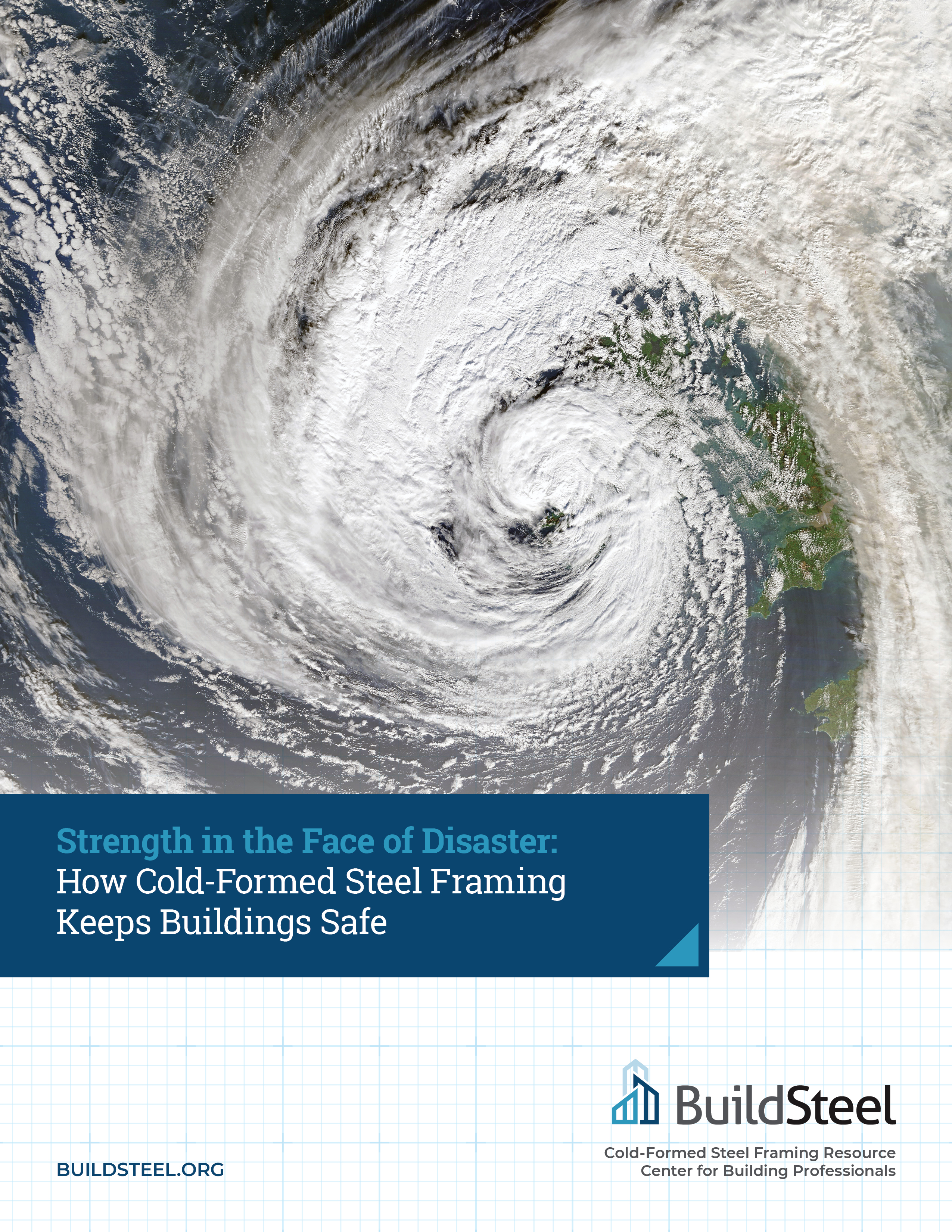
For additional information on how CFS framing can enhance the safety and reliability of building projects, while also minimizing disaster-related challenges, download the BuildSteel eBook, “Strength in the Face of Disaster: How Cold-Formed Steel Framing Keeps Buildings Safe.”
Additional Resources
- Steel Selected Over Concrete to Rebuild Homes After Hurricane Michael
- Homebuilders Embrace Steel as an Alternative to Wood Framing
- Cold-Formed Steel (CFS) Makes Homes Safer—and Insurable—in Wildfire Country
- CFS10’s Trial by Fire: Photos from UC San Diego’s Burn Tests Prove CFS’s Resilience