
Photos courtesy of Veev.
Veev, a panelized building technology innovator and an SFIA member, is manufacturing smart prefabricated luxury homes in Silicon Valley. A new $9.3 million smart prefabricated home at 993 Los Robles Ave in Palo Alto, California features cold-formed steel (CFS) framing.
Designed to attract local tech executives, the Los Robles home was manufactured off-site using Veev’s vertically integrated end-to-end panelized building technology.

A new $9.3 million smart prefabricated home at 993 Los Robles Ave in Palo Alto, California features cold-formed steel (CFS) framing.
A Home Built through Innovation
The 5,380-square-foot steel-framed home has five bedrooms and seven bathrooms. Like other luxury homes in the area, the Los Robles home has smart-home features and an elevator. It is within a 15-minute drive from Stanford University and Googleplex, says Insider Intelligence.
But unlike a traditional luxury home custom built on-site, the Los Robles home was partly prefabricated. Some of its components were built off-site in the Veev factory.


Dafna Akiva, Veev’s co-founder and CRO
“Our modular construction takes the approach of a home as a product, and we designed a [panelized] system that can build anything,” said Dafna Akiva, Veev’s co-founder and CRO. “A home is the most important, expensive product anybody has.”
Veev was founded by technology entrepreneurs who saw the opportunity to transform real estate development with an inventive approach to construction, says the Veev website. The company’s approach is to build homes focused on the needs of customers. This calls for innovation, rather than replying centuries-old building techniques, its website says.
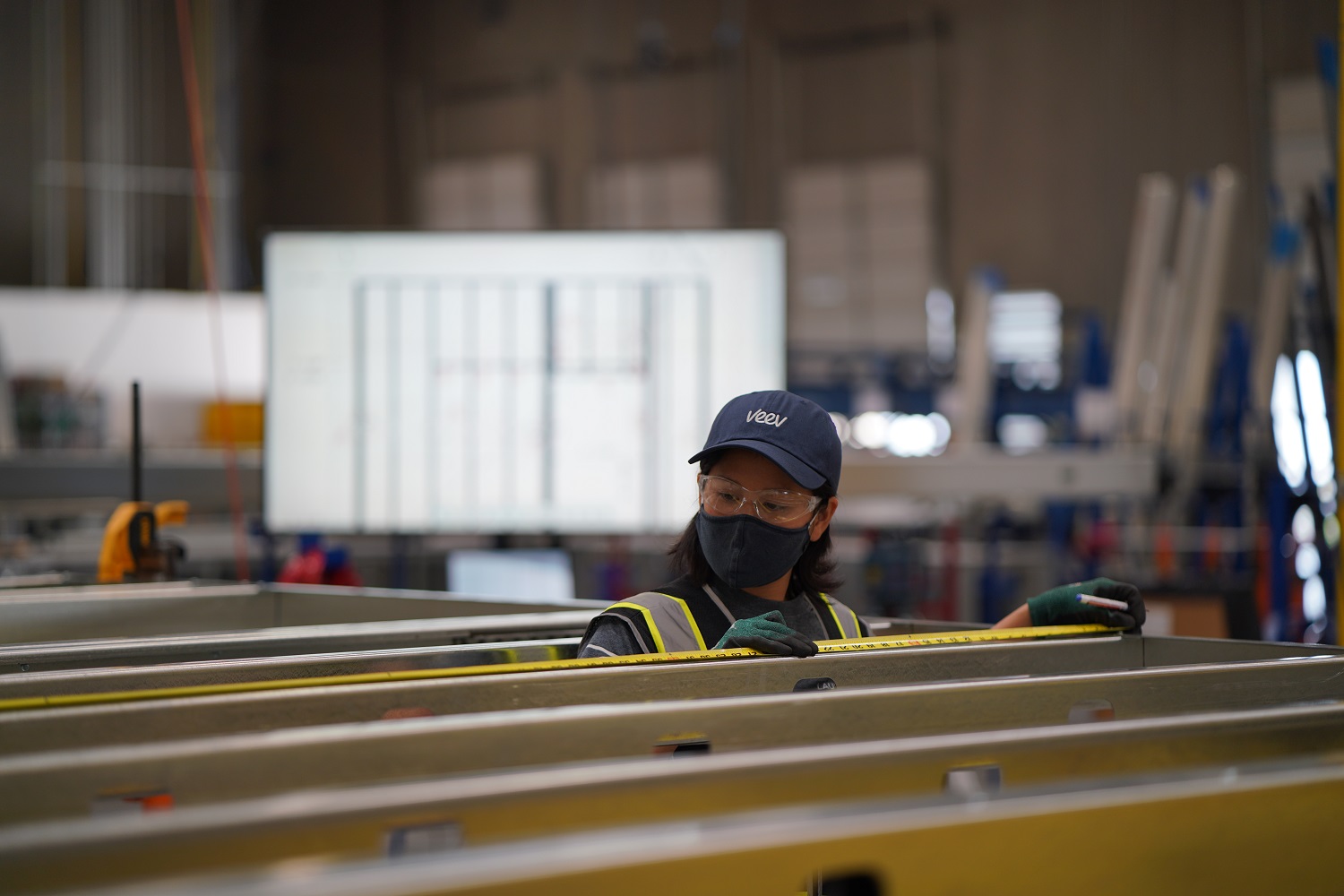
According to Yahoo Finance, Veev designs, manufactures and assembles key components of its homes. It manufactures steel-framed walls with mechanical, electrical and plumbing hook-ups already in place.
- Prefabricated walls can be transported and assembled on site faster than traditional construction
- Prefabrication also cuts down the layers and stages of construction as well as the number of parties involved in production and installation

The lights and temperature of the Los Robles Ave home are controlled through phone apps or through touch panels flushed into the home’s walls.
Advanced Control Systems
Given the Los Robles home’s tech-forward location, it should be no surprise that the home has technological advanced control systems. According to Insider Intelligence, the home doesn’t have any light switches. Instead, lights and temperature can be controlled through phone apps or through touch panels flushed into the home’s walls.
Luxury home buyers in Silicon Valley are typically executives age 30 to 50 working in the tech industry. Most have families. And almost all are looking for a modern home with integrated technology, Akiva said.
In 2019, Veev replaced wood framing with steel framing to build homes faster and at a lower cost.
Switch to Steel Framing Speeds Home Construction
In 2019, Veev eliminated lumber from the homes it built. The company replaced wood framing with steel framing and uses slabs made of a mix of acrylic and minerals that bind together, says USA TODAY. By using these processes, Veev can build homes faster and at lower cost.
In addition, Veev.com says that building with steel results in near-zero waste framing and a low carbon footprint.
“Veev is not the only company using a factory to make buildings,” says Fast Company, “but with a uniquely integrated approach that pulls design, material supply chain, manufacturing, and construction in-house, it’s carving a niche of pure efficiency.”
Since 2019, Veev has completed 138 residential units and is currently developing 231 residential units, of which 86 are single-family homes.
Veev Shifts Focus Towards Affordable Housing
According to Insider Intelligence, 993 Los Robles Ave may be one of the company’s last high-end projects. Veev plans to shift its focus to alleviating the housing crisis, “and this you can’t do with one-off $10 million homes,” Akiva said.
Veev is set to begin building a new residential community in Northern California. The new 102-house development, to be built in Northern California in the coming months, will use Veev’s vertically integrated, end-to-end, panelized building technology that optimizes every element of the living experience.
The residential community, comprising homes created entirely with Veev’s patented and productized approach to design and construction, will be the biggest to date for the company, according to Construction Review Online.
Additional Resources
- Veev’s Switch to Steel Framing Lowers Costs and Speeds Housing Construction
- 102-House Northern California Community to Use Veev Steel Framing Technology
- Prefabrication with Steel Framing: Centuries in the Making