
Researchers at the University of Aberdeen, a public research university in Aberdeen, Scotland, have developed advanced 3D printed metal connectors for cold-formed steel (CFS) framing. The development could lead to improvements in residential construction.
Printing Overcomes Distortion and Stress
Aberdeen’s researchers combined CFS framing expertise and digital fabrication to create connectors that can be reused rather than demolished at the end of a building’s lifecycle, advancing sustainable building practices. The project integrates manufacturing with engineering to make buildings easier to assemble while reducing construction waste.
The team designed the system to support circular construction goals and long-term material reuse. The connectors help builders adapt structures instead of sending materials to landfills.
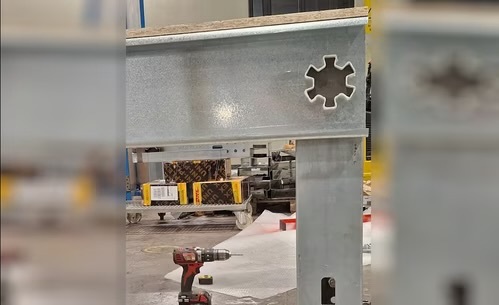
University of Aberdeen researchers developed 3D-printed metal connectors that enhance cold-formed steel framing performance and constructability.
University of Aberdeen researchers developed 3D-printed metal connectors that enhance CFS framing performance and constructability. The connectors improve precision and reduce installation complexity on site. Workers can assemble and disassemble framing systems without damaging primary steel members.
The Aberdeen team focused on high-precision connectors that work with CFS framing sections typical in housing. By printing directly onto thin substrates, the researchers overcame distortion and stress challenges.
The team printed onto steel sheets measuring only one to three millimeters thick. This method reduces residual stress and maintains structural integrity. The breakthrough makes the technology viable for real-world construction projects.
“This approach is entirely new,” says Dr Alireza Bagheri, senior lecturer in engineering at the University of Aberdeen. “No existing construction system currently combines metal 3D-printed connectors with cold-formed steel to enable rapid, automated assembly and complete disassembly for reuse.”
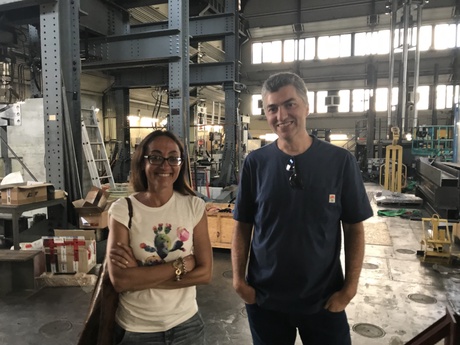
Professor Ornella Iuorio (left) and Dr Alireza Bagheri.
Connectors To Replace Traditional Connections
The researchers collaborated with Politecnico di Milano and combined prototyping, finite element modeling and full-scale testing. The team advanced the concept through laboratory validation and structural performance evaluation.
The connectors replace traditional mechanical connections. They allow for rapid assembly and complete disassembly without damage to structural parts. Builders can recover framing components and reuse them in future projects.
The innovation offers a scalable alternative to conventional building systems, promising reduced material waste, greater adaptability and longer building lifespans with lower environmental impact. The research positions CFS framing as a practical solution for construction strategies. The system supports faster construction while maintaining structural performance.