
Recent trends show limited construction spending, but data centers are the standout growth driver. And cold-formed steel (CFS) framing delivers the speed and performance these large-scale facilities require.
In the Walls & Ceilings article, “Why the Explosion in the Growth of Data Centers in the U.S. is a Boon for Steel Framing Manufacturers in 2026,” Steve Farkas, director of business development at CEMCO, an SFIA member, highlights how AI expansion is driving demand for large, clear-span buildings where steel framing offers clear advantages.
“The rapid expansion of AI-driven data centers is creating major opportunities for steel framing manufacturers because of steel’s safety, strength and sustainability advantages,” says Farkas.
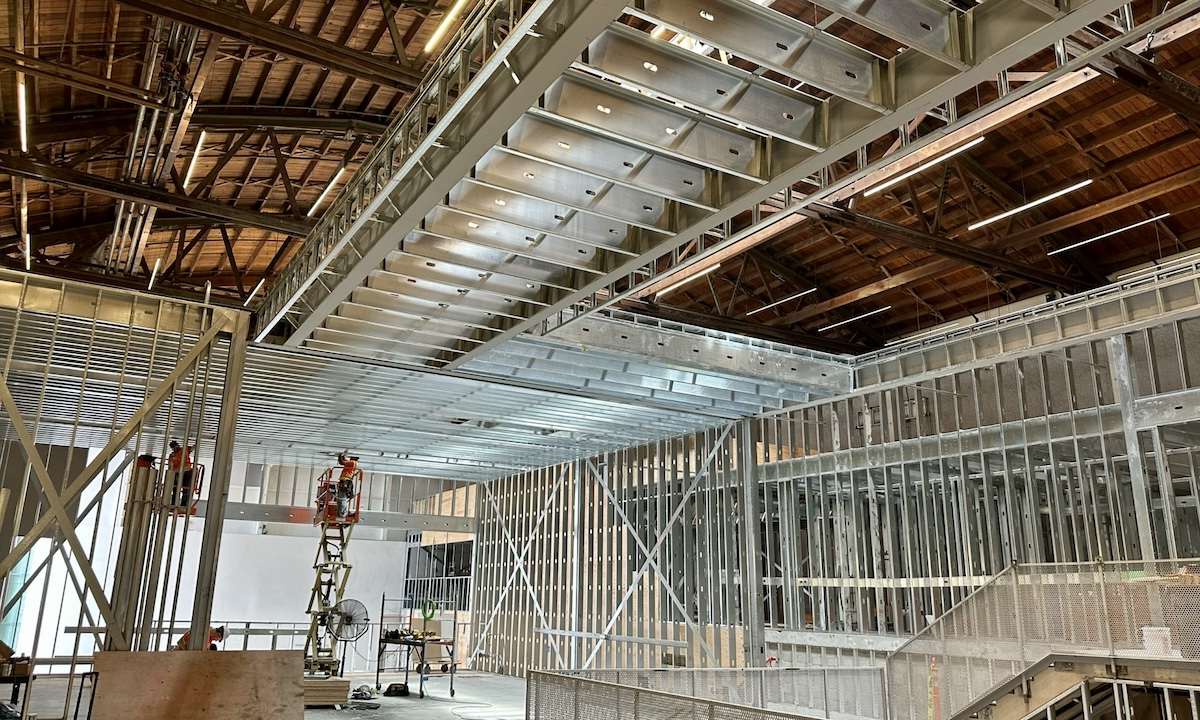
AI expansion is driving demand for large, clear-span buildings where steel framing offers clear advantages.
Comparing Structural Systems
Data center construction moves quickly, and projects demand massive footprints and flexible design. Many facilities span 200,000 to 500,000 square feet, with hyperscale projects reaching into the millions. These buildings rely on large clear spans to support cooling systems and adaptable server layouts.
To meet these requirements, project teams must evaluate the pros and cons associated with available structural systems:
- Wood framing can burn, warp and attract pests, limiting long-term performance
- Concrete blocks require large, heavy foundations to support walls typically 20 to 30 feet high.
- Steel framing delivers strength, efficiency and design flexibility
“When comparing wood-framed, concrete block and steel-framed construction, steel framing is often the most practical choice,” says Farkas.
Cold-formed steel framing systems support the critical performance demands of large-scale data center construction. Engineers rely on CFS to meet safety, load capacity and sustainability targets.

Steel framing delivers strength, efficiency and design flexibility.
5 Reasons CFS Contributes to Resilience
- It’s highly ductile. CFS can easily bend or stretch without breaking when force is applied. This gives it a higher degree of resistance to lateral loads, uplift and gravity loading, such as those imposed on a structure by seismic or high wind events
- CFS is non-combustible. According to the Steel Framing Industry Association, both load-bearing and non-load-bearing CFS-framed assemblies are fireproof up to four hours when subjected to tests conforming to ASTM E119
- CFS is durable. CFS is corrosion resistant. It does not retain moisture and will not harbor mold growth. CFS uses zinc or similar coatings to boost durability and will last hundreds of years before its corrosion resistance deteriorates
- CFS is impervious to pests. CFS is one of the few building materials completely impervious to termites and other pests in any climate or building type
- CFS is a highly sustainable material. Steel framing contains on average a minimum of 25% recycled content and is 100% recyclable at the end of its life
Why CFS Meets Data Center Demands
- CFS Is Safe — Steel framing supports resilient design with hundreds of fire-tested assemblies and decades of validated structural performance data. Engineers specify certified, code-compliant products to meet building codes.
“Organizations such as the Steel Framing Industry Association require members to maintain compliance through programs like the Code Compliance Certification Program, which involves third-party inspections by groups such as the International Code Council and Intertek to verify materials, manufacturing quality, and code transparency,” says Farkas.

The Steel Framing Industry Association (SFIA) requires members to maintain compliance through its Code Compliance Certification Program, which uses third-party inspections to verify materials, manufacturing quality and code compliance transparency.
- CFS Is Strong — Steel framing handles significant axial and lateral loads while maintaining structural integrity over decades of service. It accommodates seismic movement through controlled flexibility, while tight manufacturing tolerances and custom profiles improve installation efficiency and jobsite safety.
- CFS Is Sustainable — Steel framing supports a circular lifecycle with high recycled content and efficient electric arc furnace production. It reduces embodied carbon during manufacturing and allows full recovery and reuse of materials at the end of a building’s life.
“Using scrap steel lowers Global Warming Potential, a metric that measures the climate impact of production in kilograms of CO₂ per metric ton of steel,” says Farkas. “EAFs’ lower GWP translates to lower embodied carbon in steel framing products.”
‘Light Gauge’: An Obsolete Term
The term “light gauge” refers to the thickness of sheet and strip steel. This method for specifying thickness is now obsolete. Gauge numbers are only a rough approximation of steel thickness and should not be used to order, design or specify any sheet or strip product. Instead of gauge numbers, the steel framing industry now uses mils — 18 mil, 33 mi, for example — to designate CFS thicknesses in design specifications and contract documents.
While many still use the term "gauge" to refer to thickness, it is good to know gauge numbers and, where applicable, their corresponding mil thicknesses. Other industries, such as the steel deck industry, still use "gauge" to refer to thickness, but often their thicknesses are different from those used in steel framing. Therefore, this is another reason to use mil thickness or decimal inch to specify or order material.
CFS Readies the AI Era
As AI continues to advance, it is driving optimism in the construction sector. CFS framing delivers the speed and durability required for large-scale data center construction.
“With growing domestic steel capacity and ongoing technological progress, steel framing manufacturers are well positioned to support data center growth by delivering products that are safe, strong, and sustainable for generations to come,” says Farkas.
Read the full article from Walls & Ceilings.
Additional Resources
- CEMCO Wins SFIA Award for the Steel Framing at Denver’s Wynkoop Street High-Rise
- The Steel Framing Industry Association (SFIA) Names 13 Recipients of the 2025 Industry Awards
- Data and Noncombustible Materials Hold the Key to Safer Construction, Says SFIA’s Don Allen