
January 21, 2026 — The Cold-Formed Steel Engineers Institute (CFSEI) has published Tech J200-26, “Tech Note G500-25: Vibration of Cold-Formed Steel Joist Framed Floors.”
Cold-formed steel (CFS) floor systems are widely used in residential and multi-residential construction, driven by trends toward more open areas and efficient material use. As these systems become more prevalent, floor vibration performance has emerged as a critical design consideration. CFSEI Tech Note J200-26 helps CFS design engineers address vibration within everyday practice, an area where limited design guidance has been available until now.
Analyze CFS Floor Vibration Performance
CFSEI has developed this Tech Note to familiarize CFS design engineers with key vibration performance criteria and analysis methods. J200-26 demonstrates how these two tools can be applied to deliver floors that perform well.
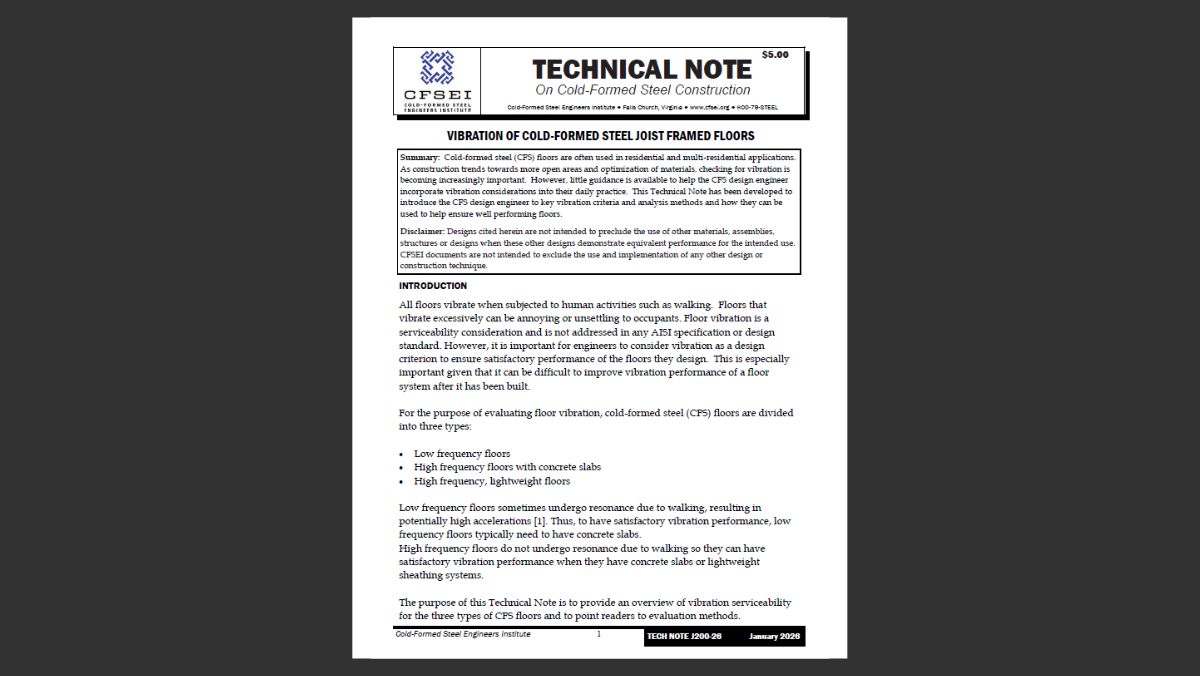
Tech Note G500-25: Vibration of Cold-Formed Steel Joist Framed Floors
CFSEI Tech Note J200-26 covers:
- Overview of vibration serviceability considerations for CFS joist-framed floors
- Distinction between low-frequency and high-frequency CFS floor systems
- Key vibration criteria, including natural frequency, acceleration and deflection
- Factors that influence vibration performance, such as damping, mass, span and partitions
- Evaluation methods for floors with concrete slabs and lightweight sheathing systems
Purpose and Application
This Tech Note explains how engineers apply vibration criteria and analysis methods to evaluate floor serviceability during design. It helps engineers achieve acceptable vibration performance and occupant comfort in residential and multi-residential buildings.
The document outlines practical evaluation approaches based on floor type and directs engineers to appropriate methods for low- and high-frequency floors. It emphasizes addressing vibration during design, when engineers can most effectively improve performance and avoid post-construction remediation.
Referenced Standards
The publication references widely used vibration and design resources, including:
- AISC Design Guide 11
- ATC Design Guide 1
- Peer-reviewed research on vibration serviceability of CFS floor systems
Readers can use this document as a technical reference when evaluating vibration performance of cold-formed steel joist-framed floor systems.
- Tech Note J200-26 is available free of charge to CFSEI Corporate, Professional and Student Members
- Nonmembers: J200-26 is available for purchase
Industry experts write and update CFSEI Technical Notes to guide professionals in cold-formed steel design and construction.

Cold-Formed Steel Engineers Institute
The Cold-Formed Steel Engineers Institute (CFSEI) comprises hundreds of structural engineers and other design professionals. Together, they are finding a better way to produce safe and efficient cold-formed steel (CFS) designs for commercial and residential structures. CFSEI members develop industry standards and design methods. CFSEI issues technical bulletins, organizes seminars and provides online training so that engineers and design professionals can improve their knowledge and skills. CFSEI is part of the Steel Framing Industry Association (SFIA) family. For more information, visit www.cfsei.org.
Additional Resources
- CFSEI Releases Updated Tech Note G500-25: Field Guide – Inspection Checklist for Structural CFS Framing
- CFSEI Releases Tech Note B011-25 for Engineers New to Cold-Formed Steel Framing Design
- CFSEI Publishes Tech Note F140-25: ‘Welding Cold-Formed Steel’
- CFSEI Publishes Tech Note L400-25: ‘Non-Bearing Cold-formed Steel Lateral Force Resisting Systems’
- CFSEI Publishes Tech Note on Evaluation and Remediation of Cold-Formed Steel Members and Connections
- CFSEI Publishes Tech Note on the Design of Cold-Formed Steel Bearing Stiffeners
- CFSEI Publishes Tech Note on Hole Reinforcement of Cold-Formed Steel Compression Members
- CFSEI Publishes Technical Note on Strap Braced Wall Design, Loose Strap Considerations