
Featured image: The cold-formed steel (CFS) floor framing, roof framing and wall framing of this home survived the Palisades Fire of January 2025. The wood framing did not. All photos: Don Wheeler
When a wall of fire swept through the hillside neighborhood of Pacific Palisades in early 2025, it left behind a trail of destruction. Entire blocks of timber-framed homes were reduced to ash. One house, built in 2021, offers a striking example of resilience in the face of extreme conditions.
Situated just 8 feet from homes destroyed on either side, the Palisades home was constructed with noncombustible cold-formed steel (CFS) framing. Though partially damaged, the core structural frame — its floor joists, walls and roof framed with CFS members — endured extreme temperatures and survived.
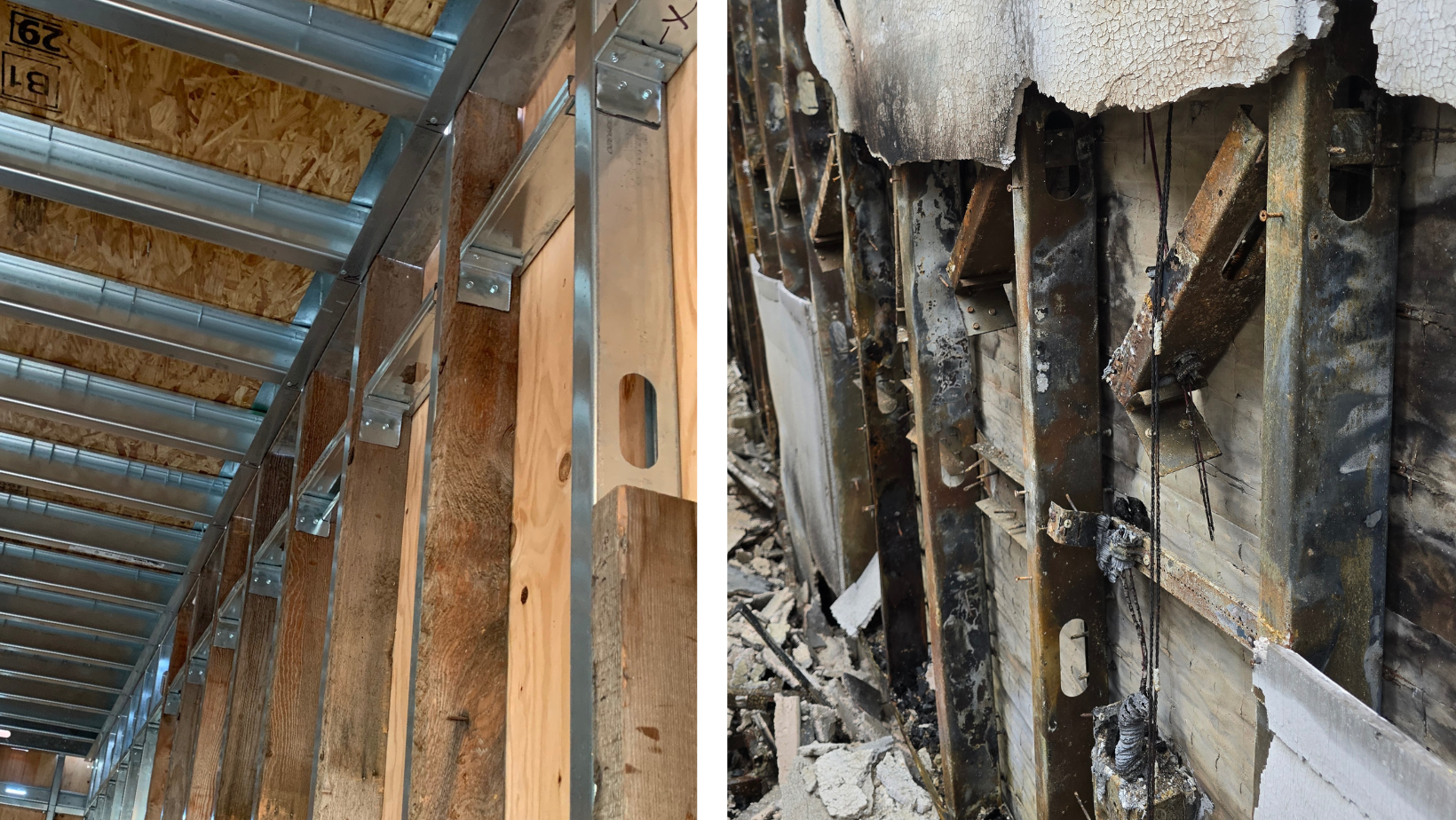
In the Palisades Fire, a home’s wood studs and plywood (left) burned away completely (right), leaving only cold-formed steel (CFS) framing, nail heads and the back of the exterior stucco.
Carl Welty, an architect familiar with the Pacific Palisades home and a Malibu home whose steel framing survived, says most nearby wood-framed structures became fuel for the fires.
- Welty calculates that a wood-framed, 3,000-square-foot house contains — in latent BTUs — the equivalent of 2,794 gallons of gasoline.
- Modern homes generate 200 times more smoke and burn 8 times faster than 50 years ago, the International Association of Fire and Rescue Services says.
“There’s this idea out there that steel will melt in a house fire,” said Welty. “But house fires don’t get anywhere near the temperature needed to melt steel. These homes prove that.”
Modern homes burn 8 times faster than 50 years ago.
Wood Feeds Fires — Steel Does Not
Wood framing ignites at temperatures as low as 500°F. During a house fire, interior wood elements often burn at 1,100° to 1,500°F — far below the 2,500°F needed to melt steel. Yet a persistent myth remains that steel framing will collapse or melt in a house fire.
Both homes — which feature custom steel framing packages provided by supplier Don Wheeler of Wheeler Steel Framing Supply — refute that myth with vivid, post-fire reality. Even where burning wood was bolted directly to the steel, the steel framing remained intact. The conventional plywood sheathing — used for floor, roof and wall assemblies — was the weak link.
“The plywood burned. The steel didn’t,” Wheeler noted. “How simpler can it get than that?”

At the Palisades home, cantilevered cold-formed steel (CFS) deck joists and their foundation connection remained intact — where less wood meant less fire intensity.
When the radiant heat shattered nearby windows, embers entered the home, igniting furniture and wood materials, Welty said. The plywood floor, roof deck and shear panels burned completely away. The furniture disintegrated. But the steel studs and joists held their form, supporting the still-standing stucco exterior.
“About half of the material is being reused,” Wheeler said. “On the Malibu house, it’s 70%. We’re not recycling it — we’re reusing it structurally.”
The steel studs and joists held their form, supporting the still-standing stucco exterior.
A Second Test Case: Malibu
Just 15 miles up the coast, a second home under construction in Malibu faced similar fire conditions. This project had just passed its framing inspection when the wildfire struck.
Despite being exposed to open flame, the steel floor joists and concrete walls remained untouched. What burned? The plywood floor sheathing — combustible material used in the structure.
As a consultant to the construction team on both projects, Wheeler noted, “I tried to get the engineer to use metal decking. He said the plywood would be fine — that’s what burned.”
At one point, a heavy 4×12 wood ledger, spanning the gap between a concrete wall and steel floor joists, was entirely incinerated. But, the surrounding steel members showed no warping or deformation.
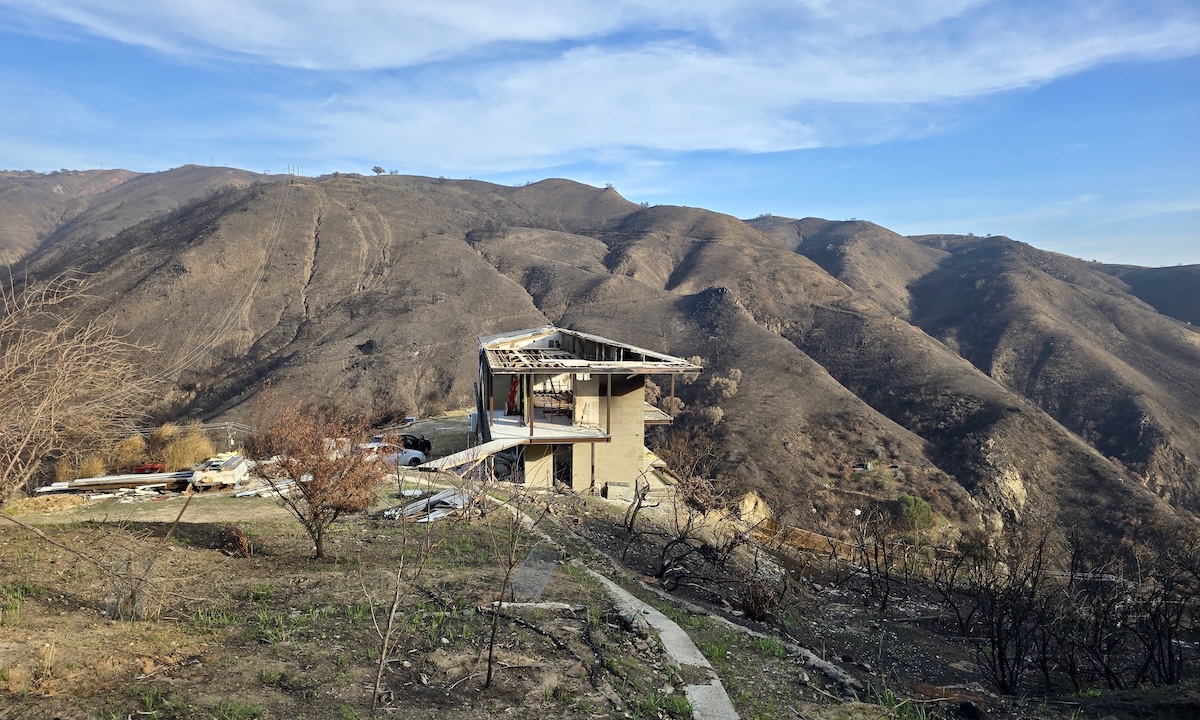
Partially constructed when the wildfire hit, this Malibu home’s cold-formed steel (CFS) framing package provided by Wheeler Steel Framing Supply withstood the flames.
Cost-Effective, Resilient, Sustainable
The Pacific Palisades and Malibu homes prove that fire-resilient construction isn’t just possible — it’s practical.
Contrary to common assumptions, building with pre-cut CFS can be cost-competitive with wood framing. Using efficient offsite fabrication methods, suppliers like Wheeler deliver steel framing kits that reduce onsite labor, minimize framing waste by 90% and lower total construction costs.
In fact, some CFS-framed projects have shown cost reductions of 10–20% over traditional wood-framed homes, Welty said.
“House fires don’t get anywhere near the temperature needed to melt steel. These homes prove that.”
Welty breaks it down further:
- $195K in potential savings on a 3,000-square-foot home from reduced labor, waste and callbacks
- Fewer callbacks due to dimensionally stable steel, which doesn’t warp or shrink
- Sustainable reuse: Half of the steel from the burned Pacific Palisades home is being salvaged and reused — something building codes prohibit for wood framing
Moreover, the homes demonstrate another key benefit of steel framing: easier deconstruction.
“You can unscrew the damaged steel elements and reuse the rest,” Welty said. “Try doing that with a charred wood-framed structure.”
Wheeler added that deconstructing the steel framing at the Pacific Palisades house took 3 days using a crew of two. Most of the wood-framed houses around it were bulldozed away. No wood was left — only “nails in the dirt,” Wheeler said.
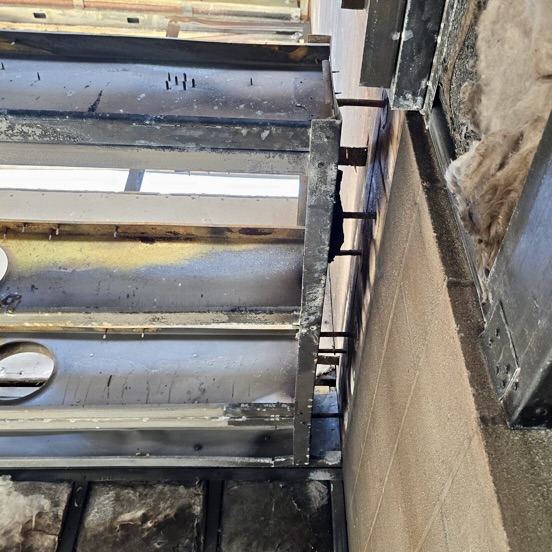
At the Malibu home, the 4 x 12 wood ledger burned away completely, leaving the steel floor joists and rim track — still bolted to the concrete block — intact and reusable.
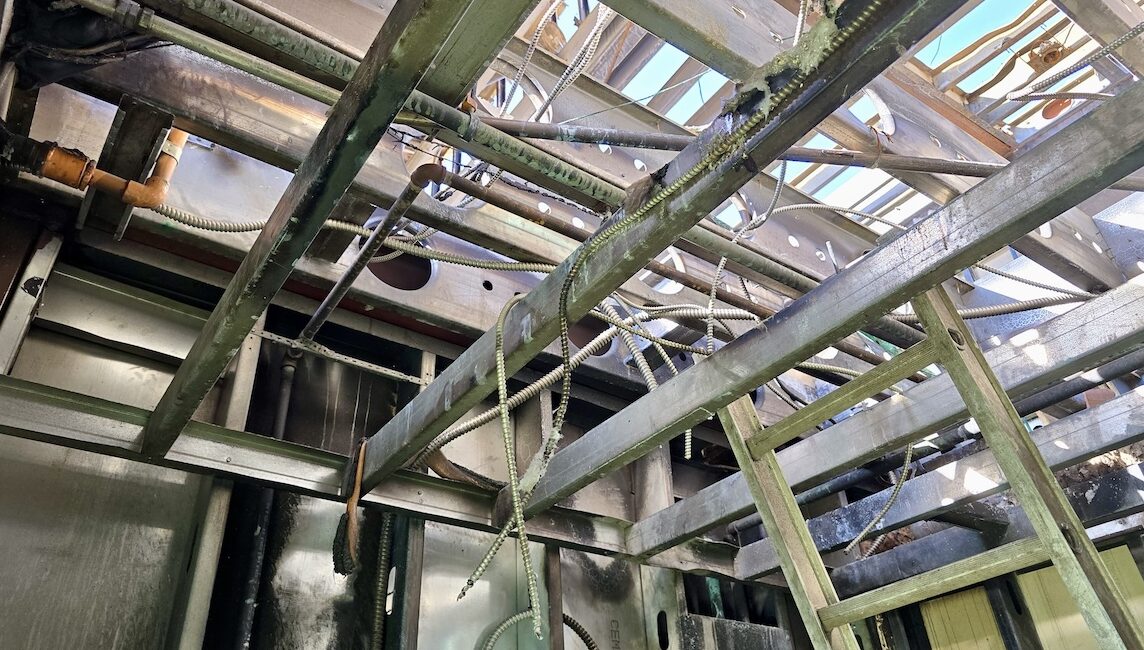
The wood is clearly missing — burned away, though the cold-formed steel (CFS) remains intact.
A Smarter Future for Fire Zones
California’s rebuilding efforts must confront a hard truth: The traditional wood-framed house has become a liability in fire-prone regions. And efforts to “harden” combustible structures — by adding defensible space, thicker windows or flame-retardant cladding — often fail to address the real issue: the wood in the house becomes the fuel.
Welty proposes a new model: noncombustible homes built with steel framing and surrounded by rehydrated landscapes. Without the need to create barren defensible zones, communities could build resilient steel-framed homes that allow for trees, gardens and green buffers — landscaping that would help to cool neighborhoods and reduce long-term fire risk.
“Instead of creating desert-like fire buffers around combustible homes, we can ‘open the door’ to denser, greener communities,” Welty said.
When Urban Firestorms Hit
The lessons from Pacific Palisades and Malibu are stark: in dense neighborhoods, the primary fuel in large urban conflagrations isn’t the landscape — it’s the homes themselves. Combustible wood framing feeds the flames. Noncombustible steel framing resists them.
As climate-driven fires become more frequent and destructive, builders, insurers and policymakers must confront the risks of rebuilding communities with flammable materials. CFS offers a proven alternative: durable, resilient and tested in the heat of real-world disasters.
Fire Safety: 5 Reasons to Use Steel
1. Steel is Noncombustible
Steel can’t burn, because it contains no elements that can serve as fuel.
2. Steel Maintains its Noncombustibility
Steel remains noncombustible throughout the entire lifecycle of a building — during construction, occupation and renovation and repair.
3. Steel Framing Reduces Fire Risk to Workers and Occupants
Fire-rated walls and floors help contain flames and preserve the integrity of a structure.
4. Steel-Framed Buildings Reduce the Impact on Municipal Fire Services
Fires have strained local fire departments, prompting many municipalities to adopt site-safety regulations for combustible buildings.
5. Steel-Framed Buildings Tend to Cost Less to Insure
CFS framing saved $1.32 million in builders risk insurance premiums over the 24-month construction of a four-story, 400-unit hotel — plus $66,000 annually in property insurance premiums compared to wood framing.
Additional Resources
- This Wildfire Season, Cold-Formed Steel Leads the Way in Building Fire-Resilient Homes
- Wildfire Resilience with Cold-Formed Steel: Insights from NASH’s Ken Watson
- As Wildfires Rage On, One Homebuilder Urges a Shift to Steel Construction