
Don Allen, executive director of the Steel Framing Industry Association (SFIA), has been involved in the cold-formed steel (CFS) framing since 1990. In a recent interview with Mahsa Mahdavian, technical marketing director for SFIA member Scottsdale Construction Systems, Allen shares his experiences on how advancements in roll-forming, digital design and manufacturing have transformed CFS framing into a more efficient, adaptable and sustainable building solution. Watch the interview:
Tech-Driven Breakthroughs
In the interview, Allen told Mahdavian that technological advancements have transformed the CFS industry, especially In the past decade. Sophisticated software tools now simplify design and analysis, while labor-saving technologies, prefabricated systems and computer-aided manufacturing continue to boost production efficiency.
“There is a lot of innovation in our industry,” Allen said. “With companies like Scottsdale Construction Systems, roll-forming machines that are tied with computer-aided manufacturing allow someone to design and then immediately produce the products and produce the panels.”
Allen said developments like these are paving the way for broader use of CFS in mid-rise and high-rise floor systems. This is especially true in urban areas with growing demand for high-rise buildings.
Redefining Sustainability
Sustainability is a key focus in the steel framing industry. Over the past 15 years, Allen said that product innovations have led to thinner, lighter studs with reduced embodied carbon, all while maintaining stud strength. Such resilience and sustainability qualities are making steel framing increasingly attractive to environmentally conscious builders.
The steel framing industry, Allen said, is shifting toward sourcing steel coils produced by electric arc furnaces that use over 90% recycled steel and, as a result, lower the environmental impact of steel production.
Besides such sustainability benefits, Allen told Mahdavian that another CFS quality — steel framing’s dimensional stability — prevents thermal bridging, enhances insulation and reduces energy costs. The result is improved steel framing transparency, which is backed by the industry’s comprehensive environmental product declarations.
“Later this year, we will come out with new product category rules to develop new environmental product declarations for steel framing, adding even more transparency to our industry,” says Allen, alluding to the SFIA’s new role as an accredited ANSI Standards Development Organization responsible for managing many CFS test and framing standards. “This will provide architects and builders the opportunity to make an apples-to-apples comparison of steel framing to other products.”
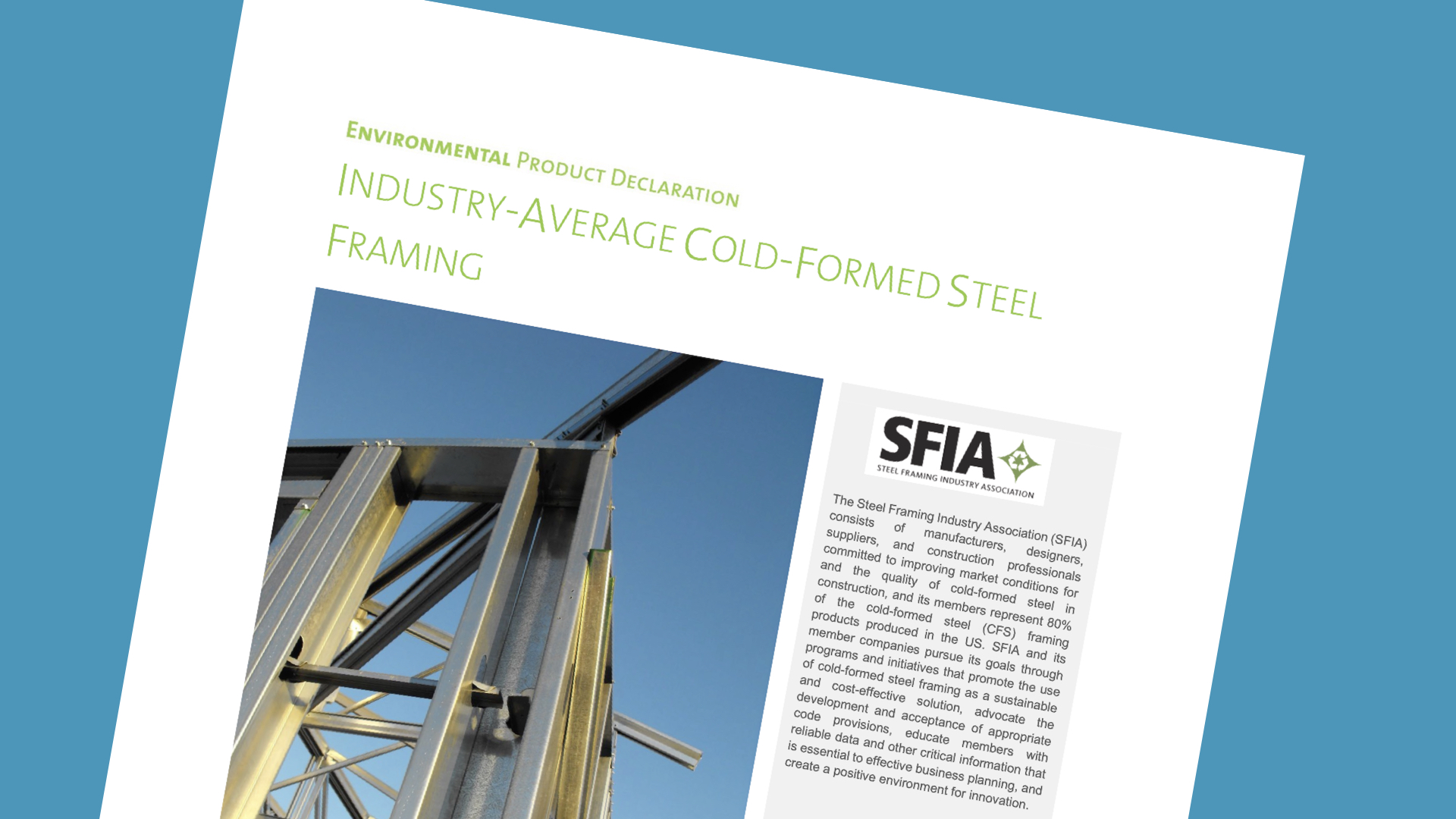
SFIA’s new industry-average EPD provides independently verified environmental impact data for cold-formed steel framing products.
SFIA EPD
The Steel Framing Industry Association (SFIA) Environmental Product Declaration for Cold-Formed Steel Framing (EPD) is a must-have tool for contractors, building owners, architects and others who strive to deliver advanced building designs that meet the latest LEED™ and other sustainable rating systems, programs and standards.
The SFIA EPD for CFS Framing can be seamlessly integrated into project specifications as an option with company-specific EPDs. SFIA offers a Specifications Review Service for steel framing, which is a completely free checkup.
Next-Gen Construction
Emerging technologies like robotics, modular construction and on-site fabrication can reduce waste, enhance efficiency and lower environmental impact, Allen said. The shift toward on-demand contractor manufacturing promises greater flexibility and faster permitting, ultimately reducing construction timelines and costs.
Additionally, Allen said the industry is focused on attracting new talent by highlighting the exciting potential for creativity and high-tech innovation in steel framing, paving the way for future growth and innovation.
“Construction is fun, I dedicated my life to it,” said Allen. “It’s a great career with endless opportunities for people of all ages — especially with steel framing, where you can create beautiful, enduring structures.”
Scottsdale Construction Systems offers a comprehensive range of roll-forming machines, cutting-edge software and support services tailored to the industry’s needs. Learn more about Scottsdale’s ecosystem and its roll-forming technology.
Read the original Scottsdale Construction Systems article.
About Scottsdale Construction Systems
Scottsdale Construction Systems is a global company focused on research and development and the innovative development of light gauge steel technology for the house building and construction industries.
Scottsdale Construction Systems has been providing world leading solutions for the manufacture of steel frames and trusses for both the residential and commercial construction markets since its inception in 1995.
We are based in Australia and have North American operations and a rich history in the United States and North America. We have an established network here in North America and also in almost 100 countries worldwide.
For more information, visit scottsdalesteelframes.com.

Additional Resources
- Scottsdale Posts Guide for Engineering Cold-Formed Steel Framed Homes
- Scottsdale Posts Comprehensive Guide to Steel Framing for Modern Construction
- Australian Research Council and Scottsdale Fund CFS Floor Truss Research