
Images provided by FRAMECAD.
In hurricane-prone regions, choosing the right construction materials is crucial for safety, durability and long-term value. Cold-formed steel (CFS) framing stands out as a superior choice, offering exceptional wind resistance, structural strength and favorable insurance benefits, making it a strong alternative to traditional materials like wood.
In the article “Building Resilience: How Steel Framing Stands Up to Hurricane Forces,” FRAMECAD, an SFIA member, explores three reasons why CFS outperforms traditional framing materials in the construction of hurricane-resistant homes and buildings.

Cold-formed steel (CFS) framing provides superior wind resistance and strong structural integrity, making it an ideal alternative to traditional wood materials.
3 CFS Benefits in Storm-Prone Regions
1. Wind Resistance
Steel framing excels in resisting high winds. This makes it ideal for regions prone to tropical storms, cyclones and severe weather. CFS structures withstand wind forces that would severely damage traditional buildings due to its superior strength-to-weight ratio and secure connections.
Recent hurricanes, like Ian (2022) and Milton (2024) affecting the eastern United States, demonstrated the resilience of steel-framed buildings under extreme wind speeds. Such structures were able to maintain their core stability during the sudden, powerful gusts.
2. Structural Integrity
Steel does not warp, rot or crack under pressure. Its integrity ensures long-term durability even after enduring harsh weather conditions. Unlike wood, which can absorb moisture and weaken over time, CFS studs and joists retain their structural properties. Thus, CFS framing provides reliable support, even during storms.
The flexibility of CFS allows it to bend without fracturing, enhancing its performance during severe weather events .
3. Financial Incentives
By enhancing a building’s resilience, steel framing can offer significant financial advantages, the FRAMECAD article says.
“Properties constructed with steel often qualify for reduced insurance premiums due to their enhanced resistance to weather-related damage,” FRAMECAD says. “Insurance providers recognize that steel structures have a lower risk profile, which can result in significant cost savings for property owners, developers and investors.”
Additionally, a steel-framed structure may require fewer repairs after a hurricane.
“[The] reduced repair costs associated with steel framing make it an economically savvy choice, helping offset initial construction investments over the building’s lifespan,” FRAMECAD says.
By specifying CFS framing, developers can gain “a competitive edge in a market increasingly focused on sustainability and disaster readiness,” the article says.
“The choice of materials can be the difference between a structure that weathers the storm and one that succumbs to it,” it adds.
How Cold-Formed Steel (CFS) Contributes to Resiliency
- CFS is highly ductile. CFS can easily bend or stretch without breaking when force is applied. This gives it a higher degree of resistance to lateral loads, uplift and gravity loading, such as those imposed on a structure by seismic or high wind events.
- CFS is non-combustible. According to the Steel Framing Industry Association, both load-bearing and non-load-bearing CFS-framed assemblies are fireproof up to four hours when subjected to tests conforming to ASTM E119.
- CFS is durable. CFS is corrosion resistant. It does not retain moisture and will not harbor mold growth. CFS uses zinc or similar coatings to boost durability and will last hundreds of years before its corrosion resistance deteriorates.
- CFS is impervious to pests. CFS is one of the few building materials completely impervious to termites and other pests in any climate or building type.
- CFS is a highly sustainable material. Steel framing contains on average a minimum of 25% recycled content and is 100% recyclable at the end of its life.
Free eBook Offers Additional Insights
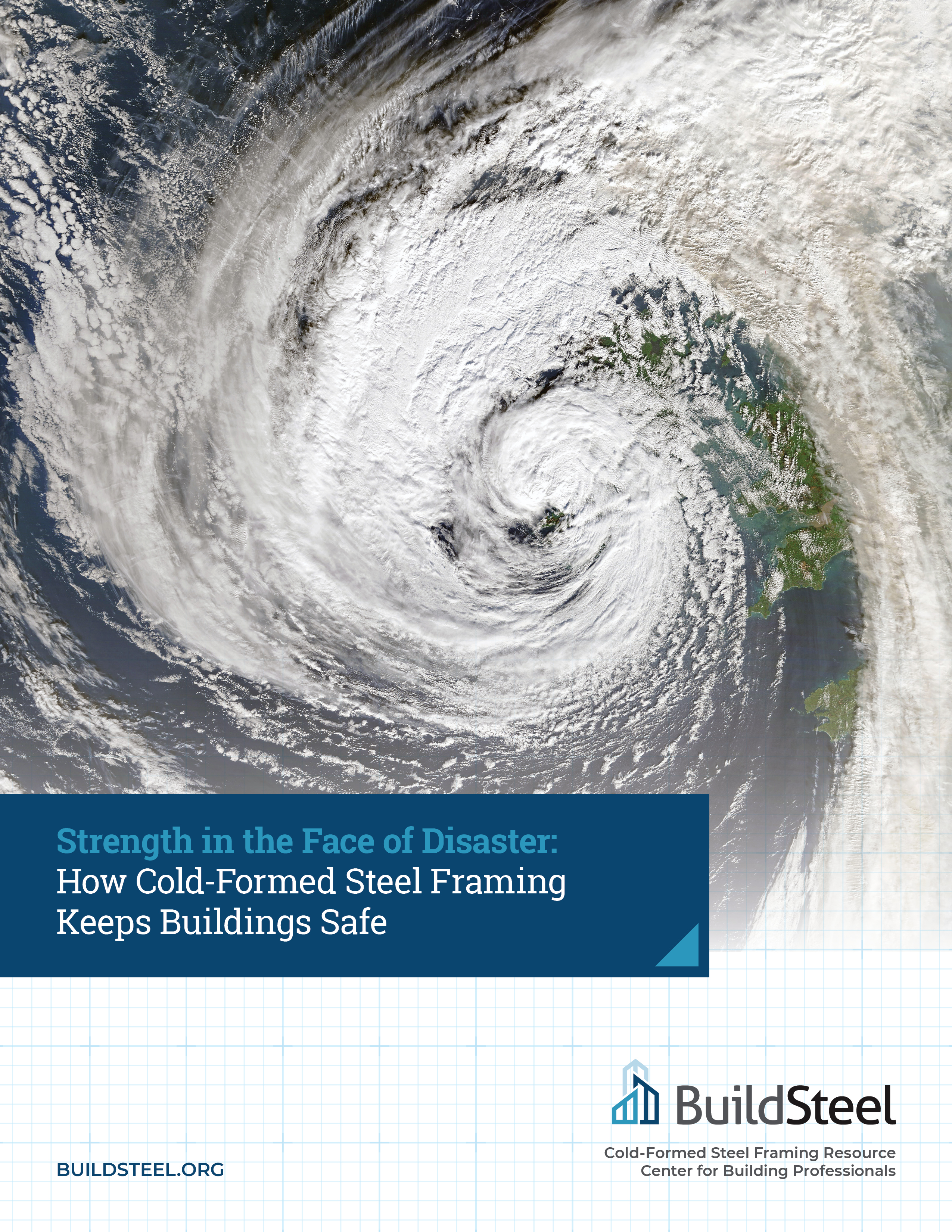
For additional information on how CFS framing can enhance the safety and reliability of building projects, while also minimizing disaster-related challenges, download the BuildSteel eBook, “Strength in the Face of Disaster: How Cold-Formed Steel Framing Keeps Buildings Safe.”
Additional Resources
- Homebuilders Embrace Steel as an Alternative to Wood Framing
- Construction Begins on 10-Story CFS-NHERI Building, Seismic and Fire Testing to Follow
- Top 5 Reasons Steel Framing Can Keep a Building Safe During an Earthquake