
Image Credit: FRAMECAD
In the past, modular buildings were sometimes viewed as low quality due to their association with temporary structures like school portables. Today, however, modular construction has advanced technologically, and the healthcare industry is leveraging the improvements, says the article “Will the healthcare building revolution be modularized?” by Architecture & Design, an Australian publication.
“Modular construction has advanced, resolving many of its earlier issues with strict standards and state-of-the-art technology,” the article says.
Today, modular construction is making significant strides, particularly with the use of cold-formed steel (CFS) framing. CFS framing offers durability, reduced waste, termite resistance and cost efficiency, benefits noted by the healthcare sector.
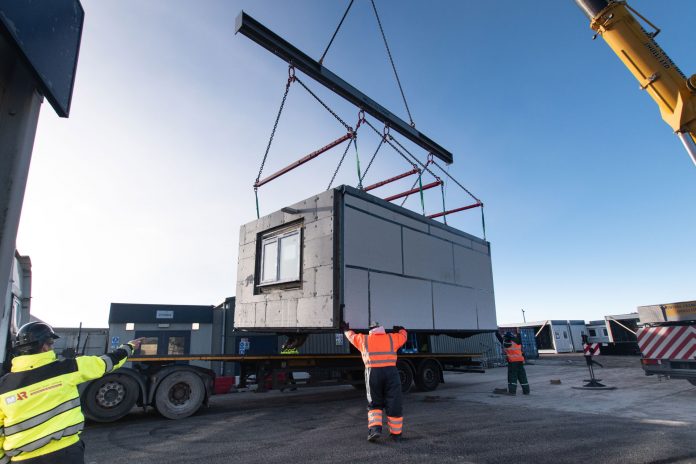
Housing 21, manager of 20,000 retirement properties in the United Kingdom, is using modular construction to build two senior housing projects framed with cold-formed steel (CFS).
Steel Speeds Up Construction of Senior Living Project
UnitingCare Queensland’s Sunrise Beach Aged Care Facility, located in Australia, was designed using modular steel construction to enhance the living environment for residents while significantly reducing construction time and costs.
“The homes are designed to provide residents with an authentic domestic experience, arranged in small clusters of 8-9 rooms,” says Pino Gentile, principal architect at Thomson Adsett. “Each room is situated around a series of light-filled courtyards or offers views of the adjacent national park.”
View this post on Instagram
The implementation of CFS framing for this project offers significant advantages, including natural resistance to termites without the need for chemical treatments and exceptional durability in tropical climates. Unlike other materials, CFS does not warp, twist or shrink when exposed to moisture, effectively addressing critical climate-related challenges. For UnitingCare, these attributes, combined with the accelerated construction timeline, were among the primary benefits of selecting CFS framing for their project.
“Smaller cranes were used, reducing costs and allowing materials to be positioned efficiently,” says Mitchell Crisp, principal at fabricator Ultimate Steel Framing. “The ease of handling CFS frames enabled the labor force to be split into smaller teams, working on multiple areas simultaneously, which helped expedite the project’s progress.”
In a region where demand for senior living facilities is outpacing most other parts of Australia, the timely delivery of high-quality homes for residents is essential. Modular design, enabled by CFS framing, presents a significant opportunity not only in Queensland but for other senior living centers across the country.
Why Cold-Formed Steel for Modular Construction?
- Site Impact – Fewer onsite materials reduce congestion and injury potential while improving traffic flow
- Improved Design – Virtual Design and Construction models all aspects of the building components. This enables innovation, improves quality, reduces errors and neutralizes escalation costs
- Speed to Market – Advances supply chain deliverables and accelerates early revenue
- Offset Worker Shortage – Enables greater production offsite, reducing the need to increase labor
Steel-Framed Bathroom PODs Keep Hospital Construction on Schedule
In the United States, the $550 million SSM Health Saint Louis University Hospital opened on schedule and within budget in September 2020. To achieve the project’s aggressive schedule, the construction team used collaborative lean building methods. This included the use of CFS framed modular bathroom PODs.
SFIA member T.J. Wies Contracting, a commercial wall and ceiling contractor specializing in metal stud framing, prefabricated 294 PODs and then installed the modular units once transported to the jobsite. The PODs reduced labor, materials, waste, costs and increased speed to occupancy for the project.
The worksite during the construction of the new hospital was complicated and congested, including heavy use of mechanical, electrical and plumbing (MEP) to meet the needs of the hospital. By building the bathroom PODs offsite, T.J. Wies was able to control the production environment without constraints.
“Being able to control the environment allowed us to complete this work with zero lost time injuries, the highest form of productivity, and quality,” says Chris Sauer, T.J. Wies senior project manager. “The project itself benefited by the hours being implemented offsite while steel was being set, and the punch list process being done months ahead of time – all of this saved months on the schedule.”
In 2022, T.J. Wies won the Association of the Wall and Ceiling Industry (AWCI) Excellence in Construction Award in the interior prefabrication category for the POD project.
Modular Steel Set to Reshape Healthcare Construction
Modular construction in the healthcare sector is anticipated to experience significant growth as more builders recognize the cost-effectiveness and durability of CFS framing.
As awareness of modular construction increases, the stigma surrounding these methods will further diminish, leading to broader industry acceptance.
Over time, modular construction, enhanced by CFS framing, has the potential to transform the construction industry. It offers a sustainable, efficient and innovative alternative to traditional building practices, particularly in sectors like healthcare, where the demand for high-quality solutions is critical.
Additional Resources
- Steel Framed Bathroom PODs Keep St. Louis Hospital Construction on Schedule
- Builders Embrace Steel Framing for Offsite Construction
- Modular Steel Units Elevate Supportive Housing Project in Los Angeles