
Each month, the Cold-Formed Steel Engineers Institute (CFSEI) publishes answers to questions about the design of cold-formed steel (CFS) framing, which it receives through its 1-800-79STEEL hotline. “Ask an Expert,” the name of this series of frequently asked questions, can be accessed at CFSEI’s FAQ of The Month web page.
CFSEI Hotline
1-800-79STEEL
Clip Angle Design
Recently, CFSEI’s “Ask an Expert” responded to this question: Does AISI D114, Clip Angle Design Guide, require consideration of prying action when evaluating the anchored leg of a clip angle?
Does AISI D114, Clip Angle Design Guide, require consideration of prying action when evaluating the anchored leg of a clip angle?
Answer
AISI D114 provides design guidance based on both a strength limit state and a deflection limit state for clip angles subject to tension.
Traditional limit states associated with prying action are:
- Bending failure of the connecting element (e.g., anchored clip leg)
- Tension failure of the fastener

Fig. 1: Pull-over failure mode. Courtesy CFSEI
However, a University of North Texas study on thin screw attached clips identified two additional strength limit states. Both are addressed in AISI D114:
- Pull-over of the anchored clip angle leg (Fig. 1)
- Pull-out of the screw from the base material
The pull-over strength limit state, Pnov is defined as:
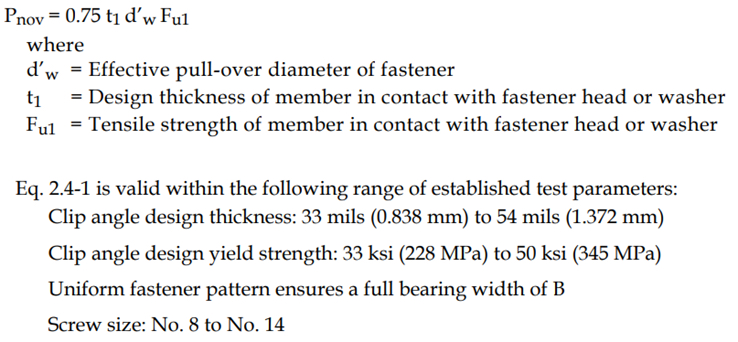
Definition of Pnov.
The pull-over strength design equation was calibrated to test results. Thus, any prying effects are included in the design equation. Therefore, prying effects need not be considered.
However …
For the pull-out strength and screw tension strength evaluations, the prying effects should be considered.
The D114 deflection limit state is as follows:

The deflection limit state as published in AISI D114.
Based on the UNT testing, for thicker clip angles, the 1/8” deflection limit was achieved prior to a failure of the clip angle. Thus, when applying the AISI D114 design methods because a deflection limit is imposed for clip angles thicker than 54 mils the traditional prying action limit states are not a design consideration.
However, if the 1/8” deflection limit is not imposed as a design limit state, then prying action should be considered when evaluating the following limit states:
- Bending failure of the connecting element (e.g., anchored clip leg)
- Tension failure of the fastener
- Pull-over of the anchored clip angle leg
- Pull-out of the fastener from the base material
Ask an Expert
If you have any cold-formed steel (CFS) questions, contact CFSEI experts online or call CFSEI Hotline at 1.800.79STEEL.
Read more Ask an Expert questions and answers here:
CFSEI Hotline
1-800-79STEEL
1-800-79STEEL
The CFSEI Hotline from the Cold-Formed Steel Engineers Institute receives inquiries about cold-formed steel (CFS) applications. Architects, engineers, building officials, students and contractors needing answers from respected experts can check “Ask an Expert” on the CFSEI website or call 1-800-79STEEL.
CFSEI is part of the Steel Framing Industry Association (SFIA), where its leadership as the industry’s key touchpoint for CFS design receives full support.

Additional Resources
- SFIA Releases Guide to the Performance-Based Nonstructural Partition Selection of Metal Framing
- SFIA Releases Updated Technical Guide with the Most Up-to-Date CFS Load and Span Tables in the Industry
- 5 Need-to-Knows about Building Codes and Cold-Formed Steel