
BuildSteel is tracking the sustainability initiatives of Steel Framing Industry Association (SFIA) members and their partners. Here are some recent sustainability news releases related to the cold-formed steel (CFS) framing industry.
Steel Dynamics Supports The Steel Climate Standard
Steel Dynamics Inc., one of the largest steel producers and metals recyclers in the United States and an SFIA member, announced recently that the company supports The Steel Climate Standard.
The Steel Climate Standard published by the Global Steel Climate Council provides a technology-agnostic global standard to measure and report steel product greenhouse gas emissions and provide a science-based target-setting framework to enable the industry to reduce carbon emissions.
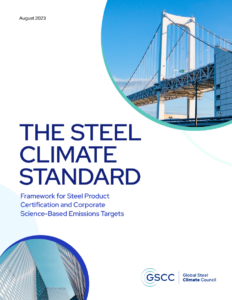
The Steel Climate Standard, August 2023
“We are proud to be a founding member of the Global Steel Climate Council,” said Mark D. Millett, SDI chairman and chief executive officer. “Steel is an integral component of the global economy and foundational to the world’s essential infrastructure.”
“This new standard will accelerate the actual reduction of greenhouse gas emissions and provide key decision-makers with transparent and consistent data to make informed decisions,” he added.
GSCC’s standard is comprised of two main components:
- Product certification criteria that allows customers to know if the steel they are buying is on the glidepath to achieve Paris Climate Agreement goals
- A science-based target-setting framework based on a 1.5°C scenario glidepath for net zero GHG emissions (Scope 1, Scope 2 and Scope 3 categories) by 2050
Read the full text of The Steel Climate Standard, first published in April 2023 and refined since then. Access the complete Steel Dynamics press release here.
Cleveland-Cliffs Cuts CO2 Emissions by 32%
Testifying at a recent Congressional Steel Caucus’s State of Steel hearing, Cleveland-Cliffs Inc. chairman, president and CEO, Lourenco Goncalves said the company reduced its greenhouse gas emissions by 32% in 2022 as compared to a 2017 baseline. An SFIA member, Cleveland-Cliffs aimed to reduce carbon emissions by 25% by 2030, but Goncalves said it has far exceeded that goal.
“Due to our decision — made in 2018 — to spend $1 billion to build a state-of-the-art Direct Reduction Plant, and then to use our low-emissions direct reduced iron in the form of HBI as feedstock in our blast furnaces, Cleveland-Cliffs was able to not only exceed the target by a large margin, but also to get there in 2022 — eight years ahead of schedule,” Goncalves said.
The company also completed a successful hydrogen trial at its Middletown Works blast furnace in Ohio. It injected hydrogen into all 20 tuyeres of the furnace as a replacement for coke, a purified form of coal.
The groundbreaking use of hydrogen as an iron reductant has the potential to greatly reduce carbon emissions at vertically integrated blast furnaces. Goncalves said the trial proved that use of massive amounts of hydrogen as a reductant, replacing coke, effectively replaces CO2 generation with the generation of water.
Cleveland-Cliffs is working to bring about a clean hydrogen economy through its participation in two Midwestern hydrogen hubs, Goncalves said.
“As a major consumer of the hydrogen to be produced by the hubs, we will enable the use of hydrogen by other carbon-intensive industries, particularly the automotive sector,” he said.
Read the complete story reported by nwi.com.
Carnegie Mellon Receives $3 Million to Pioneer Decarbonized Steelmaking
Earlier this year, Congresswoman Summer Lee, PA-12, who serves on the House Science, Space and Technology committee, announced that Carnegie Mellon University will receive $3,094,435 in federal funding through the Department of Energy for advancements enabling decarbonization in ore-based iron and steelmaking operations. The funding will help establish research efforts in line with the DOE’s Low Emissions Steel Manufacturing Research Program, according to a news release from Congresswoman Lee.

Congresswoman Summer Lee

Margaret Morrison Carnegie Hall at Carnegie Mellon University
In 2022, DOE released the Industrial Decarbonization Roadmap. The Roadmap identifies key pathways to reducing industrial emissions and focuses on five energy-intensive subsectors where industrial decarbonization efforts can have the greatest impact: cement and concrete, chemicals, food and beverage, iron and steel and petroleum refining.
To help reduce greenhouse gas emissions, the DOE’s Industrial Efficiency and Decarbonization Office funding programs to develop key decarbonization pathways. These pathways include:
- Alternative iron and steelmaking processes
- Hydrogen injection into blast furnaces
- Using clean electricity sources
- Increased use of scrap
- Integrating hydrogen use into existing processes
Iron and steel manufacturing in the United States produces 7% of industrial emissions. Steelmaking requires high process temperatures and a source of carbon to drive reactions. Pittsburgh leads the country in the production of steel, of which more than 1 billion tons are produced annually for buildings, transportation and more.
Read the complete news release here.
Additional Resources
- Update #10 | Sustainability News from ArcelorMittal, U.S. Steel and Nucor
- Update #9 | Sustainability News from Nucor, Cleveland-Cliffs and U.S. Steel
- Update #8 | Sustainability News from FrameCAD, Cleveland-Cliffs and ArcelorMittal Dofasco
- Update #7 | Sustainability news from ArcelorMittal, SDI and U.S. Steel
- Update #6 | Sustainability news from Cleveland-Cliffs, Worldsteel and U.S. Steel
- Update #5 | News from Nucor, Cleveland-Cliffs and a New Low-Emissions Steel Coalition
- Update #4 | Steel Framing Industry Sustainability Initiatives
- Update #3 | Steel Framing Industry Sustainability Initiatives
- Update #2 | Steel Framing Industry Sustainability Initiatives
- Update #1 | Steel Framing Industry Sustainability Initiatives