
In 2021, the United States announced a commitment to reduce national greenhouse emissions 50–52% by 2030 and create a net zero emissions economy by 2050. Achieving these goals requires the design community to understand how to appropriately use competing materials.
While other industries have chosen not to be transparent in their environmental product declarations, the steel industry has offered straightforward and factual data related to its environmental impact.
EPDs: Fact or Fiction?
It can be a challenge to navigate the various information that is offered to determine the environmental impacts of building materials.
“In the analysis of environmental impact, whether steel, concrete or wood, or any other material, it is important to consider certain elements which are based on facts and not fiction,” said Hellen Christodoulou, executive vice president at Corbec, a Canadian steel galvanizer. “Unfortunately, industries are angling to make their products more appealing and often rather than stating facts, as the steel industry does, they instigate hype with fiction and false extrapolations.”
According to the American Iron and Steel Institute, wood claims in some studies to have a smaller environmental footprint than any other major building material. However, a closer look at the facts reveal some significant inconsistencies with that claim.
Kevin Dempsey, president and CEO of AISI, raised an important question recently in The Wall Street Journal. “Who says it is more sustainable to build with wood than steel?” he asks.
“Harvesting wood, which is often cited as a renewable resource, destroys forests, releasing carbon dioxide from mature trees and affecting wildlife, water storage and filtration,” Dempsey writes.
Steel should be included in discussions about sustainable building materials, Dempsey says.

The American steel industry is the cleanest and most energy efficient of the leading steel industries in the world.
Transitioning to Near-Zero-Emissions Steel
The steel industry is the largest materials industry in the global economy. The global iron and steel market size is valued at over $1 trillion dollars. It is 7.5 times the size of the copper industry, 10 times the size of the aluminum industry and 3 times the value of the cement industry.
Steel is a key component for thousands of the products that make our lives possible, from building materials to automobiles. Building a sustainable steel industry requires cooperation and mutual commitment from companies at all levels of the steel supply chain, representatives of civil society and other stakeholders.
McKinsey & Company analysts believe the steel industry’s pathway to net-zero greenhouse gas emissions looks promising.
Lower carbon steel production technologies coming soon “will support the transition to near-zero-emissions steel,” says the April 2022 McKinsey report, “Net-zero steel in building and construction: The way forward.” The viable options include natural gas direct-reduced iron and electric-arc furnaces and 100% scrap electric-arc furnaces, McKinsey says.
McKinsey notes that ArcelorMittal Dofasco, Cleveland-Cliffs, Inc., Nucor Corp., Steel Dynamics, Inc. and United States Steel Corporation, all Steel Framing Industry Association (SFIA) members, among other steel mills, are:
- Replacing iron ore pellets in blast furnace feeds with carbon-free direct reduced iron or hot briquetted iron
- Using carbon capture and storage
- Increasing their scrap use
- Switching from natural gas to renewable power
- Piloting other technologies to create near-zero emissions steel
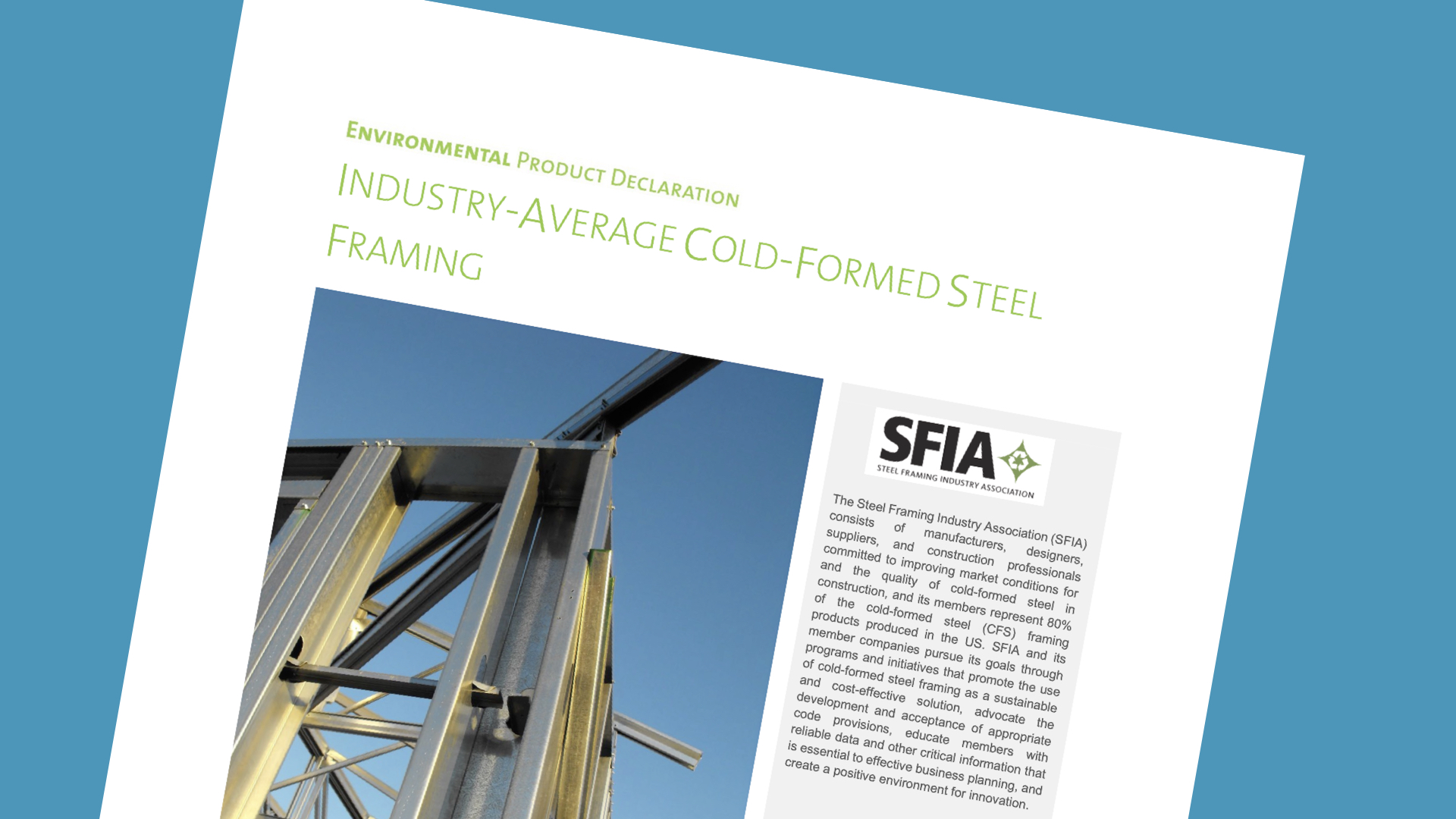
SFIA’s new industry-average EPD provides independently verified environmental impact data for cold-formed steel framing products.
SFIA EPD
The Steel Framing Industry Association (SFIA) Environmental Product Declaration for Cold-Formed Steel Framing (EPD) is a must-have tool for contractors, building owners, architects and others who strive to deliver advanced building designs that meet the latest LEED™ and other sustainable rating systems, programs and standards.
The SFIA EPD for CFS Framing can be seamlessly integrated into project specifications as an option with company-specific EPDs. SFIA offers a Specifications Review Service for steel framing, which is a completely free checkup.
Cradle to Gate or Grave?
Environmental Product Declarations are documents that summarize the results of a life cycle assessment for specific products. These declarations have been compared to the nutrition label on food packaging because they present concise information to help product specifiers make better-informed product decisions.
EPDs describe the potential environmental impacts of a product across a specified list of environmental impact categories.
“Everyone benefits when a product’s claim of environmental sustainability is easily validated against objective and transparent criteria, thereby simplifying the process of making informed direct comparisons among similar products,” according to Architect Magazine.
The International Organization for Standardization (ISO) 14025:2006, defines an EPD as a Type III declaration that quantifies environmental information on the life cycle of a product, from raw material extraction and manufacturing through installation, use and maintenance to disposal. All these stages illustrated below, contribute to the total embodied carbon impact of a building.
“Why does wood or concrete fail to declare past the production stage A1 to A3 (Cradle to Gate),” asked Christodoulou? “Steel declares from A1 to D (Cradle to Grave).”

Source: Canada Construct Connect
Spun Truth and Hype
Comparing the EPDs between materials can be difficult. Christodoulou notes that comparing EPDs should only be made if:
- Their impacts are calculated using the same methodologies
- The products being compared are functionally equivalent
“So here is the challenge that the concrete and wood industry have,” said Christodoulou. “They push the use of EPD’s to architects and engineers, failing to be transparent about the fact that material EPDs are just not comparable.”
“Many claims fostered by special interest do not clearly define the assumptions and contain nuggets of spun truth and hype used to develop their environmental statements and rely on false equivalencies when comparing competing systems,” said Christodoulou. “The sheer volume of often contradictory claims is overwhelming.”
Additional Resources
- Steel Framing Industry Offers 4 Tools to Help Reduce Construction’s Carbon Footprint
- Again, Who Says It Is More Sustainable to Build With Wood Than Steel?
- Which is the More Sustainable Building Material – Wood or Steel?