
Featured image: The Rosie under construction in Chicago. Project profile provided courtesy of CFSEI. All photos courtesy of R.A. Smith, Inc.
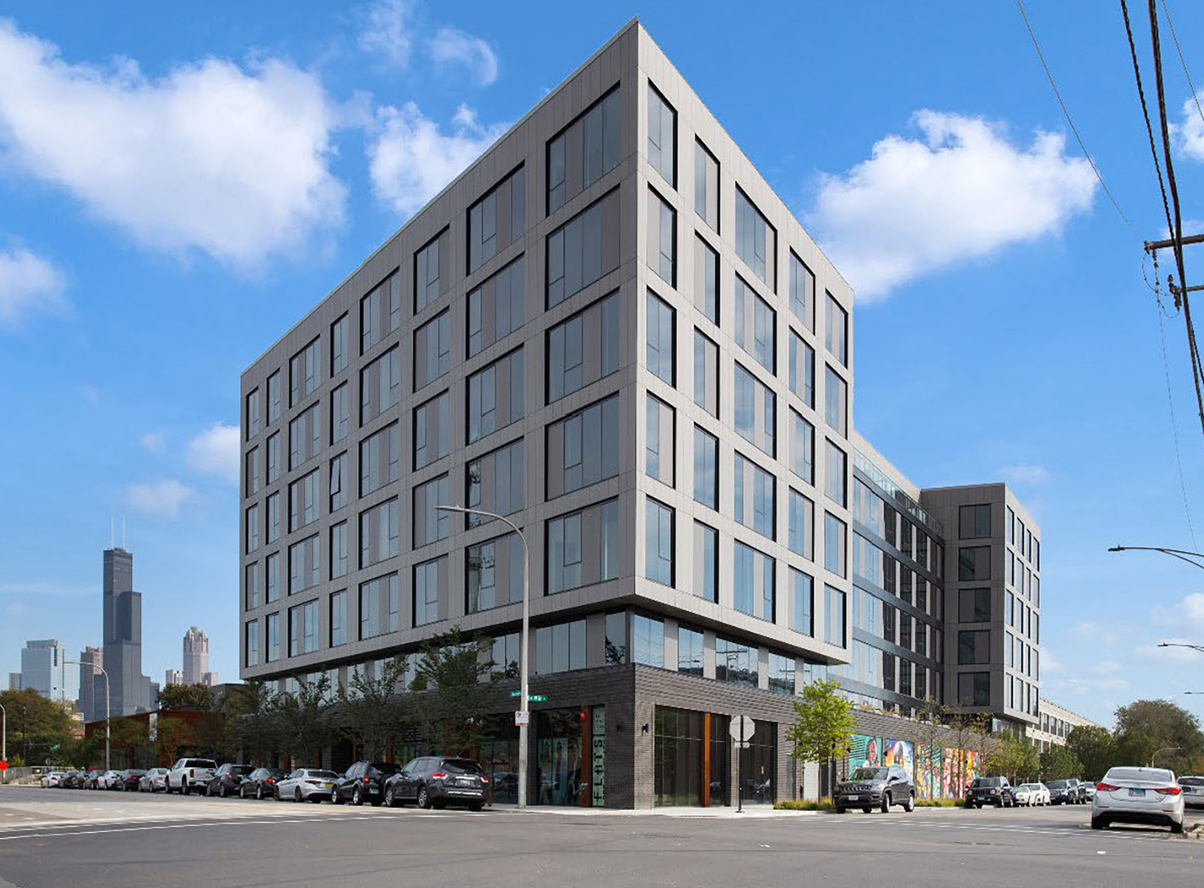
The Rosie from Cedar Street Development has 202 luxury residential units, parking and two high-level retail spaces. Many apartments are convertible with movable partitions and Ori technology.
The apartment building is groundbreaking for its design. The building is seven stories. It has a large, one-story cast-in-place reinforced concrete podium, which is followed by six stories of cold-formed steel (CFS) framing.

Cold-formed steel (CFS) framing at The Rosie includes both C-stud load-bearing and exterior wall framing and CFS joists.
The primary lateral bracing of the structure is provided by cast-in-place concrete stair and elevator cores. The CFS framing includes both C-stud load-bearing and exterior wall framing and CFS joists.
R.A. Smith, Inc., a member of the Steel Framing Industry Association (SFIA), is the 2023 CFSEI Design Excellence Award winner for the project, taking second place in the residential/hospitality category in the Cold-Formed Steel Engineers Institute’s award competition.
Hybrid Steel Design
The Rosie’s design is unusual. It features a cantilevered third floor around virtually the entire perimeter of the apartment tower. To achieve a cantilevered third floor, R.A. Smith designed a hybrid system featuring CFS framing and hot-rolled steel transfer beams and columns (posts) concealed within the third-floor cavity and second-story walls.
Further complicating the structural design is the “H”- shaped overall plan that includes one of the outer wings at an acute angle from the rest of the tower.

The Rosie’s H-shaped layout has several acute angles as shown here in raSmith’s third-floor framing plan.
Architecturally, the second story is designed to be exclusively glass on the exterior. This required the bearing walls to be perpendicular to the exterior wherever possible or for the support to be provided by additional steel beams with the floor cavity. The clean exterior and interior look of the building belies the complexities concealed with the second story and third floor.
R.A. Smith was hired at the onset of design to work directly with the architect and structural engineer of record. This also allowed R. A. Smith to coordinate all lateral and gravity transfer loads early on with the structural engineer to create the most efficient podium, foundation and core structures possible.
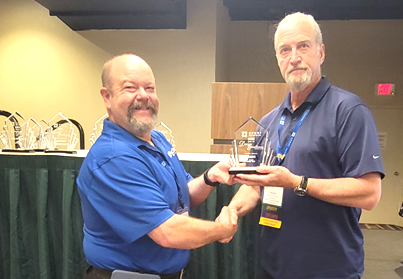
Dana Hennis (left), P.E., S.E., CFSEI vice chair, presents the CFSEI 2023 award to Patrick Ford, P.E., S.E., of R.A. Smith.
Additional CFS Structural Features
The rooftop fall arrest and window washing anchors were designed into the CFS roof structure. This was completed by designing the joists at the specific locations for the significant applied lateral forces and movements, resolving any torsions into couple forces, and reinforcing all affected members accordingly. The detail is concealed within the roof joist cavity and finished above the roof with roof jacks and the necessary waterproofing.
An additional CFS structural feature was the inclusion of the “skip hoist” or construction elevator support to be provided by the CFS upper structure. This elevator was supported for gravity loads primarily by a trussed tower bearing at the foundation level. This deals with most of the vertical load support, while the induced lateral and torsional support loads were resisted by the CFS above. This was a “means and methods” issue, and as such was contracted separately by R.A. Smith with the general contractor.
The elevator tower shop drawings with loads were submitted to R.A. Smith, including the hot-rolled steel struts with desired attachment heights (typically at or near alternating stories and aligning with panel points on the trussed tower), and any minimum anchorage thickness requirements.

The Rosie features a hybrid of cold-formed steel (CFS) and hot-rolled steel transfer beams and posts.
Since struts are rarely perfectly horizontal and the elevator is eccentric to the tower, additional vertical forces would be induced and significant lateral (including storm) forces would have to be resisted by the CFS structure. This would sometimes require reinforcing or increasing the perimeter member bending capacity, with the major lateral forces being resisted by the diaphragm strength of the CFS assembly.
Since the installation by necessity must be completed before the structure is entirely finished, the bare deck strengths need to be relied on. The hot-rolled anchorage hardware and connections into the floor were typically welded and blocking or drag struts extended into the building to develop the required diaphragm strength to resist the loads. After construction was completed, these supplemental structural elements were simply abandoned with the CFS floor assemblies.
Dead Loads for the Project
The dead loads for the project were typical of light framing, although the floors are not particularly lightweight since the featured floor finish is exposed (polished/sealed) concrete.
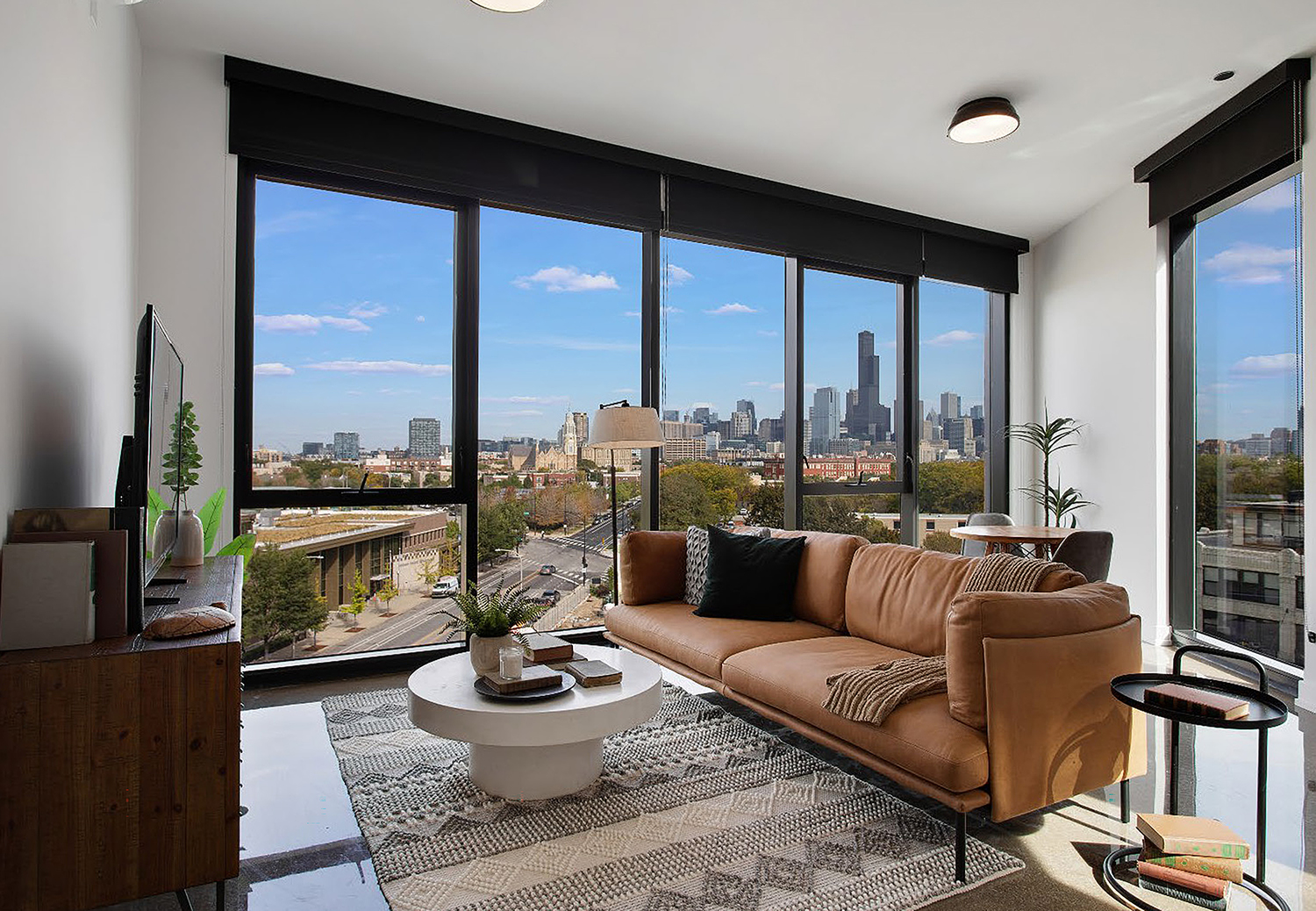
Floor-to-ceiling windows are typical at The Rosie. The building is located close to Little Italy, Chinatown and the University of Illinois-Chicago.
The main exterior architectural finishes on the project are glass and architectural composite metal. CFS supported terraces are pavers over a membrane-protected insulated metal deck. Interior walls are all gypsum wall panels over CFS, and numerous assemblies include resilient furring and sound insulation.
Here is some additional design information for The Rosie:
- Transient loads were typical, although in some locations snow drift loads did exceed 56 psf (ASD)
- Unit loads were 40 psf, with other areas ranging up to 100 psf, and 125 at light storage areas
- Wind loads were roughly 20 psf (primary) and 25 psf to 40 psf (secondary)
- Deflection limits used were typically L/360 for walls, L/600 for masonry, and L/480 (live load) for floor deflections
Read more about raSmith’s CFS details for The Rosie, and download shop drawings, here.
The Rosie
1461 S. Blue Island Street
Chicago, IL 60602Completion Date
November 2020 (Top Out/Dry In)Construction Cost
$41 millionPEOPLE
Owner
Cedar Street CompaniesArchitect of Record
Dan Retzner, AIA, Hartshorne Plunkard ArchitectureEngineer of Record for Structural Work
Steve Franckowiak, S.E., P.E., Forefront Structural Engineers Inc.Cold-Formed Steel Specialty Engineer
Patrick W. Ford, P.E., S.E., R.A. Smith, Inc.Cold-Formed Steel Specialty Contractor
Jason Brown, Denk & Roche Builders
Additional Resources