
With this post, BuildSteel begins tracking the sustainability initiatives led by various steel framing companies.
“We hope to drive positive change in our industry,” says Larry Williams, SFIA executive director. “Sustainability initiatives will be key to cold-formed steel (CFS) gaining momentum in being a material of choice in construction.”
Here is some recent sustainability news reported by steel framing companies.
Steel Dynamics Partnership to Reduce Greenhouse Gases
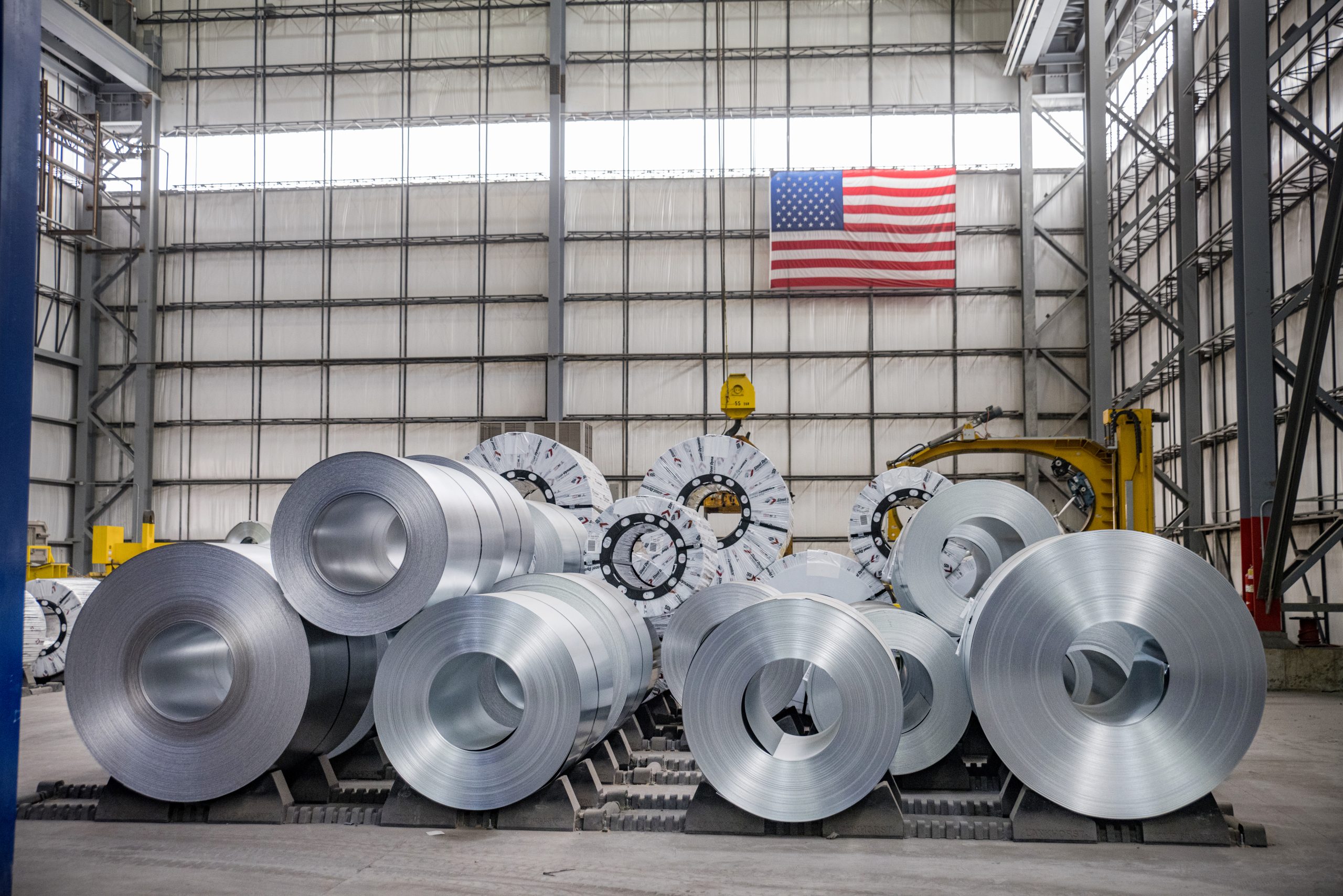
Biocarbons will help Steel Dynamics, Inc. reduce its greenhouse gas emissions intensity by 20% to 25% at its electric arc furnace steel mills.
In June 2022, Steel Dynamics, Inc. (NASDAQ/GS: STLD), one of the largest domestic steel producers and metals recyclers in the United States and an SFIA member, announced the creation of a strategic joint venture with Aymium, a leading producer of renewable biocarbon products. The venture will operate under the name SDI Biocarbon Solutions, LLC.
Initial plans include the construction and operation of a biocarbon production facility to supply Steel Dynamics’ electric arc furnace steel mills with a renewable alternative to fossil fuel carbon using Aymium’s patented technology.
Once fully operational, the first biocarbon production facility will help reduce SDI’s Scope 1 steelmaking greenhouse gas emissions intensity by 20% to 25%, according to the conservative estimate made by Mark D. Millett, chairman, president and CEO of Steel Dynamics.
“We are proud to help accelerate our collective goal to reduce greenhouse gas emissions through this further partnering with Aymium,” Millett said.
Millett added: “This investment represents a significant step forward on our path to carbon neutrality, and our continued commitment to reduce our environmental footprint.”
ClarkDietrich Names Its Corporate Sustainability Manager

Adam Shoemaker, ClarkDietrich corporate sustainability manager
In a move that reinforces its commitment to sustainability, ClarkDietrich announced in May 2022 that former building code compliance and real estate manager Adam Shoemaker will lead the sustainability initiatives for ClarkDietrich as corporate sustainability manager
“Adam has done extensive work on the sustainability front over the last several years,” said Jim Collins, president and CEO at ClarkDietrich, a manufacturer of interior and exterior framing productors, connectors, and other products, and an SFIA member company.
Collins added: “In this newly created role, Adam will be responsible for expanding the company’s efforts to minimize its carbon footprint while providing high-quality products that contribute to overall sustainability in the built environment.”
ClarkDietrich is a leader in the cold-formed steel (CFS) framing industry.
- In 2015, ClarkDietrich became the first CFS framing manufacturer to receive third-party verified, ISO-compliant Environmental Product Declarations (EPDs) for its complete steel product portfolio
- ClarkDietrich recycles 100% of the steel waste at its manufacturing facilities
- The company employs a technical team that includes numerous LEED® accredited professionals
- Its product development team consciously engages in the optimal use of material and makes the ease of construction a priority
“We’ve come a long way, but there’s still a lot of work to be done. As the largest manufacturer of cold-formed steel framing in North America, ClarkDietrich has an opportunity to provide leadership in how we, as an industry, can attain a more sustainable future,” Shoemaker said. “I’m looking forward to rolling up my sleeves and doing my part to get us there.”
Cleveland-Cliffs Reports Lower Carbon Intensity for 2021
In 2021, Cleveland-Cliffs’s total carbon emissions per ton of steel was down from 2020 and prior years.
Cleveland-Cliffs, the largest flat-rolled steel producer in North America and an SFIA member, reported in June 2022 that it has made progress toward reducing its carbon emissions per short ton of steel produced, according to a 2021 sustainability report the company released.
“Our increased consumption of scrap and our successful use of hot-briquetted iron (HBI) in our furnaces to reduce coke rate, enhance productivity and quality, and stretch hot metal production, led to an overall reduction in carbon intensity per ton for 2021,” the Cleveland-Cliffs report stated.
While the company’s total greenhouse gas (GHG) emissions rose slightly in 2021 over 2020 when production levels were much lower, total carbon emissions per ton of steel produced declined in 2021 over 2020 and prior years, the report noted.
- Total steel production at Cleveland-Cliffs rose to 15.89 million tons in 2021 from 3.78 million tons in 2020
- In January 2021 Cleveland-Cliffs set a goal of reducing its total GHG emissions by 30% from 2017 levels by 2030
In 2017 Cleveland-Cliffs’ combined Scope 1 and 2 GHG emissions stood at 44.1 million tons of carbon dioxide equivalent, falling to 39.8 million tons by 2019. In 2020, GHG emissions fell to 32.2 million tons, then rose to 34.5 million tons in 2021.
Scope 1 GHG measures direct emissions from sources owned or controlled by a company, and Scope 2 measures emissions from purchased electricity, steam, heat and cooling.
The company’s decision to build the Toledo HBI plant is a cornerstone of its carbon reduction efforts. HBI is used in the company’s electric-arc furnaces and blast furnaces to enhance productivity and the quality of the finished product and is seen as a scrap alternative.
From 2017 to 2021, the company invested $1 billion in the HBI plant, and during 2021 it was able to ramp up operations to achieve full production rates.
CFS Meets All Sustainability Requirements
Cold-formed steel (CFS) meets the highest sustainability requirements set in all major green building standards and rating programs, including the Leadership in Energy and Environmental Design (LEED®) from the U.S. Green Building Council, the National Green Building Standard (ICC-700) for residential buildings, ASHRAE Standard 189.1 for commercial construction and the International Green Construction Code (IgCC).
The American Iron and Steel Institute reports:
- Steel framing contains a minimum of 25% recycled steel and is continually and completely “remade without any loss of quality”
- Most other construction products can only be down-cycled into lower-quality products
- Steel framing minimizes construction site waste
Additional Resources
- Steel Industry Pushes Toward Net-Zero Energy Target
- Infographic: The True Sustainability of Steel in Numbers
- 3 Tips to Construct Greener Buildings with Steel Framing