
Photos courtesy of AIM Recycling
Recycling metal may not be the sexiest topic, but scrap metal processing is vital both to the economy and to industry sustainability processes, says Diego Gagnon, general manager at AIM Recycling California, an SFIA member.
With that in mind, let’s look at the recycled metals industry. What is the market’s size? How does AIM Recycling process scrap metal? How does the steel framing industry benefit?
Size of the Recycled Metals Market
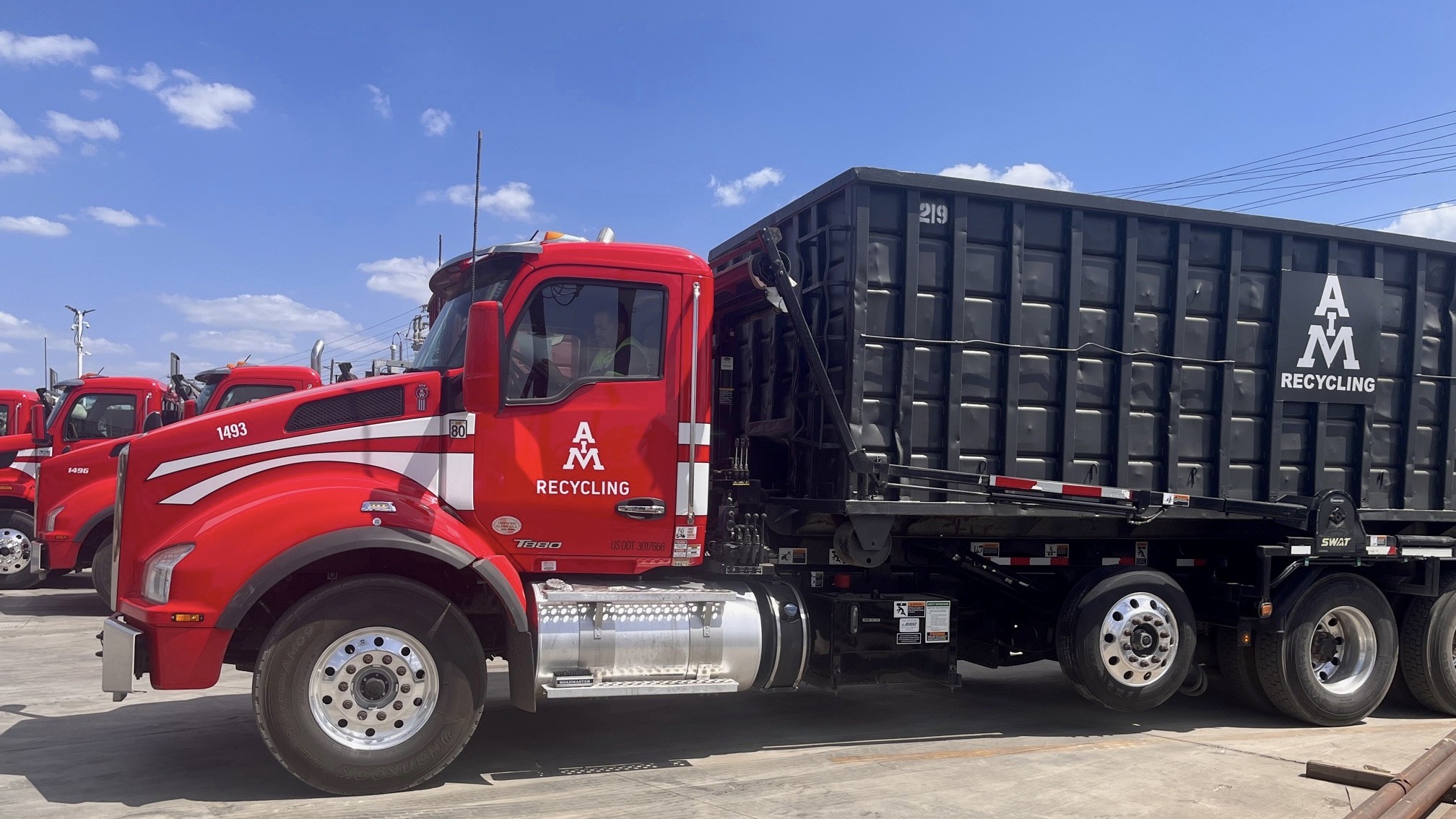
AIM Recycling has a fleet of 800 trucks to pick up full bins of scrap from its customers.
Recycling steel reduces raw material costs, minimizes the environmental footprint of steel production and provides feedstocks for steel producers.
Fact.MR, a market research firm, pegged the global scrap metal recycling market at 624.5 million metric tons in 2022. According to Fact.MR’s report, “Steel Scrap Metal Outlook (2023-2033),” the global recycled metals industry will register a global market growth rate of 4.9% between 2023 and 2033.
Rapid industrialization, gradual depletion of natural resources and increasing demand for metals across various industries, including construction, are factors driving the scrap metal recycling market.
With demand for metals soaring, steel mills are keenly interested in recycling scrap metals. Some mills, such as SFIA members Cleveland-Cliffs, Inc., Nucor Corp. and Steel Dynamics, Inc., have their own metals recycling subsidiaries, or have recently purchased scrap operations, and buy, process and resell ferrous and nonferrous scrap metals in reusable forms and grades. Ferrous scrap metal is the primary raw material for electric arc furnaces, a sustainable, energy-efficient process for producing steel products.
However, Diego Gagnon, general manager at SFIA member AIM Recycling California in Colton, California, says the recycled metals market is changing.
More customers with scrap metal rely on scrap processors that offer turnkey services, Gagnon says. This includes sorting, shredding and cutting scrap, providing logistics and transportation services and even helping customers to run their recycling operations more efficiently.
How AIM Recycling Processes Scrap Metal

AIM Recycling has a fleet of 2,600 private rail cars.
Headquartered in Montreal, Quebec, Canada, American Iron & Metal Recycling (AIM Recycling) buys, processes and sells ferrous and nonferrous metals, in addition to providing other services.
“We deal with huge stamping companies in Canada — Toyota, Honda and Ford,” Gagnon says. “We like to bring what no one else does on the tech side so the last thing our customers have to think about is their scrap metal and instead can focus on their main business.”
That “tech side” for AIM Recycling includes supplying customers with scales, relays, cameras and conveyors, which allow for larger quantities of material to be collected and moved for processing. “We can tell when it’s time to service their scrap boxes,” Gagnon says. “We have even changed the layout of our customers’ operations so they can more efficiently handle scrap.”
To achieve recycling efficiency, AIM Recycling uses state-of-the-art tracking software and high-tech dismantling equipment to ensure the scrap material passing through its facilities is sustainably processed. “A lot of recyclers have the business mentality of an old scrap yard. We’re different,” Gagnon says. “We’re investing in technology, software and marketing and joining groups like the SFIA.”
“There is a lot of value in scrap,” Gagnon says. “Steel prices ran up last year, and they are coming down right now. But you always get a return by selling your scrap.”
The leading steel benchmark in North America is the US Midwest Hot-rolled Coil Index, known as The CRU, from commodity research firm CRU. It is used in the settlement of futures and options contracts on the Chicago Mercantile Exchange.
How the Steel Framing Industry Benefits

AIM Recycling supplies customers with scales, relays, cameras and conveyors.
Steel stud producers buy steel coils from the mills to roll form studs, track and other products. The stamping and roll-forming process generates cutouts and other excess steel scrap, which AIM Recycling buys, processes and sells back to the mills.
“Metals can be infinitely recycled in a closed-loop without any degradation in quality, thus recycling of scrap metals decreases the waste produced and indirectly [cuts] down expenditure to obtain new metal,” the Fact.MR report says.
AIM Recycling has 115 recycling locations across North America, and operates around the world, according to the AIM Recycling website. AIM Recycling established operations in California in 2018. The firm acquired a site in Arizona in 2021.
“We’re the middleman between the stud providers and the steel mills,” Gagnon says. He says SFIA member Consolidated Fabricators Corp. is an AIM Recycling customer, benefitting from its vast logistics capacity.
One material arrives on site, AIM Recycling uses a shredder to pulverize material. The steel is usually mixed in with gypsum board and other construction waste. The shredder cuts material into small pieces, and a giant magnet separates the steel from the rest of the waste.
AIM Recycling delivers processed scrap to steel mills using a fleet of trucks, trailers and private rail cars. “We own the biggest fleet of rail cars — more than 2,600 across North America,” Gagnon says. “Most of the steel we recycle stays domestically in the U.S. and in Canada.”
Gagnon says that scrap is not waste but is valuable because the steel mills need it back. “We pay for it, and our customers get revenue,” he says.
About AIM Recycling
Founded in 1936 by Peter Black, American Iron & Metal began as a small business on Notre-Dame Street East in Montreal, Quebec. The family-owned company has since grown into one of the most innovative recycling companies in the world.
AIM Recycling’s 115 locations include a fleet of 800 trucks, 700 trailers and 2,600 private rail cars. Its operations include the buying, processing, and selling of ferrous and nonferrous metals, as well as a retail buying division. The company provides customers with top-quality services, while operating under strict observance of the environment.
To learn more, visit AIM Recycling. AIM Recycling California is a member of the Steel Framing Industry Association.
Additional Resources
- Why Building with CFS is the Most Sustainable Solution in Construction
- Steel—Doing It Right®: Metal Framing Has Many Advantages and is Green
- Recycled Steel Offsets Costs for Building Owners