
The American Iron and Steel Institute (AISI) has published AISI D250-23, “Thermal Design and Code Compliance Guide for C-Shape Cold-Formed Steel Framing in Building Envelopes.” The guide was developed to assist users of AISI S250-21 w/S1-22, North American Standard for Thermal Transmittance of Building Envelopes with Cold-Formed Steel Framing, 2021 Edition with Supplement 1, 2022 Edition, to calculate the thermal resistance of building envelope assemblies containing cold-formed steel (CFS) framing.
AISI D250-23 can be purchased from the AISI Steel Store or directly at https://ow.ly/KEKh50PMbsI.
AISI D250-23 provides a general discussion about the national model codes of the United States and Canada and a general review of the basic principles of thermal dynamics of a building envelope. It also provides thermal design examples covering wall and roof assemblies constructed using AISI S250, a method to address custom or proprietary CFS wall framing, and thermal design examples covering floor assemblies constructed over unconditioned spaces using the International Code Council (ICC) International Energy Conservation Code, 2003 Edition.
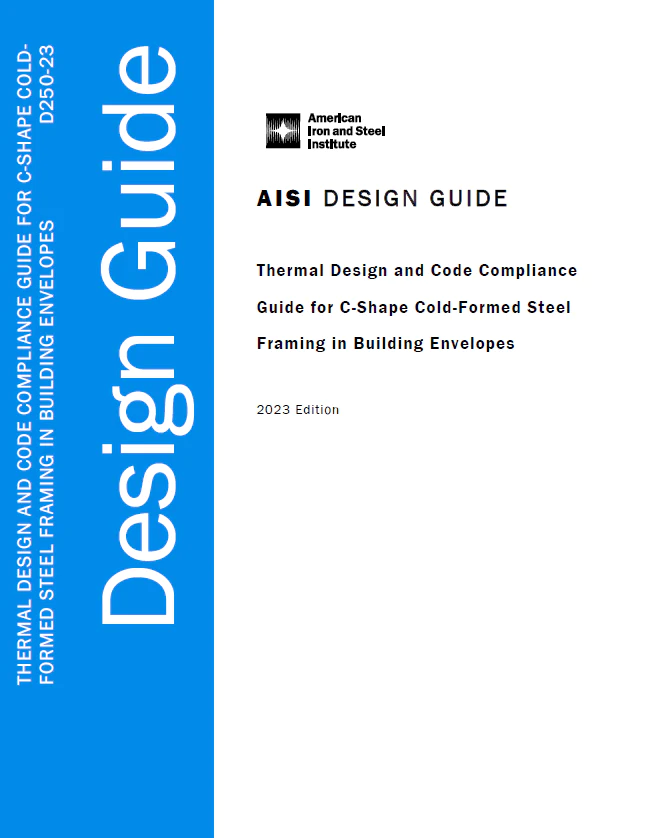
AISI D250-23
“This document is designed to meet a variety of user needs,” said Jay Larson, P.E., F.ASCE, managing director of AISI’s Construction Technical Program. “Designers and builders will find information on the specific thermal properties of materials and elements in a building envelope assembly to comply with a local or state adopted code. They will also be able to determine the level of performance in an energy code or high-performance rating system.”
“Additionally, individuals interested in whole-building performance will find detailed information on simulation tools or calculation methods, and software developers will benefit from the latest cold-formed steel thermal characteristics and calculation methods for various cold-formed steel assemblies,” Larson said. “In all cases, it is recommended that users refer to the adopted codes in effect where the building or structure will be constructed.”
Larson noted that AISI D250-23 is an update of the “Thermal Design Guide for Exterior Walls” originally published by AISI that was updated and revised in 2008 and 2015. It addresses recent changes in codes and standards and incorporates information from research conducted by AISI.
Read the original news release.
American Iron and Steel Institute
AISI serves as the voice of the American steel industry in the public policy arena and advances the case for steel in the marketplace as the preferred material of choice. AISI’s membership is comprised of integrated and electric arc furnace steelmakers, and associate members who are suppliers to or customers of the steel industry. For more news about steel and its applications, view AISI’s websites at steel.org and buildusingsteel.org. Follow AISI on Facebook, LinkedIn, Twitter (@AISISteel and @BuildUsingSteel) and Instagram.

Additional Resources
- AISI Publishes 22 Design Examples to Illustrate Updated Provisions in AISI S100
- New Research Helps Engineers, Architects Tally Cold-Formed Steel Load Buckling Stress
- CFSEI Publishes Tech Note on Cold-Formed Steel Shear Wall Design for Wind and Seismic Forces