
Featured image: David Baillot/University of California San Diego
Buildings made of mass timber — layers of wood bonded together, which can include cross laminated timber, glue laminated timber, and other products — are gaining attention. The California building code was recently updated to allow for the construction of high-rise mass-timber buildings, so many wonder if such buildings will stand up to earthquakes.
The Natural Hazards Engineering Research Infrastructure (NHERI) TallWood project — led by Shiling Pei, principal investigator and associate professor of civil and environmental engineering at Colorado School of Mines — aims to prove the resilience of tall timber buildings by simulating a series of large earthquakes on a full-scale, 10-story mass timber building.
“Mass timber is part of a massive trend in architecture and construction,” Pei says, “but the seismic performance of tall buildings made with these new systems is not as well-understood as other existing building systems.”
The building, which is currently under construction, will be the world’s tallest full-scale building ever tested on an earthquake shake table. Steel Framing Industry Association (SFIA) members CEMCO and Simpson Strong-Tie Co., Inc. are industrial partners on the project, supplying cold-formed steel (CFS) framing studs and connectors.

The NHERI TallWood project features CEMCO-donated cold-formed steel (CFS) in (a) shaft walls, (b) – (d) various wall frames with gaps for vertical joints (not yet installed) and (e) walls with corner joint assemblies.
Shake Tests Slated for May 2023
Pei’s team, a mix of researchers and practitioners, has designed a mass timber rocking wall lateral system that is suitable for regions with high earthquake hazard. This new system is aimed at resilient performance, which means the building will have minimal damage from design level earthquakes and be quickly repairable after rare earthquakes.
The NHERI TallWood project features east-west cross laminated timber rocking walls and north-south mass plywood panel rocking walls. The interior features CFS framing with special joints to accommodate their movement.
“The rocking wall system basically consists of a solid wood wall panel anchored to the ground using steel cables or rods under tension,” Pei says. “When exposed to lateral forces, the cables will allow the walls to rock back and forth – which dissipates earthquake impacts – and can then pull the building back to plumb once the earthquake passes.”
At press time, the shake table tests were slated to begin in May 2023. Located at the UC San Diego’s Englekirk Structural Engineering Center, the earthquake simulator — one of the two largest shake tables in the world — is part of the U.S. National Science Foundation’s Natural Hazards Engineering Research Infrastructure. It was recently upgraded to reproduce the full 3D ground motions that can occur during an earthquake.

Diagram of the NHERI TallWood project shows the rocking walls (colored violet and green) system and the different mass timber types being tested.
To be ready for testing, 800 sensors and approximately 60 video cameras need to be installed in the building.
A significant achievement was marked by the successful completion of the structural system by the end of December 2022. Following the installation of two additional rocking wall segments, the total height of the building was reached and the roof panels were installed to top out the 10-story building.
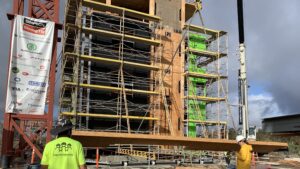
Located at the UC San Diego’s Englekirk Structural Engineering Center, the earthquake simulator is the world’s only outdoor shake table.
Progress on Wall Systems
The Southwest Carpenters Union Training Fund apprenticeship program finished all framing and sheathing of the three exterior CFS subassemblies by about mid-November 2022. The remaining steps for the exterior skin began in December and continued into January.
At the same time, Pacific Coast Drywall installed the CFS-framed interior walls. Like the exterior subassemblies, these interior walls use techniques to accommodate the floor-to-floor movement, including horizontal slip joints at the top of the wall, and vertical expansion joints to accommodate the displacement incompatibilities at intersecting walls.
Industrial Partners Include CEMCO and Simpson Strong-Tie
Besides SFIA members CEMCO and Simpson Strong-Tie, many more industrial partners are supporting the NHERI Tallwood project. The SFIA is a project design and construction partner.


The project has also received a number of grants.
- The structural system scope of this project is sponsored by NSF Grants No. 1635227, 1634628, 1634204
- The nonstructural component scope of this project is sponsored by NSF Grant No. CMMI-1635363 and USFS Grant No. 19-DG-11046000-16
- The use and operation of NHERI shake table facility is supported by NSF through Grant No. CMMI-2227407
A Consortium of Universities Are Involved
A consortium of universities have collaborated on the NHERI TallWood project. The university partners are Colorado School of Mines, Colorado State University, Kyoto University, University of Washington, Michigan Technological University, Oregon State University, Lehigh University, University of Nevada, Reno, Universitá Degli Studi Dell’Aquila, Washington State University and University of California San Diego.
Check for Updates
Follow the construction progress on the NHERI TallWood website. Background information is located here.
Additional Resources
- Steel Framing to Figure into Infrastructure Bill Spending
- The NFL’s New West Coast Headquarters Features 97 Miles of Metal Studs
- Simpson Strong-Tie Self-Drilling Screw Fastens CFS to Sheathing, Drywall and Subfloors