
The (W)rapper stands as a testament to technical innovation and creative design, soaring 235-feet high with 7 stories dedicated to fostering creativity and innovation among professionals and forward-thinking enterprises. The project received the Design Excellence — First Place honor in the 2024 CFSEI Awards presented by the Cold-Formed Steel Engineers Institute.
Lochsa Engineering, LLC, was the cold-formed steel (CFS) specialty engineer on the project. Performance Contracting, Inc., was the CFS specialty contractor.

The (W)rapper, Los Angeles, is the 2024 CFSEI Awards’ First Place winner for Design Excellence. Photo courtesy of Tom Bonner.
The building’s title, The (W)rapper, encapsulates its dual significance. The “W” when included, forms the rod “Wrapper,” which reflects the structure’s enveloping and pioneering design. But with the “W,” the title transforms into “Rapper,” which pays homage to the vibrant musical heritage of South-Central Los Angeles where the tower stands.
Notably, the (W)rapper defies convention by avoiding typical columns and rows found in most high-rise buildings. Instead, it showcases a network of curving bands skillfully engineered to wrap around the structure, originating from several geometric center points. This technical feat exemplifies the best practices in the use of cold-formed steel (CFS), setting a new standard for what is achievable in CFS engineering and design.
Framing the Hyperbolic Walls
The (W)rapper’s hyperbolic walls are complex cold-formed steel (CFS) trusses that curve in multiple directions.
The framing at the exterior walls bypassed the second level while attaching to the underside of the slab. All attachments had to be resilient to support the design loads while being flexible enough to account for anticipated horizontal and vertical deflections of the base structure.

Hyperbolic wall cold-formed steel (CFS) truss attachments had to be resilient to support the design loads. Photo courtesy of PCI.

The (W)rapper defies convention by avoiding typical columns and rows found in most high-rise buildings. Photo courtesy of Riley Mahaffey, P.E.
The high seismicity of the project location created large lateral design loads. Building movement to be accounted for to design these trussed walls properly. Finite element analysis software was used to portray the design conditions and outcomes of the CFS members and connections. Special software also helped model the fabrication of the CFS truss members for PCI. See the reference sheet, LG3.21.

LG3.21 hyperbolic wall sections at The (W)rapper, courtesy of Lochsa Engineering.
Intricate CFS Framing in Stair Systems
The stair system at the (W)rapper was unique. It cantilevers from the base building, creating an exposed condition to wind/extreme seismic loads and adverse weather.
The exterior CFS framing members that wrapped the stairs needed to be intricately designed as a finite element system for proper load resistance, fire rating and weather proofing. To solve this, the design team used finite element analysis software to aid in developing unique CFS detailing/connections that were integrated with the complex base building steel framing for these egress elements.
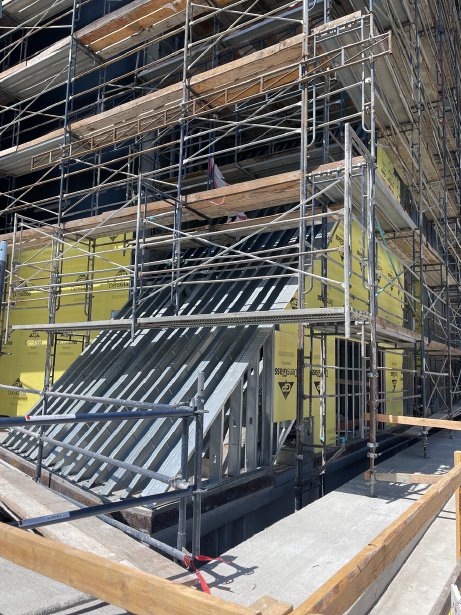
The exterior cold-formed steel (CFS) framing members that wrapped the stairs at the (W)rapper were intricately designed. Photo courtesy of Riley Mahaffey, P.E.
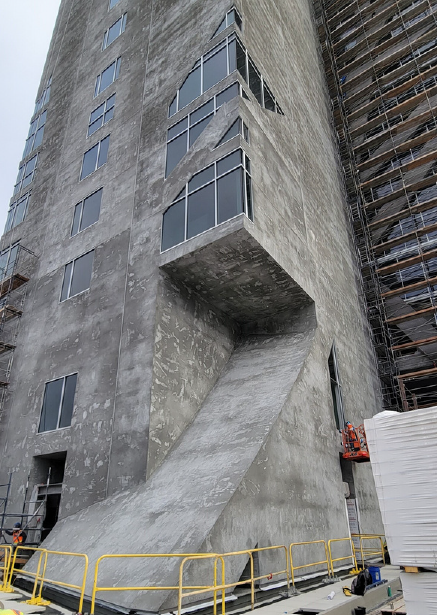
The stair system at the (W)rapper required proper load resistance, fire rating and weather proofing. Photo courtesy of PCI.
Flat Facade Transitioning to a Curve
The tower elevations were required to maintain similar architectural elevation looks as the main part of the building to create the theme of The (W)rapper. Most of the windows in these elevations matched that aesthetic.
The unique headers and jambs were at varying angles rather than straight vertical and horizontal that are accustomed typical construction. Corner conditions required the window systems to “wrap” the building at 90-degree angles. This condition required a cantilevered “knee” or low wall design condition to support the window system.
The most difficult windows wrapped corners and had typical CFS wall systems above and below the openings within the same level. To properly design these areas, finite element analysis software was used to portray the exact design conditions and outcomes of the CFS members and connections efficiently.

The (W)rapper had window headers and jambs framed with cold-formed steel (CFS) that were difficult to design. Photo courtesy of PCI.
Read the complete story and obtain the complete design diagrams for Lochsa Engineering’s 2024 CFSEI Design Excellence Award here.
The (W)rapper
First Place – 2024 CFSEI Design Excellence Award
Winner: Lochsa Engineering, LLC
Tammy Gleed (left), P.E., 2024-25 CFSEI vice chair, and Dana Hennis (right), P.E., 2024-25 CFSEI chair, present the 2024 CFSEI Design Excellence First Place Award to Derrick Suarez, P.E., Lochsa Engineering, at the 2024 CFSEI Expo.
Project
The (W)rapper
5790 West Jefferson Blvd.
Los Angeles, CA 90016
Completion Date
January 2023People
Owner
Samitaur ConstructsArchitect of Record
Eric Owen Moss, Eric Owen Moss ArchitectsEngineer of Record for Structural Work
Atka Zekioglu, ARUPCold-Formed Steel Specialty Engineer
Derrick Suarez, P.E., Lochsa Engineering, LLCCold-Formed Steel Specialty Contractor
Trevor Lykins, Performance Contracting, Inc.

Additional Resources