
Featured image: Lasch Building under renovation at Penn State University, courtesy of Mortenson Construction. Project profile provided courtesy of CFSEI. All photos courtesy of Martin/Martin Consulting Engineers, except where indicated.
The Pennsylvania State University recently completed an 89,000 SF addition to the Louis and Mildred Lasch football building, which is adjacent to indoor and outdoor practice facilities. The Lasch Building includes a 13,000 SF weight room, expansive locker room, athletic training facilities, whirlpool therapy facility, meeting rooms, video production suite, coaches and staff offices, players lounge and the academic support center and computer room.
The structure includes both one- and two-story steel-framed sections and features a large glass curtain wall for visual access to the practice field.

Dana Hennis (left), P.E., S.E., CFSEI vice chair presents the CFSEI award to Shane Ewing of Martin/Martin. Kara Peterman, Ph.D., CFSEI chair, stands behind.
Martin/Martin, Inc. is the 2023 CFSEI Design Excellence Award winner for the project, taking first place in the municipal sports category in the Cold-Formed Steel Engineers Institute’s award competition.
Complicated Design-Assist Process
Martin/Martin was contracted by BLUvera and the general contractor, Mortenson Construction, early in the design process to help guide the exterior wall framing scheme through design and detailing efforts. The design-assist process was extensive and complicated, involving complex architectural design elements on the building facade.

Martin/Martin’s coordination was critical to successfully incorporate several prefabricated elements into the supporting structural steel of the building.

Martin/Martin supplemented the modeling effort to help minimize field installation conflicts.
The exterior wall panels and cladding framing elements were modeled and prefabricated. Complete coordination was critical to ensure successful incorporation of these elements with the supporting structural steel.
The steel fabricator did not initially model the structural steel, the CFSEI report about the project says. When a model was provided, it was not at an adequate level of development to support accurate design coordination, it adds.
In support of the client and design team, Martin/Martin supplemented the modeling effort, resulting in minimal field installation conflicts and issues. Martin/Martin optimized wall panels and assemblies to maximize the work that was performed in the factory and minimize on-site installation requirements.
West End ‘Picture Frame’
The wall bump-out elements at the head, sill and sides of the large curtain wall on the west end of the building became known as the “picture frame.”
The picture frame consists of six different cold-formed steel (CFS) assemblies that were factory-completed and shipped to the jobsite. The jamb assemblies are full height, and the head and sill are split up into two pieces, for shipping and installation. Careful coordination was required to ensure that these assemblies could be shipped to the site with sheathing and air/vapor barriers (AVB), and that connections would be made at discrete points to the structural steel framing.
The jamb assemblies were returned top and bottom to allow the more complicated framing and waterproofing miter at the corner to occur in the factory. This fabrication design detail resulted in a simpler vertical joint in the field. Unlike typical wall framing elements, these three-dimensional assemblies could not be analyzed in traditional CFS design software. They were modeled in SAP2000, the design forces were extracted, and members were evaluated using CFS 13.
Canopy Framing
When Martin/Martin was first engaged on the project, the practice field side (north) first-floor cantilever canopies were framed in structural steel and would have been either field-framed or heavy shop fabricated assemblies.

Martin/Martin was contracted early in the design process to help guide the exterior wall framing efforts.
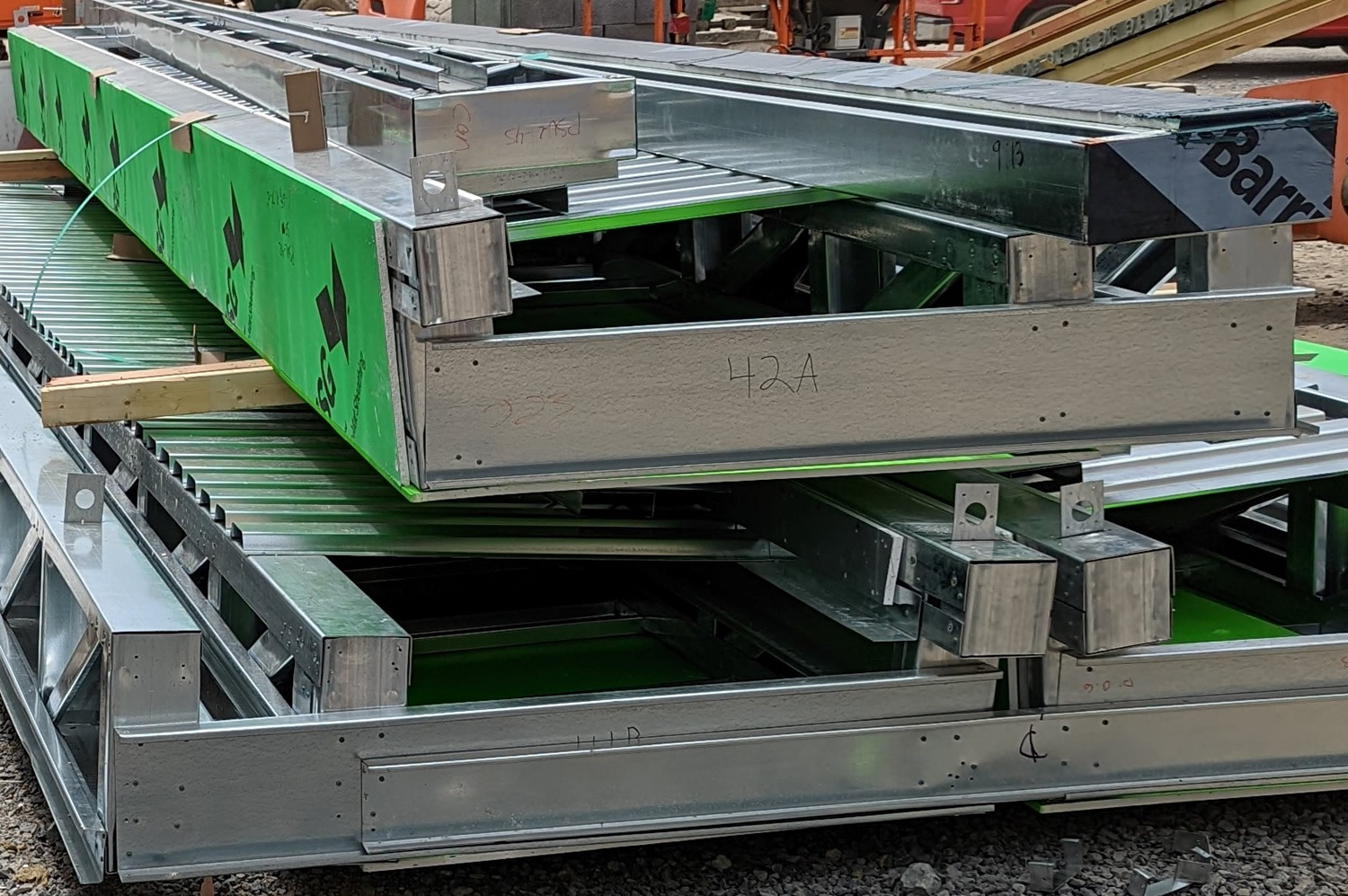
Martin/Martin’s engineers were able to redesign assemblies so they could be relatively lightweight.
Supporting the client, Martin/Martin’s engineers were able to redesign the canopies, converting them to relatively lightweight shop-fabricated CFS assemblies, reducing the structural steel to single-wide flange outriggers at approximately 30-foot spacing increments. The series of canopy sections included a nine-foot-long cantilever portion, fully framed with CFS.
The architect wanted recessed, hidden gutters and roof drains. This was originally accomplished by notching and reinforcing heavy, wide flange beams. By altering the framing to span parallel to the gutters, Martin/Martin framed around the gutters without notching the framing.
These assemblies were shipped in one piece, with sheathing and AVB, and simply dropped between the structural steel outriggers.
Exterior Wall Panels
Inclusive of the exterior framing, wall framing was fully modeled and panelized in a factory. In addition to framing, Martin/Martin also modeled the sheathing and GreenGirts, which were also installed in the factory, saving valuable field labor and eliminating the need to scaffold the building exterior.
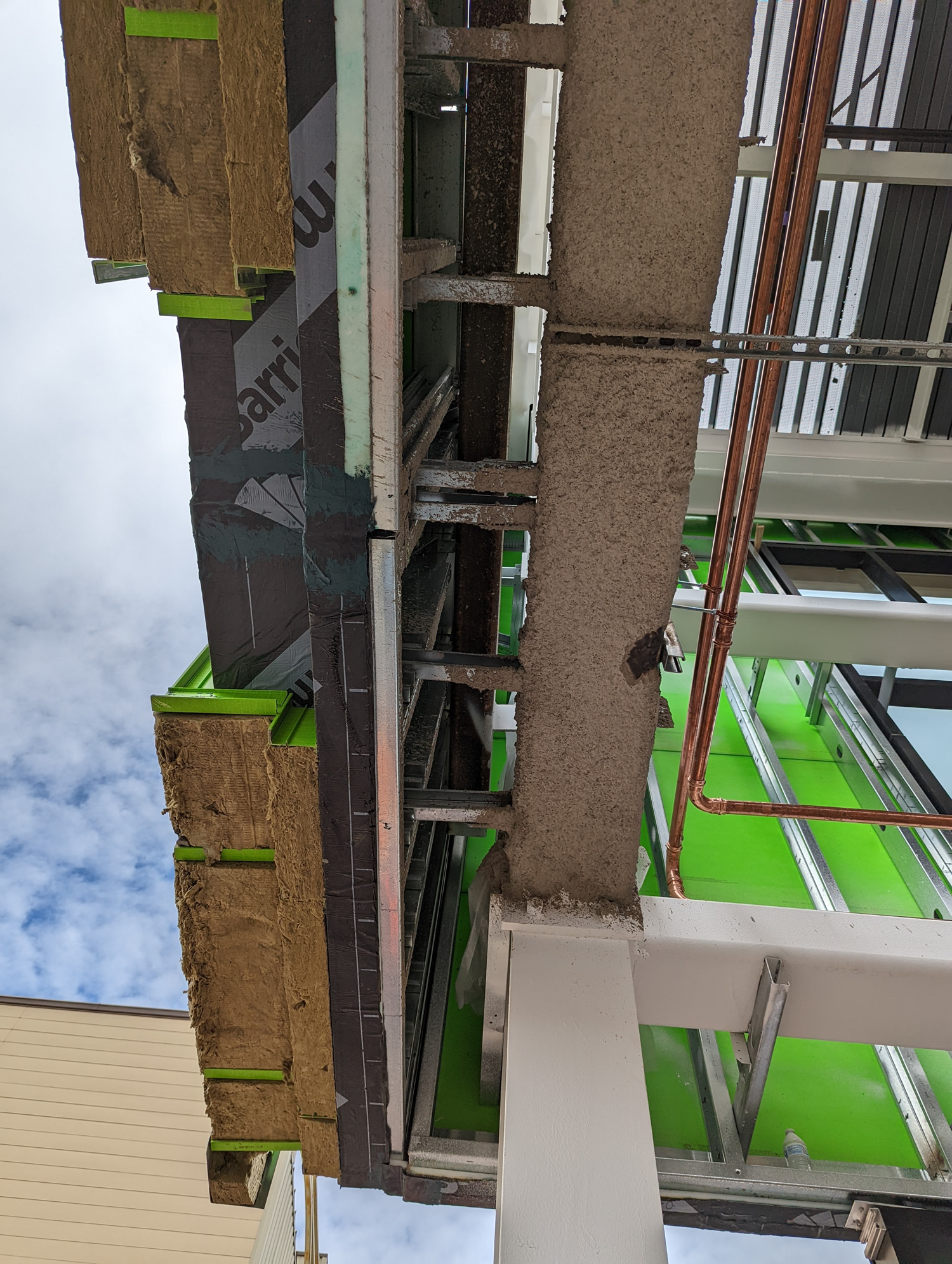
Martin/Martin provided engineering support for various stages of construction to ensure panels were not damaged during shipping and installation.
Pre-installing the sheathing, fluid applied air and vapor barrier, GreenGirts, and insulation provided challenges in handling, stacking, and shipping the panels. Martin/Martin provided engineering support for these stages of construction to ensure panels were not damaged during shipping, handling and installation.
The careful BIM coordination between Martin/Martin, the design team, and other trade partners resulted in field installation with minimal problems and minimal site-installed elements. The result is a modern, open addition to Penn State’s impressive athletic complex.
Read more about Martin/Martin’s CFS details for the Lasch Building Renovation at Penn State here.
The Louis and Mildred Lasch Building is named after the couple crucial to raising up Penn State’s initial football boosters program in 1959. Photo courtesy of Mortenson Construction
Lasch Building Renovation
Pennsylvania State University
201 Hastings Road
State College, PA 16801Completion Date
September 2022Construction Cost
$48 millionPEOPLE
Owner
Pennsylvania State UniversityArchitect of Record
Todd Carll, HOKEngineer of Record for Structural Work
Mary E. Haynes, Stahl Sheaffer Engineering, LLCCold-Formed Steel Specialty Engineer
Shane Ewing, Martin/Martin, Inc.Cold-Formed Steel Specialty Contractor
Paul Broderick, BLUvera LLC

Additional Resources
- Cold-Formed Steel Engineers Institute to Hold the 2024 CFSEI Expo in Tucson, Arizona (May 20-22, 2024)
- CFSEI Expo 2023 Sees Jump in Attendance, Greater International Flair
- Your First Cold-Formed Steel BIM Project: What to Expect