
Steel Framing Drives N.E. Pennsylvania Housing
Dmitry Pingasov, team manager and CFO of PT Development Group, is introducing cold formed steel (CFS) framing into residential construction across northeast Pennsylvania. In a region long defined by wood framing, he has completed 15 single-family homes and is planning 15 more. By using CFS framing, Pingasov says he is improving the affordability and long-term performance of his homes.
Pingasov works closely with structural engineers and steel fabricators to refine the framework and sequencing of on site work. Steel studs manufactured to exact tolerances create straighter walls and cleaner openings, which reduces corrective labor and material waste.
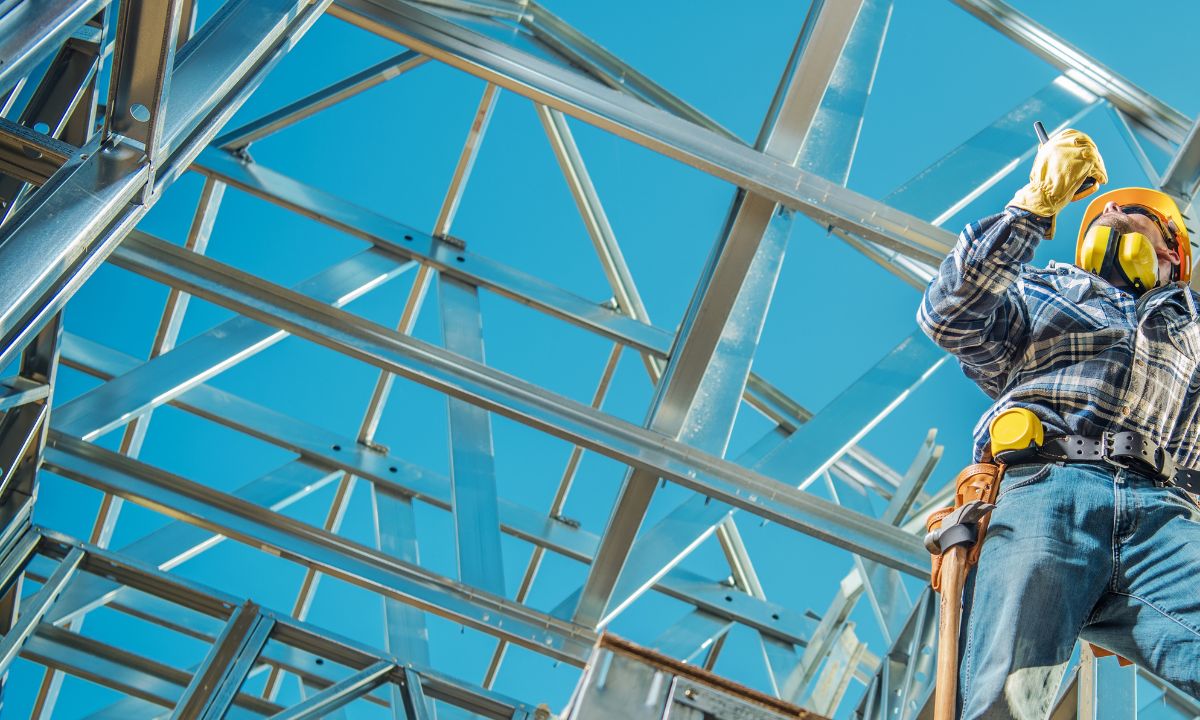
Cold formed steel (CFS) framing resists rot, pests and moisture, delivering long term stability in northeast Pennsylvania’s harsh seasonal climate.
CFS framing also resists rot, pests and moisture related movement. In northeast Pennsylvania, seasonal humidity and temperature fluctuations can stress most building materials. However, the resilience of cold-formed steel supports long-term structural stability and requires less maintenance for homeowners.
Fire performance and scalability further define Pingasov’s framing model. CFS framing does not act as a fuel source and can meet modern code and energy requirements through precise engineering. Once tested and refined, Pingasov can replicate the framing system across multiple developments.
Steel Framing Accelerates Supportive Housing Construction
Camden County, New Jersey, is building the $22 million Martin McKernan Supportive Housing Community to serve residents who are unhoused in the local area. The 60-unit complex features cold formed steel (CFS) framing to accelerate construction of the studio apartments. Crews are erecting CFS framing with pre-punched service holes. This speeds up plumbing and electrical installation and keeps interior work moving in sequence.
Construction crews in Camden County were busy on a recent Friday morning fitting metal studs and MEP at a transitional housing complex in Blackwood.
(@camdencountynj) December 15, 2025
Designers selected CFS framing for its strength, dimensional stability and ability to support repeated unit configurations. As crews complete each section, the steel framing maintains alignment and reduces delays that can affect other trades. The structure supports 50 transitional units and 10 emergency units within a clear and repeatable layout.
County officials can expand the community if demand increases. The adaptability of CFS framing will allow future units to connect directly to the existing structure without a major redesign. By pairing housing first services with durable steel framing, county leaders are creating a flexible platform that addresses immediate housing needs and positions the county for long-term growth.
Steel Framing Transforms Brazil Homebuilding
Light frame construction is advancing in Brazil as builders replace masonry with cold formed steel (CFS) framing. CFS framing organizes projects through planned component based assembly instead of traditional brick laying. Builders using CFS framing completed their residential projects 50% faster than conventional construction. They also reported cleaner job sites, lower waste volumes and more predictable budgeting.
Cold-formed steel framing relies on lightweight galvanized profiles that form a precise structural skeleton. The system delivers dimensional consistency that produces straighter walls and reduces rework. Brazilian standards ABNT NBR 16970 and ABNT NBR 15575 establish structural, safety and performance requirements for these assemblies.
Technical comparisons in Brazil continue to show measurable productivity gains. In a comparison study presented at an industry conference, a CFS framing project was completed in 11 weeks, while a conventional build took 19 weeks.The lighter structural system can also support simpler foundation solutions in compatible designs.
By combining faster assembly, reduced debris and engineered wall systems, steel framing is strengthening the case for industrialized housing across Brazil’s residential market.
Additional Resources
- Update #17: Cold-Formed Steel Advances Healing Facility, History Center and Middle East ConTech
- Update #16: Cold-Formed Steel for Wildfire Recovery, Campus Housing and Martha Stewart Prefab Homes
- Update #15: Cold-Formed Steel for Student Housing, Greenhouse and Fire Station
- Update #14: Cold-Formed Steel for Student Housing, Urban Redevelopment and Municipal Projects
- Update #13: Cold-Formed Steel for a Ski Resort, Apartment Complex and Residence Hall