
Developers seek faster, more predictable construction as labor shortages and rising land costs reshape commercial building. Scott Fournier, president of SFIA member Integrated Steel Solutions, believes cold-formed steel (CFS) framing can meet those demands.
Fournier joined Matt Stillwell of SFIA member FRAMECAD on the Steel Framing Connections podcast. Their conversation explored how engineering, manufacturing and DfMA, Design for Manufacturing and Assembly, can improve CFS project delivery.
Mid-Rise Construction Favors CFS
Fournier believes CFS framing’s greatest opportunity lies in buildings between 5 and 10 stories. At that height, CFS framing can compete with post-tensioned concrete, structural steel and traditional wood framing.
According to Fournier, CFS framing in many mid-rise applications provides:
- Competitive performance against post-tensioned concrete, structural steel and wood framing
- Noncombustible construction for code-driven projects
- Greater building height as land prices increase
- Improved schedule certainty through prefabrication and panelization
- Greater precision through offsite manufacturing
Current market and code trends continue reinforcing those advantages.
Higher land costs continue driving taller building construction. Many projects still fall within the mid-rise range where CFS framing performs well. Building codes also continue increasing demand for noncombustible construction.
Fournier pointed to assisted living facilities as one example. These facilities often require noncombustible construction because many residents cannot self-evacuate. Buildings also transition to steel once they exceed roughly 85 feet. At that height, wood construction reaches practical code limits.
Those market and code trends continue expanding opportunities for CFS framing in mid-rise construction.
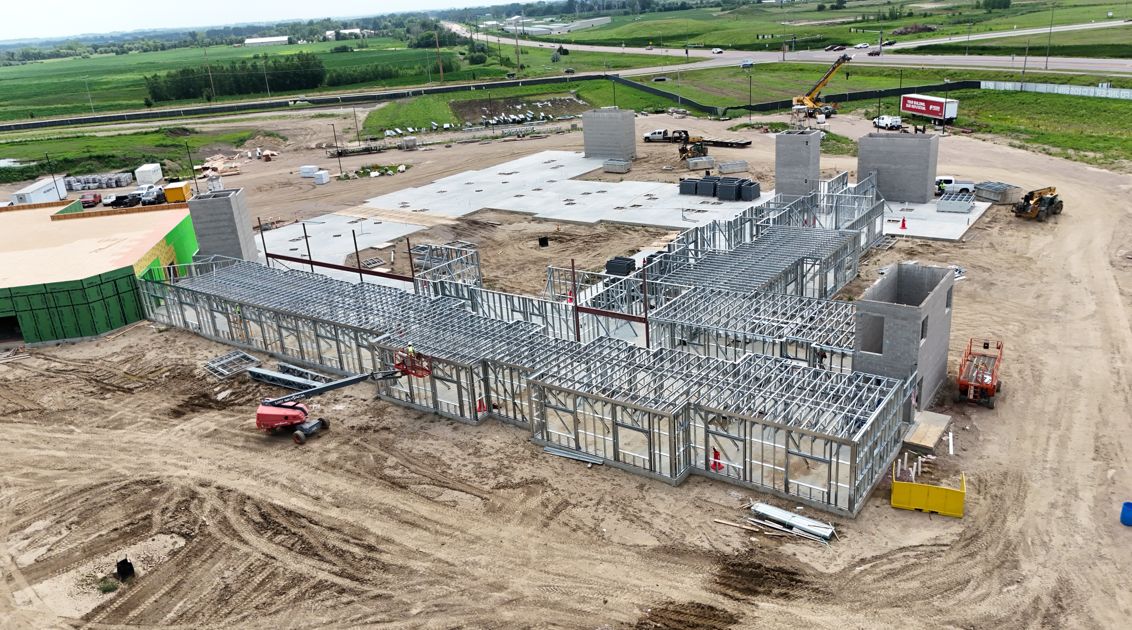
Integrated Steel Solutions designed and manufactured the exterior, interior and floor panel cold-formed steel (CFS) framing for the Good Samaritan – Founder’s Crossing senior living community in Sioux Falls, South Dakota. Photo Credit: Integrated Steel Solutions
DfMA Improves Project Delivery
Design for Manufacturing and Assembly guides every project before fabrication begins.
Engineers optimize each design before fabrication begins. They standardize member sizes and refine details for production.
“We’re able to economize our design,” says Fournier. “If there are member sizes our machines don’t run, we convert them so our machines can run them, panelize them and improve construction efficiency.”
Fournier believes education remains one of the industry’s greatest challenges. Many owners, contractors and designers continue relying on familiar construction methods. He expects successful projects and continued industry outreach to drive broader adoption of CFS framing.
Engineering Supports Offsite Manufacturing
Fournier said successful panelization begins long before fabrication. Engineering teams must determine whether offsite manufacturing makes sense for each project.
Not every building benefits from panelization, he said. When it does, engineers complete the design and production planning before fabrication begins. Panels then arrive at the jobsite in installation sequence.
“We’re trying to take the complexity out of the field,” says Fournier. “We design it, manufacture it and deliver it so contractors can simply erect it without solving complex problems on site.”
He added that factory production standardizes repetitive tasks while reducing field layout and onsite fabrication. Delivering panels in erection sequence allows crews to focus on installation instead of building framing in place.

Panelized cold-formed steel (CFS) framing moves complexity from the jobsite to the factory, helping streamline installation and improve productivity. Photo Credit: FRAMECAD
Precision Expands Design Possibilities
Fournier said advances in automated manufacturing continues to expand what engineers can accomplish with CFS framing.
Roll-formed members leave the production line with millimeter-level precision, he said. Steel framing remains dimensionally stable, resists moisture-related movement and often requires less lifting equipment because of its light weight.
Those capabilities support hospitals, schools, assisted living facilities and sports venues. They also enable precision framing for large LED video displays in Times Square and major sports stadiums.
Fournier pointed to one seven-story hospital project as an example. The contractor initially planned to enclose only 2 floors before winter. After several weeks of installation, the team enclosed the entire building before cold weather arrived. The project showed how manufacturing-led construction can accelerate schedules without sacrificing quality.
Fournier said that philosophy also guides customer relationships. He recommends the framing system that best supports each project’s goals.
Additional Resources
- FRAMECAD Launches “Steel Framing Connections” Podcast Focused on Real-World CFS Projects
- FRAMECAD: Cold-Formed Steel Framing Accelerates Brazilian Soccer Stadium Expansion Project
- FRAMECAD: Why Cold-Formed Steel Is Accelerating Data Center Construction