
The Cold-Formed Steel Engineers Institute (CFSEI) 2026 CFSEI Expo will feature a keynote session, May 19, highlighting one of the most ambitious seismic research projects ever conducted on cold-formed steel (CFS) framed building systems.
Tara Hutchinson of University of California, San Diego and Benjamin Schafer of Johns Hopkins University will present the session titled, “Advancing Cold-Formed Steel in Mid-Rise Building Systems in High Seismic Zones: Accomplishments of the CFS-NHERI and CFS10 Capstone Programs.”
The 2026 CFSEI Expo will take place May 18-20, 2026, at the Westin Long Beach Hotel in Long Beach, California. Attendees who participate in the keynote will earn 1 PDH / 1 AIA LU Credit.
The keynote session will provide engineers, designers and industry professionals with a close look at the research behind the CFS-NHERI program and the landmark CFS10 shake table testing project.
2026 CFSEI Expo
Cold-Formed Steel Engineers Institute (CFSEI) 2026 Expo
May 18-20, 2026
Westin Long Beach Hotel
Long Beach, CaliforniaEarn up to 15 PDHs / 9 AIA LU Credits
CFS Research Targets Mid-Rise Seismic Design
The NSF-sponsored Cold-Formed Steel – Natural Hazards Engineering Research Infrastructure program, known as CFS-NHERI, aimed to advance the seismic resilience and design capabilities of cold-formed steel lateral force-resisting systems.
“While CFS is commonly used in low-rise buildings, its application in mid-rise and taller structures in moderate-high seismic zones as the core load-bearing system remains limited,” says the CFSEI keynote abstract. CFS framing’s limited use is, the abstract says, “due to a lack of full-scale validation under seismic loading, and specific height limits in U.S. building codes.”
The CFS-NHERI program set out to overcome these barriers. University researchers and industry partners, which included the Steel Framing Industry Association (SFIA), launched a coordinated effort that combines material testing, subsystem experiments and advanced numerical modeling. CFS-NHERI culminated in a full-scale structural test of a 10-story cold-formed steel building, CFS10.
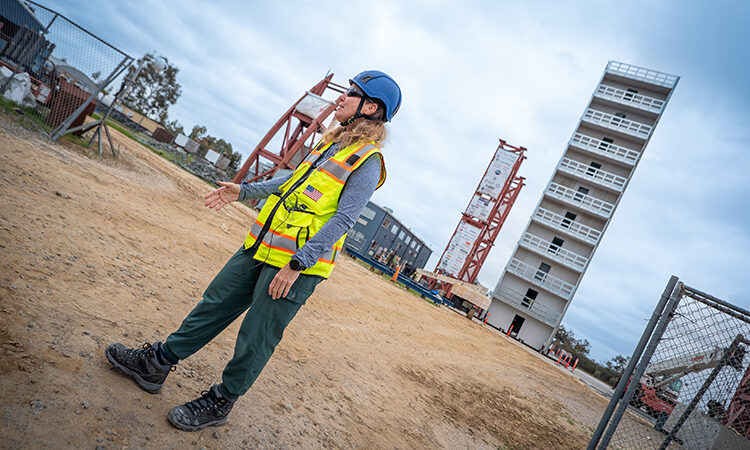
Tara Hutchinson, a professor in the UC San Diego Department of Structural Engineering, is the lead researcher on a series of tests on a 10-story, cold-formed steel (CFS) framed building at the UC San Diego outdoor earthquake simulator. Photo: David Baillot/UC San Diego Jacobs School of Engineering
CFS10 Shake-Table Testing
CFS10 is a landmark experimental project. The tests were conducted at the NHERI 6-DOF Large High Performance Outdoor Shake Table at UC San Diego. Here, researchers constructed a 10-story cold-formed steel framed building and subjected it to a series of earthquake simulations.
Specifically, CFS10 experienced multi-directional earthquake motions that increased sequentially in intensity. After the seismic testing concluded, the researchers conducted post-earthquake fire tests.
Comprehensive CFS Data
The CFS10 project produced one of the most comprehensive datasets ever assembled on the seismic behavior of cold-formed steel buildings. The test structure incorporated several construction approaches common in modern projects. Researchers integrated stick-built framing, 2D panelized systems and 3D volumetric construction methods.

The test building integrated conventional stick-framing, panelized and volumetric modular construction within one building specimen, allowing a unique opportunity to document and compare the efficiency of each construction method, and any differences in structural performance.
The building also included a range of nonstructural components and systems. This allowed the team to study how full buildings behave during major seismic events.
“Results from CFS10 demonstrate that engineered CFS systems can perform robustly under significant seismic demands, with stable energy dissipation, and minimal damage propagation,” says the 2026 CFSEI Expo keynote abstract.
CFS10 research provides learnings on functional recovery — that is, returning buildings to service quickly after earthquakes.
“Complemented by material, connection, and subsystem tests, the full-scale CFS10 seismic tests provide a landmark dataset to validate analytical tools for future design,” the keynote abstract adds.
The program sets a new benchmark for performance-based seismic design in CFS structures. Ongoing work is focused on documenting the earthquake and fire testing results and conducting complementary simulations. Hutchinson and Schafer will share with 2026 CFSEI Expo attendees how the findings translate into “design guidance, industry adoption and broader applications in high-performance CFS construction,” their abstract says.

With the CFS10 controlled burn in progress, a San Diego firefighting crew drill on-site, while researchers monitor heat, smoke and response coordination. Monitoring included heat and motion sensors, cameras and multiple drones.
What Keynote Attendees Will Learn
The 2026 CFSEI Expo keynote session will highlight several key lessons emerging from the research program. Hutchinson and Schafer will explore:
- Seismic detailing strategies for tall cold-formed steel buildings
- Findings from the ten-story full-scale shake-table testing program
- Fire testing and modeling approaches relevant to CFS systems
- Differences between stick-built, panelized and modular CFS construction methods
These insights will help engineers and designers better understand how cold-formed steel systems can support taller buildings with improved seismic performance.
Leading Researchers Behind the CFS10 Program
The keynote will be presented by two internationally recognized researchers in structural engineering.
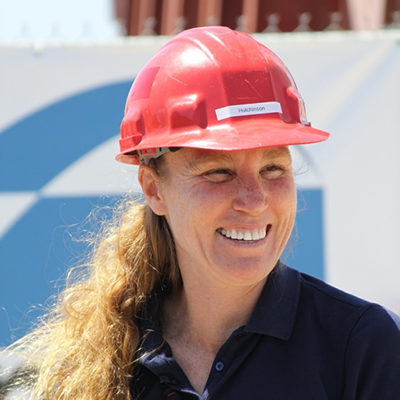
Tara Hutchinson, Ph.D., University of California, San Diego
Tara Hutchinson, Ph.D.
Tara Hutchinson is a professor in the Department of Structural Engineering at University of California, San Diego. Her research spans geotechnical, structural and earthquake engineering.
Much of her work involves large-scale shake-table and fixed-reaction experimentation. Hutchinson earned her Ph.D. from the University of California, Davis, and her M.S. from the University of Michigan.
She joined the UC San Diego faculty in 2007 and currently serves as director of the Powell Laboratory. In 2024, she was appointed the Jan Talbot Endowed Chair in the Jacobs School of Engineering.

Benjamin Schafer, Ph.D., Johns Hopkins University
Benjamin Schafer, Ph.D., P.E., F.SEI
Benjamin Schafer is the Hackerman Professor of Civil and Systems Engineering at Johns Hopkins University and director of the Ralph O’Connor Sustainable Energy Institute.
Schafer is widely recognized for his contributions to cold-formed steel structural research and design standards. He serves on several national committees focused on steel building engineering.
His work has earned numerous awards for research, teaching and professional leadership.
Join the Industry in Long Beach
The 2026 CFSEI Expo keynote will provide a rare opportunity. Attendees will hear directly from researchers leading one of the most significant structural experiments ever conducted on cold-formed steel buildings.
Professionals attending the 2026 CFSEI Expo will gain insight into the research shaping the future of cold-formed steel construction. The keynote offers a timely look at the data and design insights that could expand the material’s role in seismic regions.
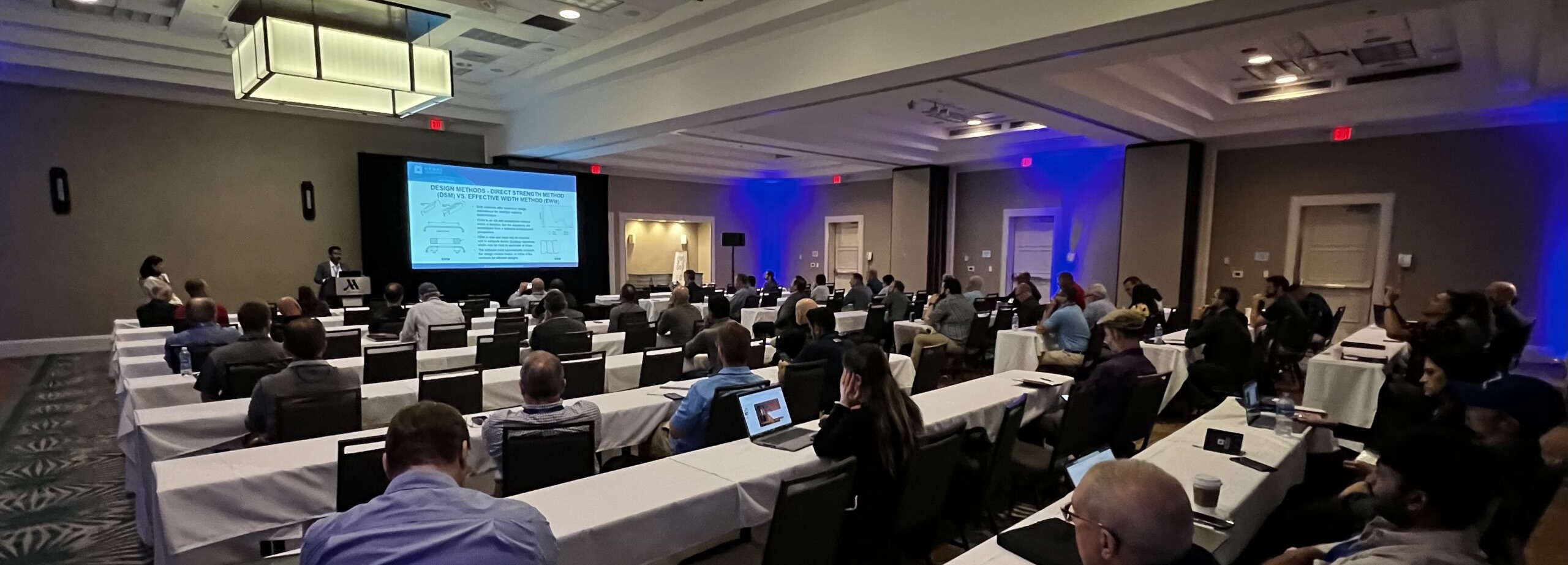
Attendees packed last year’s CFSEI Expo in Raleigh, North Carolina. More are expected this year.

Cold-Formed Steel Engineers Institute
The Cold-Formed Steel Engineers Institute (CFSEI) comprises hundreds of structural engineers and other design professionals. Together, they are finding a better way to produce safe and efficient cold-formed steel (CFS) designs for commercial and residential structures. CFSEI members develop industry standards and design methods. CFSEI issues technical bulletins, organizes seminars and provides online training so that engineers and design professionals can improve their knowledge and skills. CFSEI is part of the Steel Framing Industry Association (SFIA) family. For more information, visit www.cfsei.org.
Additional Resources
- Register for the 2026 CFSEI Expo in Long Beach, California (May 18-20)
- CFSEI Announces Speakers for 2026 CFSEI Expo in Long Beach, California (May 18-20)
- Insights and Inspiration Take Center Stage at 2025 CFSEI Expo in Raleigh