
In 2010, building scientist Joe Lstiburek published an article called The Perfect Wall. The article provides information on constructing a durable wall system for a modern home.
The gist of the article, according to Builder Online, is that the best defense against mold and rot in walls is to place all four of the home’s control layers—air, water, vapor, and thermal—on the outside of the sheathing. That requires the use of an exterior insulation.
CFS: Exterior Insulation
Exterior insulation works in all climates and with any framing material—including cold-formed steel framing (CFS). Besides reducing the chance of moisture problems, it also eliminates thermal bridging, a process by which heat can escape from the house through any framing member that’s not interrupted by insulation.
Builder Online notes that thermal bridging is a potential issue in all homes, which is one reason why builders are embracing it. In fact, the Home Innovation Research Labs‘ 2019 Builder Practices Survey found that exterior foam insulation is now used in 11 percent of homes, and growing.
At least part of that growth is thanks to a particular framing type. “My sources tell me that sales of steel framing have increased 300% in the last couple of years,” says Lee Bybee of Ox Engineered Products, which makes exterior insulation and sheathing products. “Thermal bridging is more of a challenge with steel studs, so builders using them will add a layer of rigid foam to compensate.”
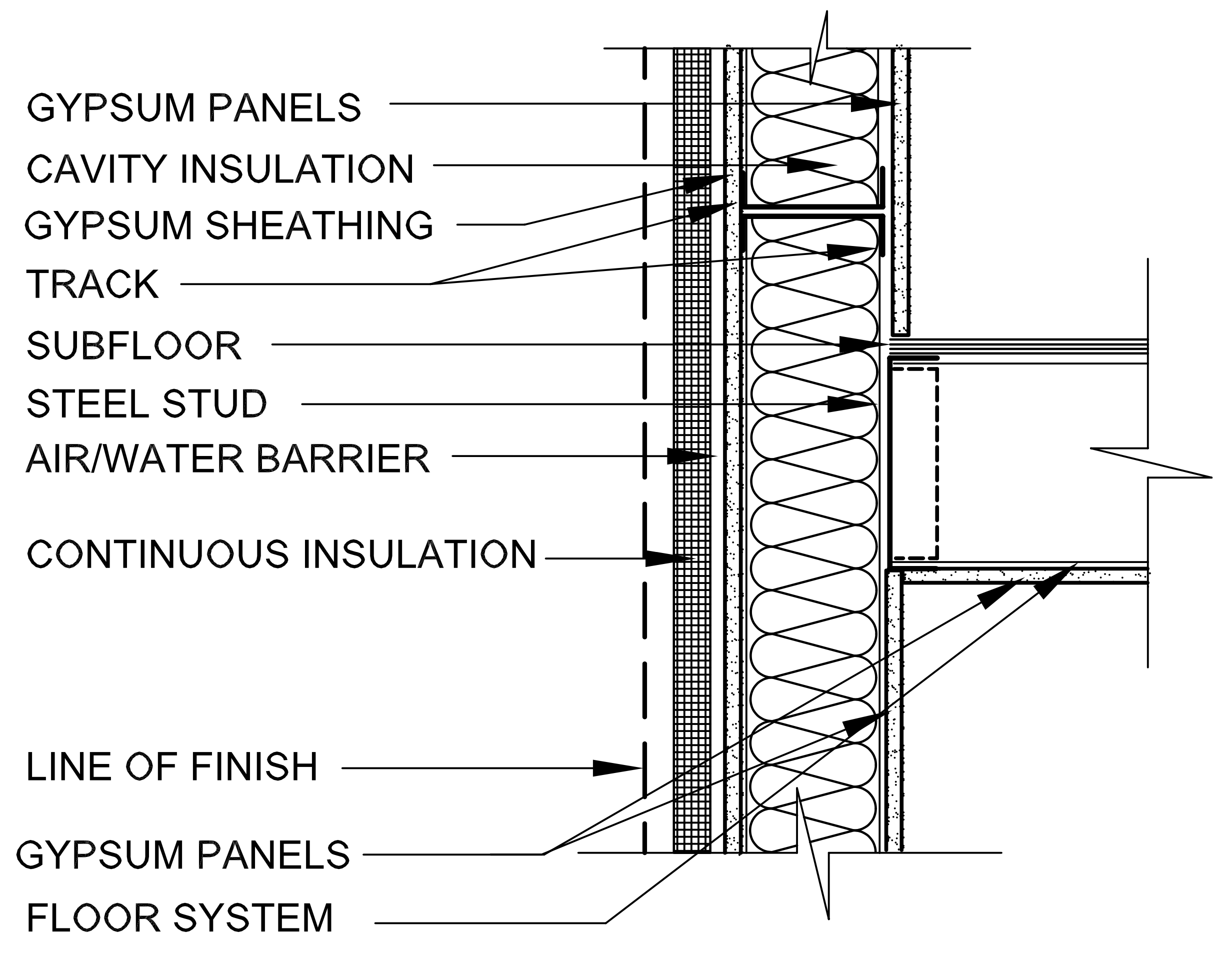
CFS and a Balloon Framed Exterior Wall – Source: AWCI Technology Center, Balloon Framed Intermediate Floor Detail – Any Finish.
Energy Code Requirements
CFS has a proven track record of providing energy-saving and sustainability benefits for buildings of all shapes and sizes. CFS framing can also be the primary structural element in mid-rise construction and meet the exterior continuous insulation requirements set by IECC, ASHRAE 90.1, ASHRAE 189.1, IgCC and LEED.
Recent changes to the energy code requirements call for one to four inches of exterior continuous insulation depending on the building location by climate zone, even in warmer zones where foam board insulation had not previously been required.
For field integrations, energy code compliance generally require adjustments in how CFS assemblies are installed. This could include the application of energy efficient framing methods such as a two-stud corner versus a three-stud corner, different framing methods for window and door openings, and the framing factor (e.g., 24 inches on center framing versus 19.2 or 16 inches on center).

A renewed understanding of how the exterior building envelope functions has generated advancements in the building code that now, more often than not, require the use of air barriers and continuous insulation.
Attaching Continuous Insulation Materials
Attaching foam board insulation to an exterior brings the surface of those materials further from the face of the framing. The fasteners used will have to resist greater bending forces, since they must cantilever farther to support the exterior cladding, and the soft nonstructural continuous insulation provides little to no support of the fastener or cladding.
The SFIA paper, “Impact of Energy Code Changes,” indicates that this is a critical design issue with heavy cladding materials on multi-story buildings that could threaten occupants or visitors walking below if not designed and installed properly.
Attaching Exterior Items
Whereas windows, doors, and light fixtures would normally attach to CFS framing, attachment points may not be directly accessible with foam insulation in place.
Therefore, pay extra attention to certain issues: the corners when attaching cladding, jamb extensions for exterior doors, supplemental framing to attach window flanges, and possible changes to the fastening system.
Adjusting the Interior Space
The requirements to add foam board insulation to CFS and wood-framed assemblies can reduce a building’s interior square footage. The exterior walls may be thicker than other types of framing systems. If there’s no room to expand the envelope footprint, then any added wall depth will have to come from the interior space.
Additional Resources
- Energy Codes: How Exterior Continuous Insulation Requirements Affect Cold-Formed Steel
- Basic Steel Framing Details for Mid-Rise Construction
- Cold-Formed Steel: Beyond Nonstructural Interior Walls
- Reducing Labor Costs: Proper Tools and Fasteners for the Job