
September 23, 2026 — Each month, the Cold-Formed Steel Engineers Institute (CFSEI) publishes answers to cold-formed steel (CFS) framing questions submitted through its 1-800-79STEEL hotline. This recent CFSEI FAQ addresses stud blocking requirements for steel sheet sheathed shear walls under AISI S400.
CFSEI Hotline: 1-800-79STEEL
AISI S400 Stud Blocking Requirements
Question
AISI S400-20 Table E2.3-1, shown below, addresses steel sheet sheathed shear walls.
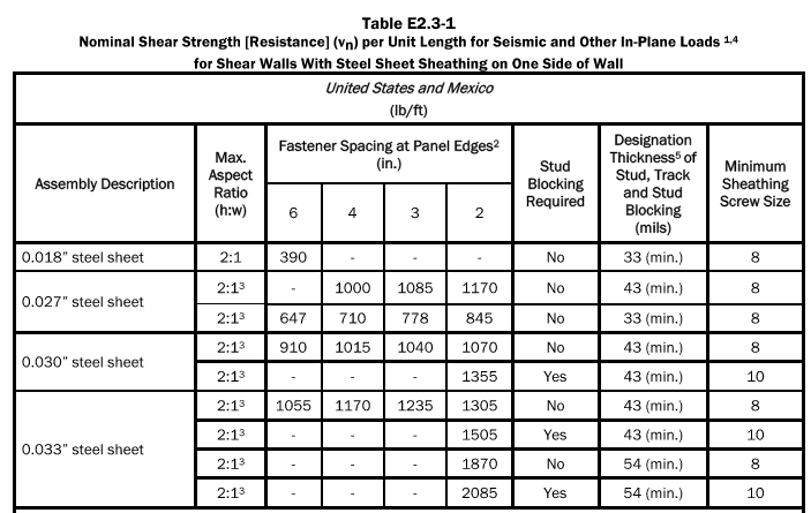
The tabulated values are showing both a blocked and unblocked option for the steel sheet shear walls. In AISI S400 Section E2.4.1.1 note (l) is as follows:

Does the ‘Yes’ or ‘No’ for ‘stud blocking required’ from Table E2.3-1 mean you may apply the 0.7 reduction factor to the values that say ‘No’?
For example, suppose 1870 lb/ft x 0.7 = 1309 plf, but you are unable to provide unblocked shear walls for 2085 lb/ft. Should the 0.7 factor be applied, or does the table already account for that reduction?
Answer
Table E2.3-1 does not include any unblocked values. However, there is an important distinction between panel blocking and stud blocking.
- Where the entry in the table column with the heading “Stud Blocking Required” is “Yes,” stud blocking is required
- Where the entry is “No” stud blocking is not required, but panel blocking is
The definitions of each are given in AISI S400 Section A2.1 as follows:
- Blocking, Panel: Blocking that transmits shear between the panels of a shear wall or diaphragm
- Blocking, Stud: Blocking that provides torsional support to the studs in a shear wall
All the assemblies in Table E2.3-1 require blocking. But only those values with “Yes” in the “Stud Blocking Required” column require stud blocking.
AISI S400 Section E2.4.1.1 (l) applies when panel-to-panel shear transfer is via overlapping of the sheets rather than using panel blocking (e.g., flat strap). No test data exists to confirm application of the 0.7 factor for stud-blocked assemblies with lapped panel seams. This requires engineering judgement that considers tension field force transfer across the seam.
- If you are using panel blocking (flat strap), use the values in the table directly
- If, in lieu of panel blocking, you are overlapping the panels, apply the 0.7 factor
1.800.79STEEL
If you have any cold-formed steel (CFS) questions, contact CFSEI experts online or call the CFSEI Hotline at 1.800.79STEEL.
Read more CFSEI “FAQ of the Month” questions and answers here:
CFSEI Hotline: 1-800-79STEEL

Cold-Formed Steel Engineers Institute
The Cold-Formed Steel Engineers Institute (CFSEI) comprises hundreds of structural engineers and other design professionals. Together, they are finding a better way to produce safe and efficient cold-formed steel (CFS) designs for commercial and residential structures. CFSEI members develop industry standards and design methods. CFSEI issues technical bulletins, organizes seminars and provides online training so that engineers and design professionals can improve their knowledge and skills. CFSEI is part of the Steel Framing Industry Association (SFIA) family. For more information, visit www.cfsei.org.
Additional Resources
- Guidance on Out-of-Plane Bracing Forces for Load-Bearing CFS Walls During CLT Floor Panel Installation
- FAQ: Does Limitation 2 of AISI S220, Section A1.2.1, Conflict with Limitation 3?
- Ask an Expert: CFSEI Responds to a Question about the Anchored Leg of a Clip Angle