
One of the many advantages of cold-formed steel (CFS) framing is that you can build tall walls without additional bracing. CFS offers dimensional strength and versatility, providing architects with enormous design freedom.
But how high can you go? Patrick W. Ford, P.E., S.E., Technical Director, Steel Framing Industry Association (SFIA), has the answer.
In the ClarkDietrich On-Point Interview below, Ford explains the concept of a maximum allowable or “limiting” height for CFS products used in interior non-loadbearing wall assemblies. CFS wall height, wall depth and other materials used in finishing the assembly are dictated by limiting heights tables published by the stud manufacturer or by an industry association, such as the SFIA. The interview appears here with permission from ClarkDietrich, an SFIA member.

Patrick W. Ford, SFIA Technical Director
On-Point with Patrick W. Ford, P.E., S.E.
What is the definition of a cold-formed steel framed composite wall?
A composite wall accounts for the properties of the cladding as well as the stud alone. That is the simplest answer.
So then when we ask about the definition of a cold-formed steel framed non-composite wall, we’re just talking about the studs?
That’s correct. The properties of the studs alone.
Composite v. Non-Composite
Who or what defines composite v. non-composite?
That one’s a little more complicated. The engineers essentially do, but the code may or may not recognize the composite wall assembly. So, it’s actually the code.
What common partition types are considered non-composite?
In reality, technically nearly all of them. Any stud partition that does not have cladding full height, and on both sides, all the way above the ceiling to the connection at the upper structure—and fastened to all framing—any of those are non-composite. If they don’t have full cladding, full height from sky to ground, they’re non-composite.
When would you choose one over the other?
The composite limiting heights are taller. It’s more efficient, the size of the steel members would be smaller, and you would save money. It’s that simple.
The SFIA Technical Guide for Cold-Formed Steel Framing Products, version 2024.1 (June 2024), is applicable to the 2021 IBC and to newer versions of the California and Florida buildings codes.
Technical Guide
The Steel Framing Industry Association (SFIA) Technical Guide for Cold‐Formed Steel Framing Products, version 2024.1, provides users with a comprehensive tool for designing with cold‐formed steel framing members. Users of previous versions of the SFIA Product Technical Guide should update to version 2024.1, which includes minor corrections and formatting updates.
SFIA Tech Note: Limiting Heights for Nonstructural Standard and EQ Wall Studs (October 2019)
Tech Note on Limiting Heights
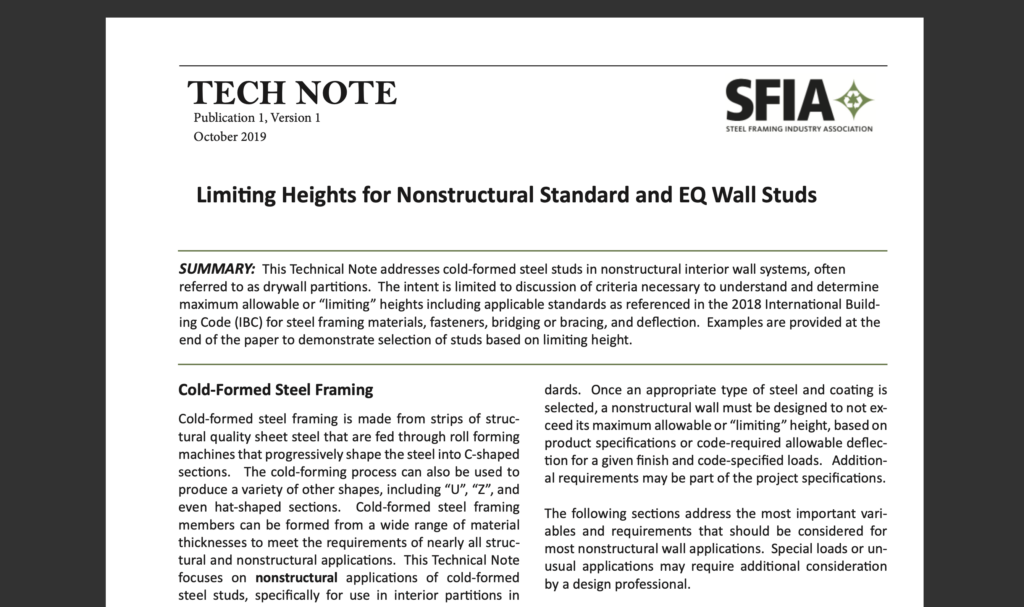
The SFIA Tech Note: Limiting Heights for Nonstructural Standard and EQ Wall Studs (October 2019) addresses cold-formed steel studs in nonstructural interior wall systems, often referred to as drywall partitions. The Tech Note discusses the criteria necessary to understand and determine maximum allowable or “limiting” heights, including applicable standards as referenced in the 2015 International Building Code, for steel framing materials, fasteners, bridging or bracing and deflection.
Gypsum Board Horizontal v. Vertical
In a composite assembly, does the orientation of the gypsum board matter? (horizontal v. vertical)
Absolutely. The composite assemblies that are listed in the limiting heights tables of the SFIA, for instance, and of virtually all manufacturers’ composite limiting heights tables, are all based on wall board that is oriented vertically. And that is based on the test assemblies that were used in determining those heights.
So, if a contractor wanted to install the wall board horizontally instead of vertically, they would have to default to the non-composite limiting height for that framing member?
That is correct. Technically they would, yes.
What is the ICC-ES AC86 testing protocol?
ICC-ES AC86 actually refers to a number of different reference standards, including AISI (American Iron and Steel Institute) standards. And we also reference the testing requirements and protocol in the SFIA appendix to our quality control program. But the ICC-ES AC86 testing protocol basically outlines how you must test these composite assemblies and how you develop the limiting heights tables from those.
Whether variables such as not having drywall fastened at a top slip track, which is commonly done nowadays, could have a significant effect on composite limiting heights, but we really don’t know. That’s the long and the short of it. It could be a huge difference, it could be no difference at all, or it could be somewhere in between. So, the SFIA is actually looking into doing tests to find out.
Does ICC-ES AC86 apply to all manufacturers as well as all associations? Why?
Oh, yes. If you want to have a composite limiting height indicated for your particular member, you have to follow it. The associations generally test to generic products, for obvious reasons, while manufacturers test for proprietary products, also for obvious reasons. But they must both meet the same criteria.
So that all member companies are testing the same way, the SFIA compliance program does require very specific details on the direction the wallboard is installed, as well as fastening and the size of the framing member. This was done to ensure all manufacturers have comparable data when the compliance administrator evaluates their data.
About ClarkDietrich
ClarkDietrich offers a comprehensive lineup of products and services for both cold-formed steel framing and drywall/plastering finishing systems. The company manufactures innovative products for interior and exterior framing, interior and exterior finishing, floor and roof framing, as well as clips, connectors, metal lath, welded wire, barrier mesh and accessories.
Contact your local ClarkDietrich technical representative for more information about the company’s latest limiting height tests.

Additional Resources
- 2 Free Tools Help Building Pros Design Interior CFS-Framed Walls at Proper Heights
- Cold-Formed Steel Framing Quality Assurance and Quality Control
- EQ Metal Studs Help Designers Build Sustainable Structures