
Photo credit: Jason O’Rear
The United States Olympic & Paralympic Museum™ in Colorado Springs, Colo., is a 60,000-square-foot curatorial and event facility celebrating American Olympians.
“The Museum focuses on the core values of the Olympic and Paralympic movements: friendship, respect and excellence; determination, equality, inspiration and courage,” says the USOPM website.
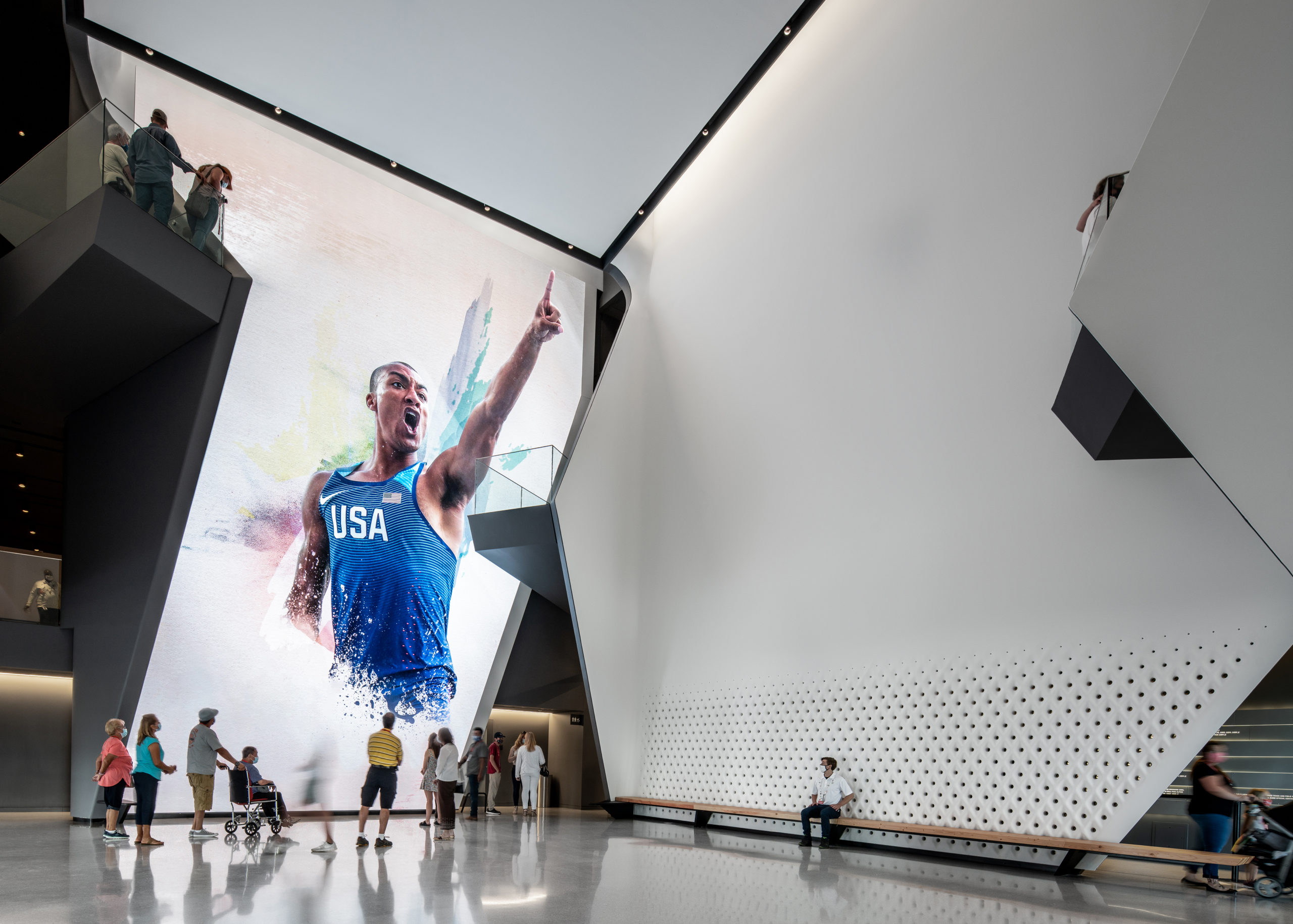
The core values of the Olympic and Paralympic movements — friendship, respect and excellence, determination, equality, inspiration and courage — are reflected at the Museum. Photo credit: Nic Lehoux.
Outer Skin Forms Walls Like Origami
Designed by New York’s Diller Scofidio + Renfro (DS+R), with architect-of-record Anderson Mason Dale, the museum’s design was “inspired by the movement of athletes,” says The Architect’s Newspaper.
The museum’s rising and twisting geometry is supported by cold-formed steel (CFS) framing, says The Architect’s Newspaper. It’s shingled with anodized aluminum panels and visually rests on a podium of glass curtain wall, the newspaper says.
- USA TODAY’s 10 Best Readers’ Choice Awards selected the Olympic Museum as the country’s Best New Attraction in 2020
- Architectural Digest listed the Museum among the “leading design-forward museums” opening in 2020 and one of the year’s most anticipated buildings
- Conde Nast Traveler says it is worth planning a trip to the U.S. Olympic & Paralympic Museum
From the onset, the design team envisioned a metallic exterior. Ultimately, the project called for anodized aluminum due to its flexibility, cost and relatively straightforward maintenance.
The massing of the project consists of four petal-like surfaces that spiral and twist up from the ground, overlap one another and sprout from the center of the structure. The facade breaks into distinct planes, bending and contorting as soffit, wall and roof.
“The outer skin wraps over the galleries and folds itself to form the walls in the atrium, just like origami,” says DS+R Associate Yushiro Okamoto in The Architect’s Newspaper. “Where surfaces overlap, daylight enters the building and that orients the visitor and marks their trajectory through the museum.”

The massing of the project effectively merges soffit, wall and roof. Photo credit: Nic Lehoux.
CFS Attached to Structural Steel
Minnesota’s MG McGrath fabricated and installed the museum’s facade, relying on 3D model-based fabrication methods facilitated by Dassault Systemes and Autodesk.
The project team constructed multiple mockups. Each panel was tracked within the digital building model from delivery to installation. The design and installation teams collaborated with Radius Track Corporation, Minneapolis, Minn., which helped develop the structure’s curved cold-formed metal framing system.
- The CFS framing is attached to the primary steel structure with an axial connection
- The exterior panels are each fastened to the cold-formed metal framing with 2 3/8-inch Z-girts
“We met weekly,” Okamoto says. “On one end we were discussing the larger design ideas of geometry and expression represented in the layout of panels, on the other end, we were discussing the smallest details and installation tolerances.”
The United States Olympic & Paralympic Museum features artifacts, media and technology. Photo credit: Nic Lehoux.
The United States Olympic & Paralympic Museum
The United States Olympic & Paralympic Museum tells the stories of U.S. Olympic and Paralympic athletes with artifacts, media and technology. Highly regarded for its accessibility, guests of all ages and abilities experience the exhibits through inclusive design and assistive technologies, such as mobile apps, video captions, audio description tracks, universal keypads, RFID-triggered customizations and more.
Location
Colorado Springs, CODate of Completion
June 2020Architects
Diller Scofidio + Renfro
Anderson Mason Dale (Architect-of-Record)Structural Engineer
KL & A Inc.

Additional Resources
- BIM + CFS Framing Delivers Adaptability and Speed
- Oregon Light-Gauge Steel Project Demonstrates Endless Possibilities of Steel
- General Contractor Talks about the Role Steel Played in Saving Project Millions